
An informative and entertaining article from Dr. Robert Malone popped up in my email this morning. Enjoy!
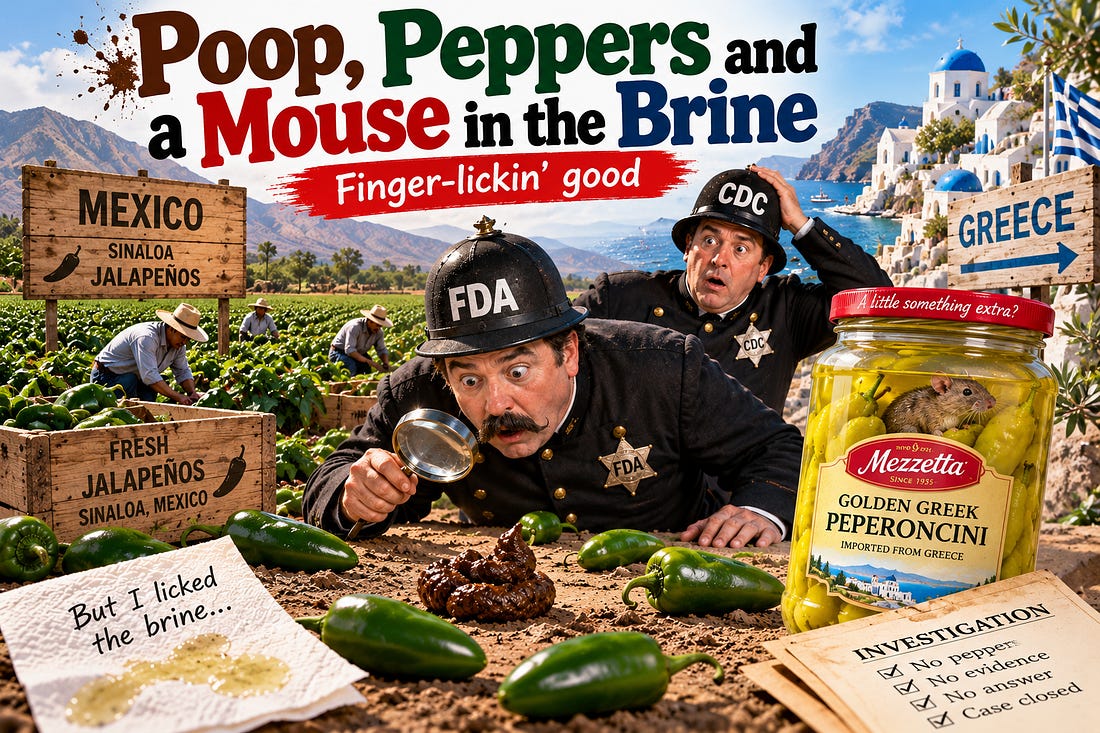 By: Drs. Jill Glasspool Malone and Robert W. Malone
The Great Mystery of the Mexican Lettuce
FDA has finally discovered Cyclospora at the Mexican operations linked to this summer’s record-breaking outbreak: one positive sample came from a tank holding outgoing wastewater at the Taylor Farms de Mexico processing plant, and another from a drainage ditch at one of its lettuce growers.
Nearly 13,000 Americans got sick. More than 570 were hospitalized. Two died.
And yet FDA says there is still “not enough evidence to conclusively determine how contamination occurred.”
Really?
Cyclospora is a fecal-oral parasite. Humans are its known host. It gets onto food when human feces contaminate water or soil.
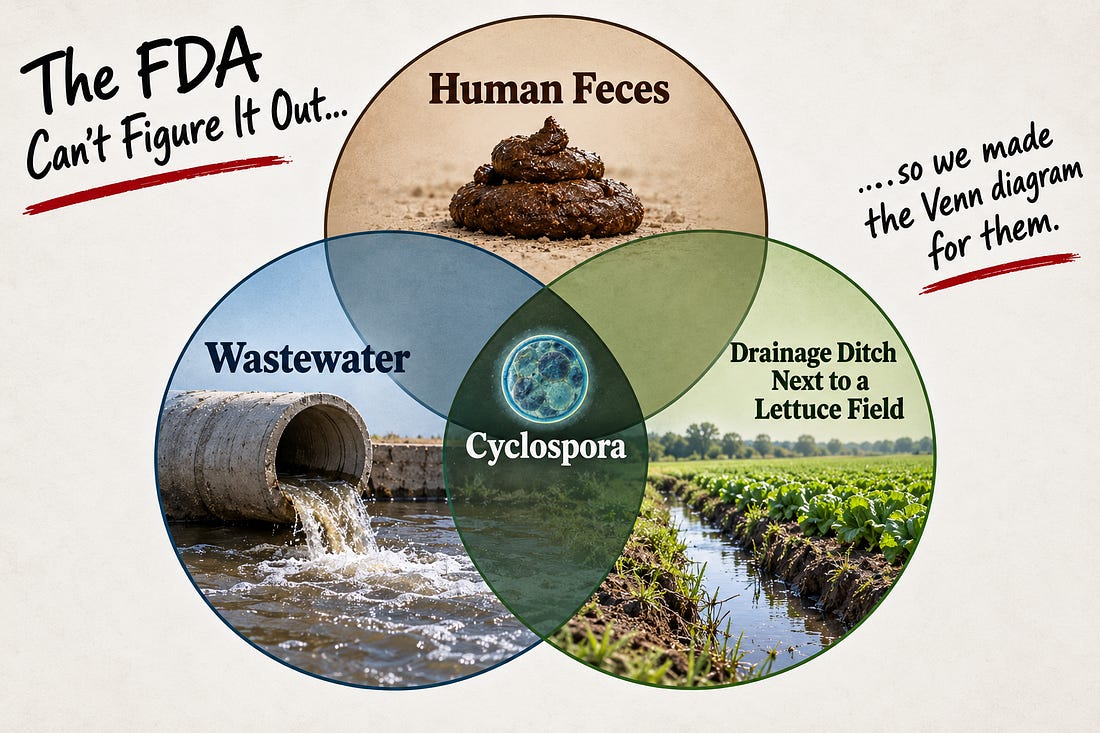
So somewhere between human feces, wastewater, a drainage ditch next to a lettuce field, and Cyclospora showing up in all, lies one of the great unsolved mysteries of modern food safety. The FDA still can’t quite figure out the relationship.
So we made the Venn diagram for them.
 |
This was not exactly unknown when I was growing up. My seventh-grade Spanish teacher, who was from Mexico, gave us one particularly memorable piece of travel advice: don’t eat raw produce in Mexico unless you want to become personally acquainted with Montezuma’s Revenge. Toilets could be hard to come by in the fields, she told us, and people sometimes pooped where they worked.
That was in the 1970s.
Apparently, the science remains unsettled as to what “fecal-oral” actually means. Or is it really that the politics remain unsettled? The corporate interest aspect is clear.
By the way, Cyclospora is actually a rather demanding little parasite. Human beings are its known host. It leaves the human body unable to infect anyone, spends days to weeks maturing in the environment, and only then becomes infectious. In other words, this wasn’t somebody failing to wash his hands before handling a head of lettuce. The fecal contamination had to become part of the agricultural environment.
The more important question is not whether anyone can prove which molecule of contaminated water touched which leaf of iceberg lettuce. It is why the United States imports enormous quantities of raw produce from regions where human sewage contamination of agricultural water has been a known food-safety problem for generations, and then acts mystified when a parasite transmitted through human feces turns up in the water surrounding the lettuce.
And sometimes, when you find a human fecal parasite in the wastewater and in the drainage ditch next to the lettuce, perhaps it is time to stop scratching your head about where the shit came from.
In the meantime, this might be a good moment to remember one of the lessons from Homesteading for Health. You don’t need a farm to grow some of your own food. Sprouts and microgreens can be grown right in the house. A few pots on a patio or a small raised bed can keep you supplied with fresh lettuce and greens for much of the year.
There are plenty of reasons to grow at least some of what you eat. Knowing exactly where it came from is one of them.
And I can say with reasonable confidence that you won’t be defecating in your own vegetable garden anytime soon.
And Now, the Jalapeños
Apparently Mexican lettuce was not having all the fun.
FDA has now closed another investigation, this one into a Salmonella Javiana outbreak linked to jalapeño peppers grown in Sinaloa, Mexico. The final tally was 488 illnesses in 34 states and 65 hospitalizations. Of the 308 people interviewed, 281, or 91 percent, reported eating at a Mexican-style restaurant before becoming sick, including Chipotle and QDOBA.
Salmonella, for those who have somehow escaped the last century of food-safety education, is primarily an intestinal bacterium of humans and animals. It gets into food largely through fecal contamination (hmmm…. where did we hear that story before)?
With fresh produce, the usual suspects are contaminated irrigation or wash water, manure and animal feces, sewage, dirty equipment, or workers with poor sanitation. FDA itself says that past outbreaks involving fresh produce have usually resulted from produce becoming contaminated with fecal material.
In other words, once again, we’re talking about poop. And about people going to the bathroom in the very same spot where they are cultivating the food that is then imported in to the USA and we eat.
FDA investigators traced the peppers backward through the supply chain, eventually identifying a common grower in Sinaloa as the likely source of the outbreak. Inspectors then traveled to Mexico to investigate the distributor that handled the implicated jalapeños.
There was just one problem. By the time FDA got there, there weren’t any jalapeños left to test.
So investigators sampled the environment instead. Those samples were negative. And FDA therefore concluded that it was “unable to determine a route or source of contamination” and closed the investigation.
Perhaps the mystery really is impenetrable. Nearly 500 Americans became ill. Ninety-one percent of those interviewed had eaten at Mexican-style restaurants. Investigators traced the outbreak to jalapeños, traced the jalapeños to Sinaloa, and identified a common grower as the likely source. Salmonella generally reaches fresh produce through fecal contamination somewhere in the growing, irrigation, harvesting, washing, or processing chain.
Unfortunately, by the time FDA arrived, the jalapeños were gone. The environmental samples came back negative. And without the offending peppers actually sitting there waiting to confess, FDA was unable to determine how the contamination occurred.
Fair enough.
But when hundreds of people get Salmonella from jalapeños traced to the same Mexican grower, perhaps we don’t need Hercule Poirot.
Something got into those peppers. And odds are, it came out of something else first. And that something most likely was human…
Sometimes I feel like both the FDA and the CDC live in some strange parallel-universe bubble where they are channeling old silent-film Keystone Cop comedies. But as I reflect more on this, I have realized that it describes pretty much all of the HHS I have encountered recently.
A Few Tips:
We grow a lot of peppers in our raised beds. They don’t take much space, although they do need a reasonably long growing season, which can make them more challenging in the northern parts of the country. We either chop them and freeze them raw, or throw them on the BBQ first, then chop and freeze them. Simple, inexpensive, and we know exactly where they came from.
But growing your own isn’t an option for everyone. So here are a couple of practical alternatives:
- Pay attention to where your produce comes from. When possible, buy produce grown in the United States or in countries with strong agricultural sanitation and wastewater controls. Sorry to our Mexican and South American neighbors, but given the repeated contamination problems involving imported produce, country of origin is something worth paying attention to.
- Consider washing produce with a hypochlorous acid product labeled for that use. And don’t forget the places people tend to miss, including the inner leaves of whole lettuce, cabbage, and similar produce. We use Curativa Bay food mist on our produce when we buy it from the store. Its non-toxic nature and rapid degradation into harmless saltwater byproducts make it environmentally friendly and safe for human health. Full disclosure: Robert and I are affiliated with the company, but it is also a company whose products we use ourselves and trust.
None of this makes fresh produce risk-free. But after reading enough FDA outbreak investigations involving fecal contamination, wastewater, drainage ditches, and imported vegetables, We have become considerably more interested in knowing exactly where our salad came from.
A Little Something Extra in the Peperoncini
Leaving Mexico behind, we travel now to Greece, where Mezzetta sources its Golden Greek Peperoncini from farms on the Peloponnese peninsula.
FDA announced a recall after what the agency rather delicately described as a “pest contaminant” was discovered in a jar.
The “pest contaminant” happened to be a dead mouse.
The discovery went viral after a woman named Tiffany posted a video to TikTok while making Mississippi-style pot roast. She had opened the jar, pulled out some peperoncini, and then noticed something else floating around inside.
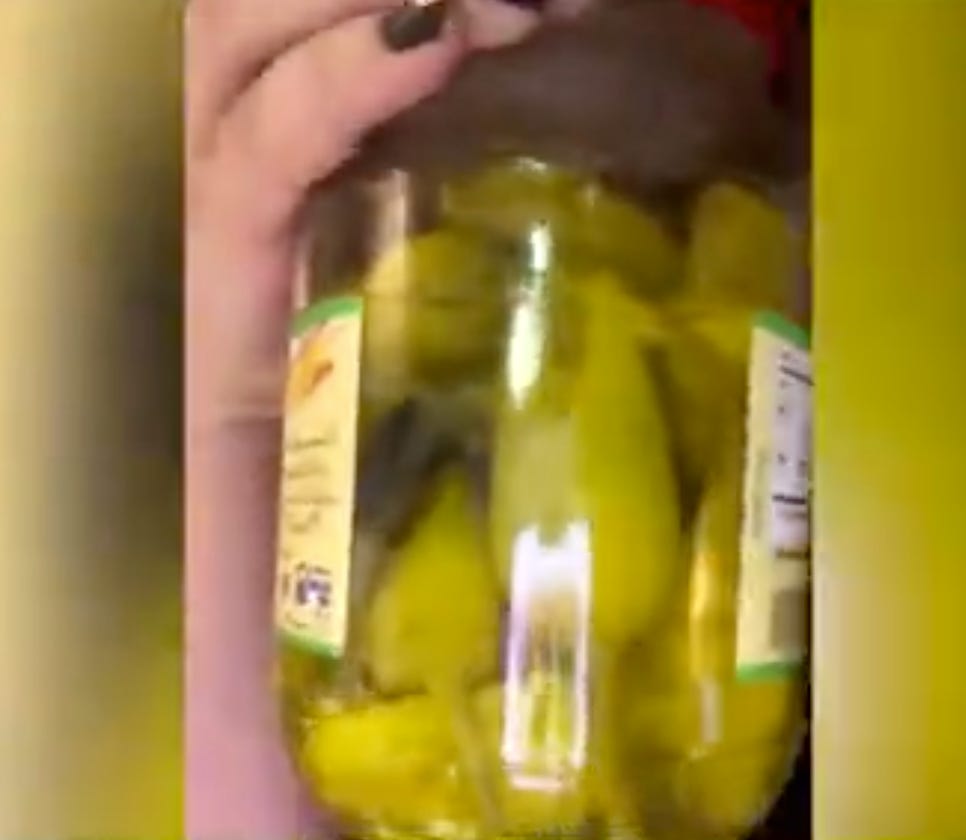 |
“I licked the brine”
Unfortunately, she had already gotten some of the liquid on her fingers.
And licked them.
(JGM: I have to stop here because, just as I was about to publish this essay, a feature caught my eye in the mouse image.) In case you all hadn’t noticed, my special power is pattern recognition.)
Then I went back and watched the video more carefully.
And something jumped out at me that I had initially missed.
That mouse is white.
We have spent years farming and have dealt with more mice than we care to count. We have never encountered a white mouse running around our barns, fields, feed rooms, or outbuildings. White mice are, of course, immediately associated with domesticated and laboratory strains. To our knowledge, white mice aren’t running around the pepper fields of Greece.
That does not prove from a video that this particular animal was a domestic or laboratory mouse, nor does it tell us when or where it entered the jar. But it raises a rather different question from the one we started with.
Was this actually a wild mouse that somehow found its way into a jar of peppers during food production, or was this a domesticated white mouse introduced somewhere along the way?
Because if it is the latter, we are no longer simply talking about sloppy agricultural sanitation. We are potentially talking about product adulteration.
And that deserves a very different investigation. And hopefully the FDA also has someone very, very good at pattern recognition – but somehow we doubt it.
FDA reports that no illnesses have been associated with the recall, which is reassuring, although perhaps not the first thing that would be going through our minds after discovering that we had just sampled the mouse-infused brine.
Mezzetta recalled the affected lot and began investigating how a rodent managed to become part of the Mediterranean experience.
FDA calls it a “pest contaminant.”
We call it the peperoncini that comes with its own mammalian protein supplement.
But for God’s sake, don’t lick your fingers.