
A good idea. And he explains exactly why.
Constitution Clarity Act: Proposed by X’s Mike Bski:
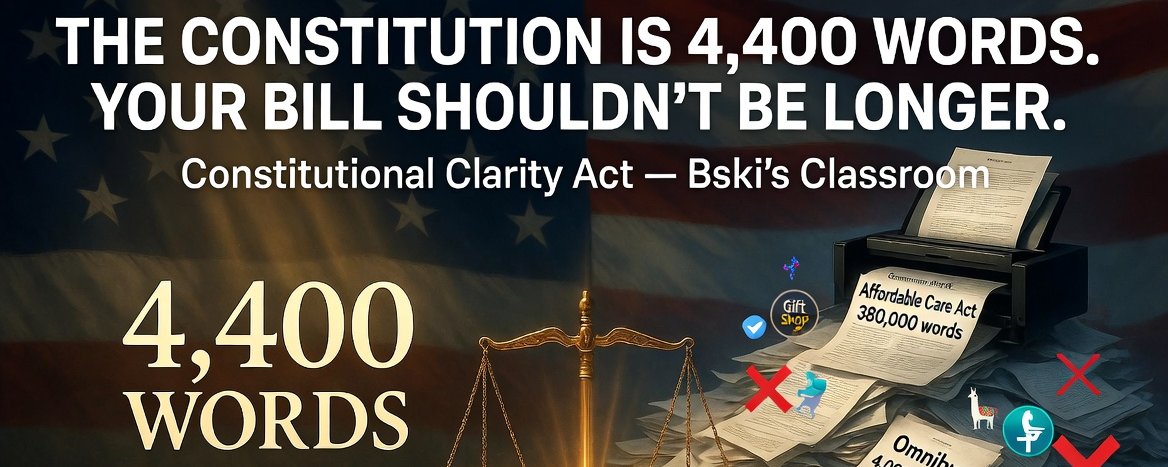
HERE’S WHY WE NEED AN AMENDMENT TO MAKE SURE OF IT.
A PROPOSAL FROM BSKI’S CLASSROOM — WHERE THE DATA DOESN’T CARE ABOUT YOUR FEELINGS
It created the most powerful constitutional government in the history of human civilization. It established three co-equal branches, enumerated the powers of each, protected individual liberties, and set up a system of checks and balances that — when actually respected — has held this republic together for nearly 250 years.
It is approximately 4,400 words long.
That is shorter than the average corporate terms-of-service agreement. Shorter than most research papers my students submit. Shorter than a single chapter of most popular novels. And yet — somehow — it governed an entire nation, survived a civil war, two world wars, a Cold War, and survived the Carter administration. Which, if you lived through that, you understand was no small feat.
That document is the United States Constitution.
Now let me describe another document for you.
The Affordable Care Act, passed in 2010, clocked in at approximately 906 PAGES and roughly 380,000 WORDS. Not one single member of Congress who voted on it had read the full text before the vote. We know this. We know this because then-Speaker Nancy Pelosi confirmed it on camera when she said, and I am quoting directly, that “we have to pass the bill so that you can find out what is in it.”
I’ll let that sink in for a moment.
The Pelosi Method of Governance: vote first, read later, apologize never.
The Inflation Reduction Act of 2022 — a bill that, by the way, did approximately nothing to reduce inflation, which is the kind of result you’d expect when you name a bill after the outcome instead of designing it to produce the outcome — ran to over 700 pages. The CARES Act of 2020 was 880 pages. The omnibus spending packages that Congress routinely passes — the ones that fund the government for an entire year and include everything from fighter jets to the Study of Peruvian Alpaca Behavior — regularly exceed 4,000 PAGES.
That’s not legislation. That’s an attack on the American people carried out with a printer.
So yes. I have a proposal. And before you dismiss it as impractical or radical, I want you to sit with one question.
If the Founders could govern a new nation with 4,400 words, why do modern legislators need 400,000 to pretend to govern it?
— THE PROPOSAL: THE CONSTITUTIONAL CLARITY ACT —
Here is what I am proposing, and I am serious about every word of it.
A constitutional amendment that prohibits any single piece of federal legislation from exceeding 4,400 words in total length — approximately the length of the original unamended Constitution.
If a bill requires more words than that to explain itself… the bill has too many things in it. Full stop. No exceptions. No workarounds. No “emergency riders” or “technical correction” appendices that balloon to 300 pages. You get 4,400 words. Write carefully.
I’m calling it the Constitutional Clarity Act, but you can call it the Please-Actually-Read-What-You’re-Voting-On Act if you want. I’m flexible.
— WHY THIS IS NOT A RADICAL IDEA: IT’S A RESTORATION —
People are going to read this and say, “Mike, that’s extreme. You can’t run a modern government in 4,400 words.” And I understand why it sounds that way. But let me take you back to a little document you may have heard of.
Article I, Section 8 of the Constitution enumerates the powers of Congress. All of them. In about 400 words. Including the power to “lay and collect Taxes,” regulate interstate commerce, coin money, declare war, raise armies, establish post offices, and protect intellectual property — all of the core functions that justify federal power.
James Madison, writing in Federalist No. 45, said — and I will paraphrase because my copyright attorney is standing nearby — that the powers delegated to the federal government “are few and defined.” That was not poetry. That was a design specification.
When a government of “few and defined” powers starts passing 4,000-page legislation, one of two things has happened. Either the government has grown far beyond what the Founders intended — which is constitutionally problematic — or the legislation is full of things that have nothing to do with its stated purpose — which is politically corrupt. Or, and I’m going out on a limb here, BOTH.
Quinn’s First Law of Liberalism: “Liberalism always generates the exact opposite of its stated intent.”
An Affordable Care Act that makes care unaffordable. An Inflation Reduction Act that doesn’t reduce inflation. A 4,000-page bill that nobody reads, passed by people whose only qualification for understanding it is that they asked a lobbyist. This is not governance. This is the theatrical performance of governance while the actual decisions are made in closed rooms by people whose names never appear on a ballot.
— WHAT’S ACTUALLY IN THOSE EXTRA PAGES: A GUIDED TOUR OF CONGRESSIONAL FRAUD —
You want to know what fills those extra pages? Let me give you a small sample of what Congress has buried in legislation that nobody was supposed to read.
In a defense spending bill. A provision requiring the Department of Defense to study the feasibility of a Space Force… gift shop. Yes. An actual gift shop. Funded by taxpayer money. In a defense bill.
In a COVID relief package. Millions of dollars for gender studies programs in Pakistan. Because nothing says “American pandemic relief” like international academic funding.
In an omnibus appropriations bill. Millions more for “cultural exchange” programs that, when anyone actually looked at them, turned out to be mostly cocktail parties in European capitals. The kind of parties where the primary cultural exchange is figuring out who’s picking up the tab with your money.
In a transportation bill. Hundreds of millions for a bridge in a state represented by a powerful committee chairperson. Not a dangerous bridge. Not a bridge that needed replacement. A BRIDGE THAT WAS POLITICALLY USEFUL TO SOMEONE WHO HAD THE POWER TO INSERT IT WITHOUT DEBATE.
This is what a 4,000-page bill enables. It is the legislative equivalent of hiding a rhinoceros in a haystack. Nobody’s looking for the rhinoceros. They’re looking at the haystack. And by the time someone finds the rhinoceros, the bill has already been signed into law for three years.
A 4,400-word limit fixes this immediately. You cannot hide a rhinoceros in a document that fits on twenty pages. There is nowhere for it to go. Every word has to justify its presence. Every provision has to stand in the open, where people can see it and ask questions about it.
What a concept.
— THE OBJECTIONS AND WHY THEY ARE WRONG —
I can already hear the objections forming, so let me save everyone some time.
OBJECTION ONE: “Some legislation is genuinely complex and requires more explanation.”
Fine. Then pass multiple bills. If your healthcare legislation genuinely requires 380,000 words, then it is not one piece of legislation. It is 86 pieces of legislation, and each of those pieces deserves its own debate, its own vote, and its own accountability. The complexity argument is not a reason to exempt legislation from length limits. It is a reason to write more focused legislation.
Nobody reads a 4,000-page bill. Nobody. If you vote yes on a 4,000-page bill, you did not vote on legislation. You voted on a summary you received from your party whip, who received it from a staffer, who received it from a lobbyist. That is not democracy. That is not even a republic. That is a puppet show. A very expensive puppet show, performed on the floor of the Capitol with your tax money funding the stage.
OBJECTION TWO: “Technical legislative language takes up a lot of space.”
Actually, no. The most precise, technically exact, and legally durable document in American history — the Constitution — managed to establish the structure of an entire government in 4,400 words. The reason modern legislation is bloated is not because precision requires length. It is because obfuscation requires length. The longer and more complex the bill, the harder it is to find the parts that were never supposed to be found.
OBJECTION THREE: “This would require a constitutional amendment, which is nearly impossible to pass.”
Correct. And that is exactly the point. If something matters enough to fix the way Congress passes legislation, it should be hard to undo. The amendment process exists to enshrine important structural changes. Making elected representatives actually read and understand what they are voting on seems like the kind of structural change worth the effort.
OBJECTION FOUR: “This would cripple Congress’s ability to function.”
I want you to think very carefully about this objection. You are telling me that requiring Congress to write legislation they can actually READ would CRIPPLE them. Congress currently has an approval rating hovering somewhere between “mild food poisoning” and “unexpected traffic jam.” If the mechanism that’s been crippling them is that they’re READING things, I think I’ve found the problem.
— THE BENEFITS: WHAT THIS ACTUALLY FIXES —
Let me be specific, because I am a science teacher and I believe in measurable outcomes.
THE ACCOUNTABILITY EFFECT: When a bill is 4,400 words, every member of Congress can read it in about 30 minutes. There is no excuse, ever, for voting on something you have not read. If you vote yes, you own every word. If you vote no, you have a specific, articulable reason. Constituent questions can be answered with specifics instead of “my staff will follow up with you on that.”
THE ANTI-CORRUPTION EFFECT: Lobbyists thrive in the dark corners of 4,000-page bills. A 4,400-word limit is essentially sunlight. Every special interest provision, every kickback, every sweetheart deal has to compete for space with the actual purpose of the legislation. The rhinoceros has nowhere to hide. This is how you reduce the power of K Street without passing a single campaign finance bill. Just turn on the lights.
THE SINGLE-SUBJECT EFFECT: A bill about healthcare should contain words about healthcare. Not art funding. Not foreign aid. Not the Study of Peruvian Alpaca Behavior. When you force the bill to be short enough to read, you force it to be about one thing. One vote, one subject, full accountability. This is how legislation was designed to work in the first place.
THE READING COMPREHENSION EFFECT: Here is something I probably should not have to point out, but given the current composition of the legislative branch, I feel compelled to mention it. A legislator who has read a bill understands what they voted on. A legislator who has not read a bill — who voted based on a party memo, a lobbyist briefing, or the direction of a party leader — has not actually performed the function they were elected to perform. The 4,400-word limit forces reading. Reading enables understanding. Understanding is the prerequisite for responsible governance. I know this is a lot to ask.
THE FISCAL RESPONSIBILITY EFFECT: Discretionary spending buried in omnibus bills is one of the primary mechanisms by which the national debt continues to explode. These provisions don’t survive sunlight. They don’t survive debate. They survive ONLY because nobody’s looking at them. A bill length limit is, indirectly, one of the most powerful deficit-reduction tools available because it eliminates the darkness in which wasteful spending breeds.
THE VETO RESTORATION EFFECT: This one does not get discussed enough, and I want to spend a moment on it because it is genuinely important.
The presidential veto is one of the most powerful tools in the constitutional checks-and-balances system. Article I, Section 7 gives the President the authority to return a bill to Congress with objections. It is a real, meaningful check on legislative overreach — when it can actually be used.
Here is the problem. Nobody is going to seriously argue that the President should have line-item veto power. The Supreme Court already addressed that in Clinton v. City of New York (1998), ruling it unconstitutional. And they were right to rule that way. Line-item veto power would give the executive branch authority the Founders never intended it to have, allowing a president to functionally rewrite legislation by surgical excision. That is Congress’s job, not the President’s.
But here is the trap that nobody wants to talk about openly. When you pack 800 pages of legislation into a single bill — some of it genuinely necessary, some of it pure political poison — you have effectively NEUTERED the veto. The President looks at a provision on page 412 that is flat-out wrong. Maybe it’s unconstitutional. Maybe it’s corrupt. Maybe it hands a sweetheart deal to a specific donor class while the rest of the bill funds the military or keeps the government open. The President has two options: sign the whole thing and own the poison provision, or veto the whole thing and own the political fallout of shutting down funding for something people actually need.
That is not a check and balance. That is a hostage situation. And Congress writes it that way ON PURPOSE.
A 4,400-word bill fixes this completely. If a bill is about one subject — and by necessity it will be, because there is not enough room to hide unrelated garbage — then a presidential veto means exactly what the Founders intended it to mean. “I object to THIS. Here is why. Send me something better.” Clean. Transparent. Accountable. The President is not forced to swallow a bad provision to avoid killing a good one. Congress cannot bury poison in legislation and then dare the President to veto it.
Small bills restore the veto to its intended function. Large bills make the veto almost useless in practice — which is precisely why the people who write large bills do not want small bills. Follow that logic wherever it leads you.
— A BRIEF HISTORY LESSON NOBODY ASKED FOR BUT EVERYONE NEEDS —
The Founders were not naive. They understood that governments have a natural tendency to expand. They understood that power corrupts and that complexity is one of the primary tools of that corruption. Alexander Hamilton, in Federalist No. 9, wrote about the importance of structural safeguards against the accumulation of unchecked power. Madison, in Federalist No. 51, famously observed that if men were angels, no government would be necessary — implying that because they are not angels, the structure of government matters enormously.
The Constitution’s brevity was not an oversight. It was a philosophy. The Founders believed that government power should be LEGIBLE to the people governed by it. If citizens can understand the framework of their own government — and they should be able to, because it should be written in language a literate adult can parse — then they can hold that government accountable.
A 4,000-page omnibus bill is the philosophical opposite of that principle. It is government that is deliberately illegible. Government by obfuscation. Government designed to exceed the attention span of the people it governs so they give up trying to understand it and simply defer to whoever they voted for.
Quinn’s Law Number Six: “Facts are the enemy of liberalism.”
The solution to uncomfortable facts is to bury them in 4,000 pages where nobody will find them. Our entire legislative process has been captured by this principle.
And here is where I must mention something from the Congressional Record that does not get nearly enough attention. On January 10, 1963, Congressman A.S. Herlong Jr. read into the Congressional Record a list of 45 Communist Goals for America, derived from Cleon Skousen’s research. I am not a conspiracy theorist. I deal in primary sources. Read it yourself.
Goal Number 32: “Support any socialist movement to give centralized control over any part of the culture, education, social agencies, welfare programs, mental health clinics, etc.”
How do you centralize control? You write legislation so long and so complex that only the people closest to the levers of power understand what it actually does. A 4,400-word limit is a direct structural countermeasure to Goal 32. When legislation is short, clear, and legible, centralized control is much harder to achieve quietly.
— THE PRACTICAL IMPLEMENTATION: HOW THIS ACTUALLY WORKS —
Alright. Down to brass tacks, because I teach physics and I require solutions alongside problem identification.
The amendment would be simple. Something like this: “No single Act of Congress shall exceed four thousand four hundred words in total length, inclusive of all titles, sections, subsections, and provisions. No provision of any Act shall reference or incorporate by reference any document that itself exceeds this limit.”
That last sentence matters. Enormously. Because the obvious workaround is to write a 4,400-word bill that incorporates by reference a 400,000-word regulatory appendix. The amendment has to close that door explicitly.
Implementation would require existing legislation to be restructured over time. New legislation would comply immediately. Omnibus bills would be illegal under this framework — which is the point. If you want to fund the Department of Defense and the Department of Education, you pass two bills. You debate both. You vote on both. You are accountable for both.
Committee structures would have to adapt. Bills would be smaller, more focused, and more numerous. But each one would be comprehensible. Each one would be defensible. Each one would require an actual argument, not a party-line vote on something nobody’s read.
— WHAT THIS SAYS ABOUT US IF WE DON’T DO IT —
Let me be direct. And yes, I’m aware that being direct is sometimes uncomfortable. That has never stopped me before.
If we continue to accept a legislative process where laws routinely exceed the length of the document that created our entire constitutional system, we are accepting governance by obfuscation as a permanent feature of American life. We are saying that complexity is acceptable. That unreadable legislation is fine. That it’s okay for the people who make the laws to not know what is in them.
That is not a republic. James Madison did not write a 4,400-word Constitution so that future legislators could ignore its spirit with 400,000-word legislation.
The people who oppose this idea will tell you it cannot work. They will say it is impractical. They will say modern governance is too complex for simple solutions. And I will ask them: too complex for the people who built the most successful constitutional democracy in history? Too complex for the people who, in those same 4,400 words, anticipated most of the problems we face today with startling accuracy?
Or maybe — just maybe — the people telling you it cannot work are the same people who benefit from the current system where it can.
Think about that.
— A PERSONAL NOTE FROM THE CLASSROOM —
I teach Anatomy and Physics at a career and technical education school in Northeast Ohio. I wrote the textbooks for both subjects. In my classroom, every standard I hold my students to is a standard I can defend in plain English in about two sentences.
My students are not the children who were given up on — though some would say they were. They are capable. They are often brilliant. And what they respond to, more than anything else, is clarity. When I explain something clearly, they understand it. When I hide it in jargon and complexity, they disengage and lose faith that it was ever meant for them to understand.
The American people deserve legislation written like a lesson plan — with a clear objective, a clear method, and a clear way to measure whether it worked.
The 4,400-word amendment is that lesson plan for Congress.
They won’t like it. People who thrive in the dark rarely welcome the lights being turned on.
But what do I know — I’m only a physics and anatomy teacher who actually reads the documents before he talks about them, including the one that created this republic in 4,400 words while current legislators can barely read their own party memos in four hundred.




 Stella's Place