
May 1 is a very popular day!
When I hear the words “May Day”, I think of May poles, flowers and little girls in white dresses with crowns of flowers on their heads. Someone else I know says it reminds her of the smell of library paste and a May pole on the school grounds (why didn’t we have one of those at our school?) From a cursory search, I found out that this is common in England.
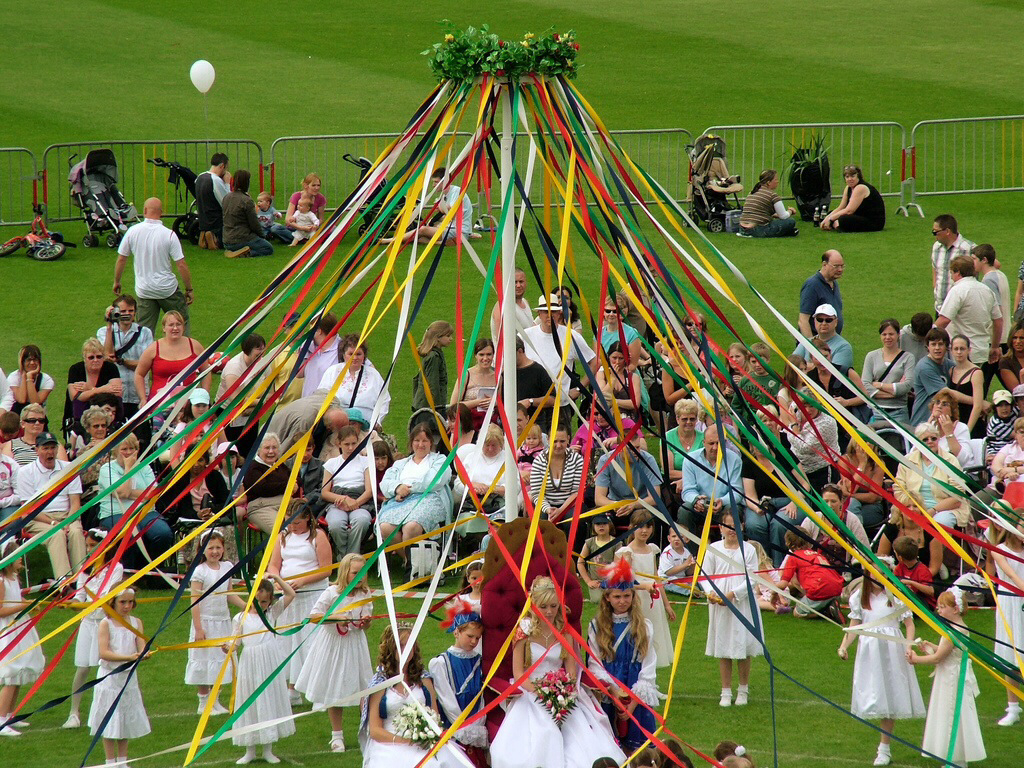
Is that the Queen of the May on her throne?
Wikipedia says that May Day on May 1 is an ancient northern hemisphere spring festival and usually a public holiday; it is also a traditional spring holiday in many cultures. Dances, singing, and cake are usually part of the celebrations that the day includes.
The name of the pagan festival in Great Britain that is celebrated on the same day is Beltane/Beltaine, or Bonfire Day. It is approximately half way between the Spring equinox and the Summer solstice, and is an important Gaelic festival. There is a modern version of this, called the Beltane fire festival, which is celebrated in Edinburgh, Scotland each year.
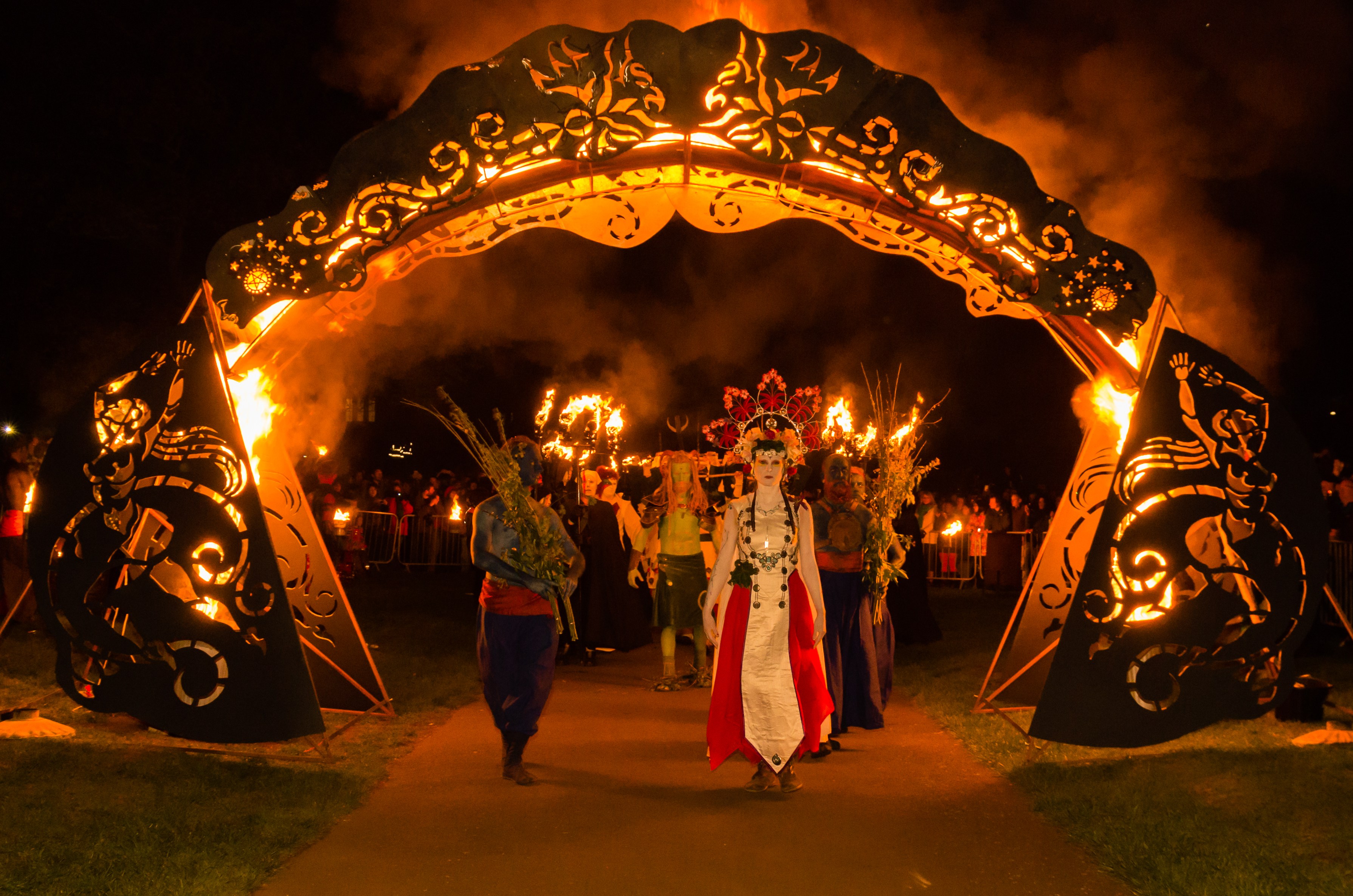
Copyright Mark.S.I.Taylor for Beltane Fire Society.
There are other, similar, festivals that have occurred throughout the world since ancient times.
In the 1900’s, Communists began to celebrate Worker’s Day on May 1. The date was chosen by an organization of socialist and communist political parties to commemorate the Haymarket affair, which occurred in Chicago on May 4 1886. In 1904 a call went out to “all Social Democratic Party organisations and trade unions of all countries to demonstrate energetically on the First of May for the legal establishment of the 8-hour day, for the class demands of the proletariat, and for universal peace.”
When I was in high school in the 1960’s, we observed “Law Day” on May 1 with a school assembly. In 1958, President Dwight D. Eisenhower declared May 1 to be Law Day in the United States. Its observance was later codified by Public Law 87-20 on April 7, 1961. My guess is that it was an answer to communist “Worker’s Day”. Eisenhower stated: “In a very real sense, the world no longer has a choice between force and law. If civilization is to survive it must choose the rule of law.”
There you have it. My five-minute history of May Day. Personally, I still prefer the little girls with flowers in their hair.
By the way, have you ever heard of Morris dancing? That is something that is done in England on May Day too. Apparently, there are all kinds, but Morris dancing is known to have been done at least as early as Elizabethan times in England.
However you decide to celebrate May day, take care, don’t over do, and – whatever you do – don’t accidentally set yourself on fire!




 Stella's Place
Whenever my lib friends talk about May Day, I’m pretty sure which one they’re referring to. Not many conservatives have any other vision except the same one you have.
LikeLiked by 2 people
It’s ‘International Remind the Commies That They’re Morons’ Day
https://pjmedia.com/stephen-kruiser/2026/05/01/the-morning-briefing-its-international-remind-the-commies-that-theyre-morons-day-n4952390
Sure, a leftist hate-inspired lunatic just tried to shoot President Trump (again), but the awful people in Indivisible, the ACLU, the Communist Party USA (CPUSA), assorted unions, and other radical leftists have already printed their signs and made their plans for this Friday. It’s May Day, doncha know, a date long polluted by Marxist agitation in Europe, whose American counterparts are attempting to normalize it in the United States.
May Day (May 1) was once a bright, fun, merry celebration of warmer weather and the beginning of the growing season. Maidens wore floral crowns, people danced around the maypole, weaving intricate patterns with its colorful ribbons, and there was music, feasting on seasonal foods, and merrymaking.
Then the Marxists got involved. Brittanica tells us May Day is a “day commemorating the historic struggles and gains made by workers and the labor movement, also called International Workers’ Day.”
Because commies ruin everything, the word “workers” is forever tainted since they tried to make it their own. All of the “commemorating” that will be going on today is being organized by people who are far more well off than any of the workers they are pretending to care about. A good many of them are the aforementioned fetishists.
LikeLiked by 1 person
Conclusion:
All of the people who are involved in May Day “commemorating” are bad for America. If I were still in the activist game, I might organize May 1 counter-rallies and call it all “Joe McCarthy Day.” As soon as I typed that, I liked the idea even more than when it was just in my head.
LikeLiked by 1 person
From a Catholic perspective, we celebrate St. Joseph the Worker, which ties in nicely as a counterpoint to the communist ideas. The ideas expressed below I find not limited to Catholicism at all, but a very fine summation of the value and dignity of our labor from a Christian standpoint.
From the website Catholic Saints and Feasts:
Part of the Church’s response to the communist appeal to workers was to exalt Saint Joseph the Worker on May 1 as a Catholic alternative to May Day. Not only was Saint Joseph to be understood, then, as the husband of Mary and the foster father of Jesus, but also as the patron of labor. He was the carpenter, the working man, who taught his God-Son how to swing a hammer and run a planer over a rugged plank.
Pius XII’s exaltation of Saint Joseph the Worker was an attractive idea. Saint Joseph was a true icon of human labor in contrast to the rough factory worker in an industrial plant in Leningrad or the tanned farm hand threshing hay under the Ukrainian sun. Saint Joseph did not have his fist raised in anger at the capitalist oppressors of Nazareth. He was not leading a mob to burn down his boss’s house. Saint Joseph worked like a normal person worked. He was quiet about it. He did his duty. He provided his family with food and shelter. He didn’t see injustice lurking behind every corner. He most likely made excellent furniture and received a fair wage for his handiwork.
Work, from a Catholic perspective, is a source of dignity. It has to be done. A life of pure leisure is no life at all. Work and want and trying times are required ingredients in the recipe for a mature, responsible adult. No work, no adult. Work itself is not pure punishment. The onerous nature of work is one of the effects of original sin, though it was not so in the beginning. Work became a burden due to the sin of our first parents. What is the theology behind this? God the Father worked and God the Son worked. When man works, then, he is participating in God’s own work. Subduing the earth is one of God’s original commandments to man. And subduing the earth cannot come about except through work of one kind or another.
It has been observed that the dash (–) on a tombstone is far more important than the years that are on each side of it. What happened in the time of that dash is more important than one’s date of birth or death. For most people that dash denotes work. Mankind works. All the time. And the will of God for us cannot be found outside of what we spend most of our life doing. If that were the case, then we wouldn’t have much of a religion. God is found in our work. So if we do it well, we give him glory, and if we do it poorly, we offer him a shoddy sacrifice. The earth becomes our altar when our daily work is our daily offering. Constant, daily work was good enough for Saint Joseph and for the Son of God. So it is good enough for all of God’s children as well. Work is a pathway to holiness, and Saint Joseph the Worker stands by our side to encourage us toward the reward that our daily sweat and labor will earn.
Saint Joseph the Worker, inspire all laborers of mind or body to work for their daily bread as much as for your glorification. May we work well to both perfect us and to make us participants in completing the creation begun in Genesis. Amen.
LikeLiked by 2 people
Morning, Menagerie!
LikeLike