
Not the only anti-USA propaganda designed to demoralize our citizens, but a recent example.
Thanks to @amuse on X for sharing the propaganda, and the TRUTH!
 Imagine you are a sailor aboard USS Abraham Lincoln, somewhere in the waters off Iran, flying combat missions around the clock during Operation Epic Fury. You are eating hot eggs for breakfast, grilled chicken for lunch, roast beef for dinner, and grabbing a plate at midnight rations before your next watch.
Meanwhile, halfway around the world, a domestic media apparatus is publishing photographs purporting to show your meals as rotten slabs of unidentified meat, telling the American public you are starving. The photographs were not taken aboard your ship. They were not taken this decade. Some of them appear to have originated during the Iran-Iraq war in the 1980s, circulated on Reddit as far back as 2017, and laundered through Southeast Asian social media accounts before being amplified by Ukrainian 𝕏 accounts and finally laundered into American living rooms by outlets like USA Today, CNN, and MSNBC.
This is not journalism. This is information warfare, and the American press is either a willing participant or too incompetent to be trusted with the facts.
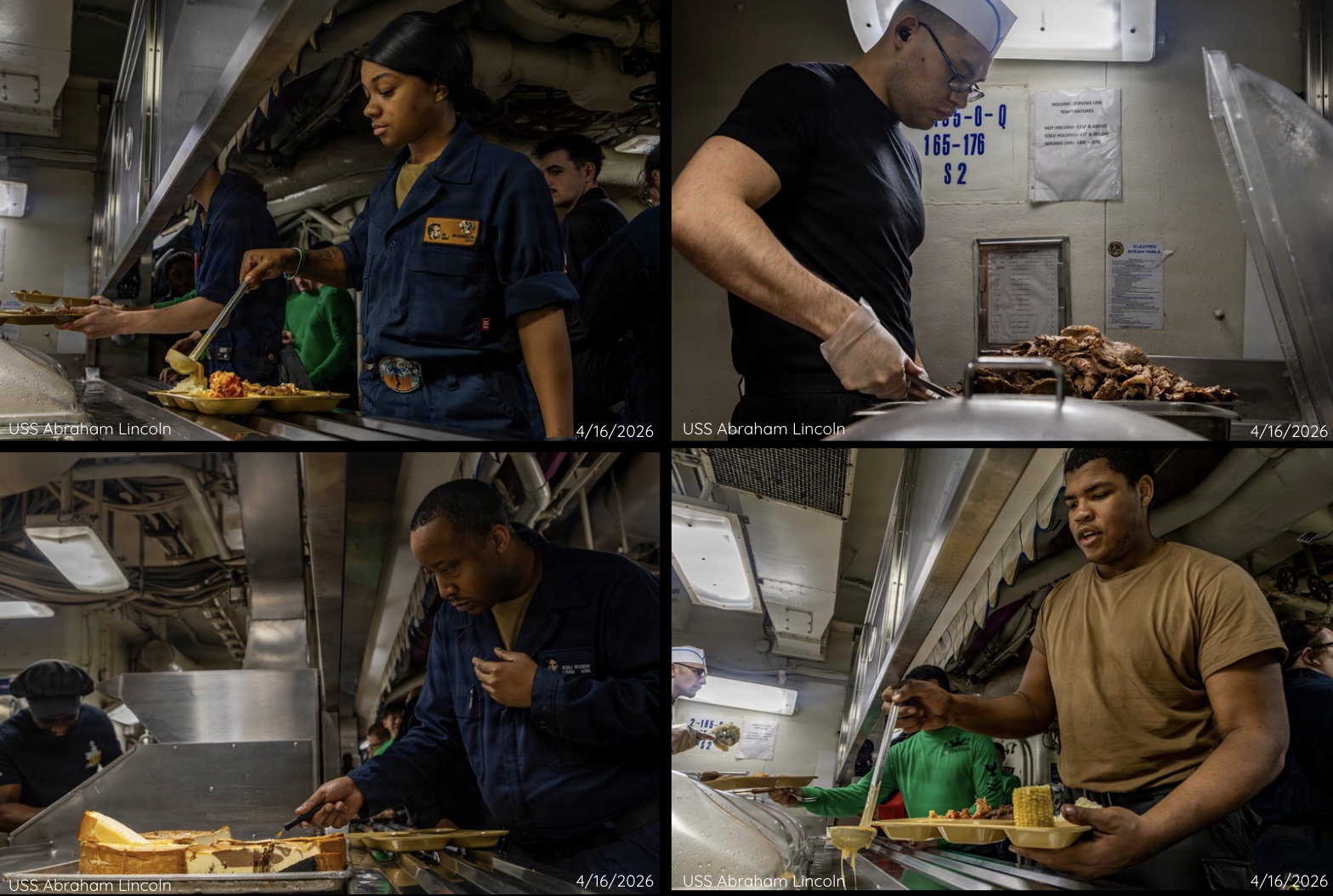
USS Abraham Lincoln April 16-17 Food (Nimitz-class aircraft carrier Strait of Hormuz)
The proposition I want to defend here is straightforward. The stories alleging food shortages and degraded conditions aboard USS Abraham Lincoln and USS Tripoli during Operation Epic Fury were coordinated anti-American propaganda, designed to demoralize the US public and generate opposition to military operations.
The evidence for this thesis comes from three directions: the provenance of the photographs themselves, the architecture of how naval food service actually works, and the categorical denials from the highest levels of US military leadership. Each of these three lines of evidence, considered independently, would be worth examining. Taken together, they form a case that is very difficult to dismiss.
Consider the photographs first. The primary image circulating on 𝕏 and amplified by accounts like @sentdefender, which describes itself as an open-source intelligence monitor focused on Europe and global conflicts, purports to show food served to American sailors during the operation. A basic reverse image search on Google reveals that at least one of the photographs had been circulating online since at least 2017, and the imagery appears to trace back to the Iran-Iraq war of the 1980s. This is not a subtle error. It is not a case of mislabeled metadata or an honest mistake about which ship generated the photograph. It is a decades-old image of food from a foreign conflict being presented, without any apparent verification effort, as contemporary evidence of US Navy conditions.
Any first-year journalism student knows that reverse image search is a baseline verification step, one that takes roughly 30 seconds and requires no specialized training. The drive-by media outlets that published these images either skipped that step deliberately or could not be bothered to perform it. Neither explanation is flattering, and one of them is far more sinister.
The geographic origin of the broader campaign is equally telling. The stories did not begin at a credible whistleblower source within the US military. They did not originate with veterans’ advocacy groups or congressional oversight inquiries. They appear to have originated in Southeast Asian information networks, then spread through Ukrainian 𝕏 accounts before being picked up by the Western press. Ukraine has obvious operational incentives to keep the US public supportive of confrontational postures in general, which requires maintaining a narrative of American military competence and resolve. However, a destabilized American domestic front, one in which citizens distrust their own military’s ability to feed its sailors, serves certain adversarial interests quite directly.
The pattern of amplification, starting from anonymous Southeast Asian sources, then gaining traction through conflict-focused European accounts, then landing in American legacy outlets, follows a textbook information operation structure. It is the same pipeline that has been studied, documented, and warned against by researchers in the field of computational propaganda for years.
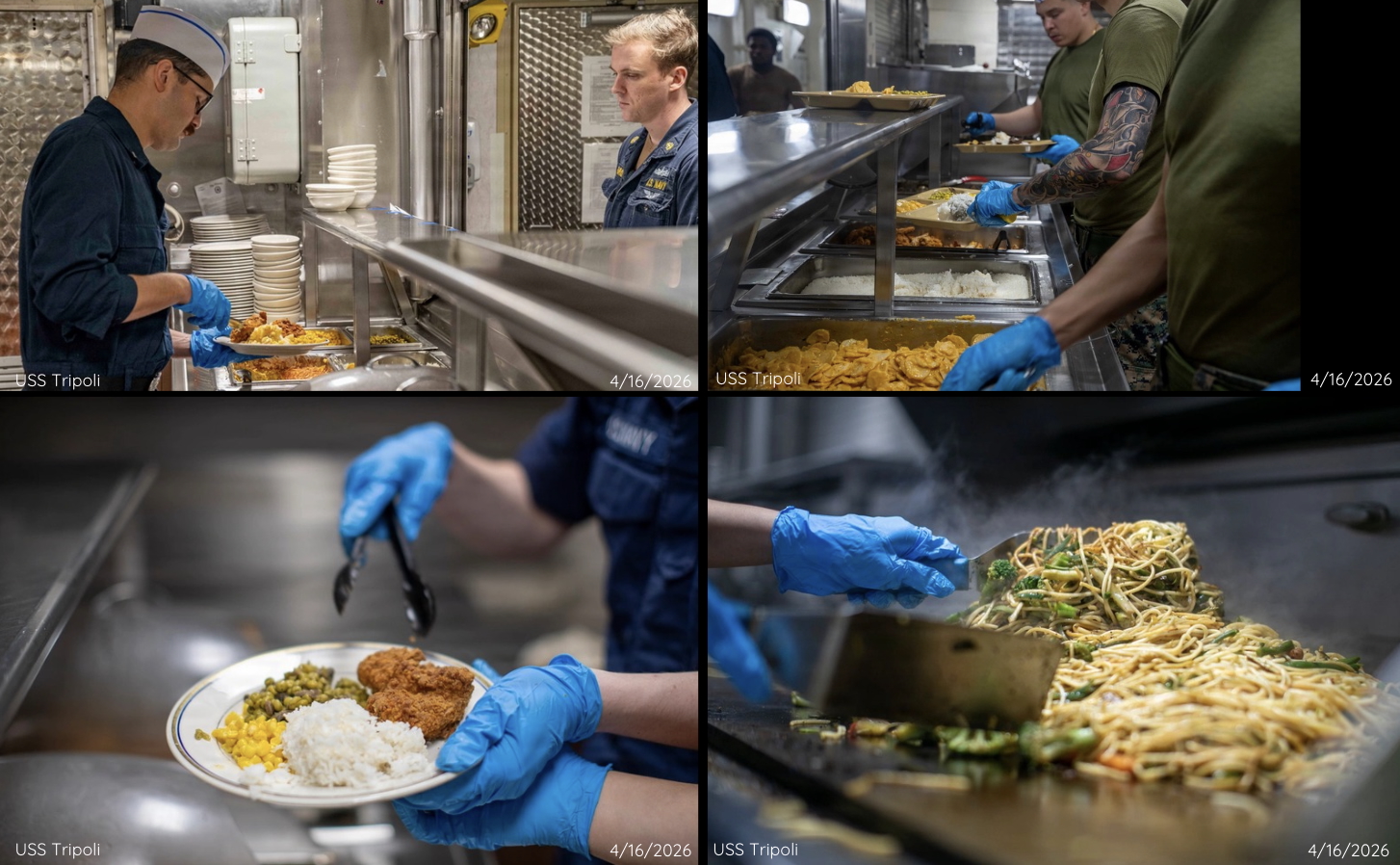
Now consider what the US Navy itself said. The Chief of Naval Operations issued an unambiguous statement: “Recent reports alleging food shortages and poor quality aboard our deployed ships are false. Both USS Abraham Lincoln and USS Tripoli have sufficient food onboard to serve their crews with healthy options. The health and wellbeing of our Sailors and Marines are my top priority, and every crew member continues to receive fully portioned, nutritionally balanced meals.” The CNO went further to address the mail question that had also circulated online, clarifying that a temporary hold on incoming mail during combat operations, which is a standard and entirely expected security and logistics measure, had been lifted.
Secretary of Defense Pete Hegseth reinforced the denial with characteristic directness: “The US Navy is correct. More FAKE NEWS from the Pharisee Press. My team confirmed the logistics stats for the Lincoln and Tripoli. Both have 30+ days of Class I supplies, which means food, on board. NavCent monitors this every day, for every ship. Our sailors deserve, and receive, the best.” These are not vague reassurances offered by a public affairs team trying to spin a bad story. These are categorical, verifiable claims about documented logistics statistics, the kind of data that NavCent tracks continuously and that would be immediately falsifiable if incorrect.
The reason these denials should be taken seriously, beyond the credibility of the individuals offering them, is that they align perfectly with how naval food service is actually structured. To understand why the propaganda narrative is not merely false but structurally implausible, one needs to understand the architecture of food service aboard a carrier like Lincoln and an amphibious assault ship like Tripoli. This is not a trivial subject, and the drive-by media’s coverage treats it as though feeding thousands of sailors at sea is roughly as complicated as stocking a college dormitory cafeteria. It is not. It is an industrial-scale logistics enterprise governed by binding doctrine, monitored daily, and designed with multiple redundancies precisely because the Navy understands that fed sailors fight better.
USS Abraham Lincoln is a Nimitz-class aircraft carrier. Ships of that class are designed to feed roughly 5,000 personnel, producing as many as 15,000 meal servings per day when underway with an embarked air wing. That is not an approximation; it is a figure drawn from official Navy reporting. The food supply chain begins months before a ship ever leaves the pier. Before deployment, carriers load provisions equivalent to roughly 45 days of food, a requirement that Navy Supply Systems Command monitors as a formal readiness metric.
For Lincoln, this means storerooms filled with frozen, chilled, and dry stores stacked on pallet-capable elevators, positioned to minimize internal movement during sea operations. Once underway, the ship does not simply consume its initial load and hope for resupply. It receives replenishment at sea, through connected underway replenishment or vertical replenishment by helicopter, at regular intervals.
Public reporting on Carl Vinson described receiving 560 pallets in a single replenishment event, with 425 of those pallets being food. Reporting on Abraham Lincoln itself described planning each replenishment up to two weeks in advance and maintaining a 45-day food posture as a continuous requirement. When Secretary Hegseth confirmed that both Lincoln and Tripoli had more than 30 days of Class I supplies on board, he was not citing an exceptional condition. He was describing what the Navy considers its baseline operational standard.
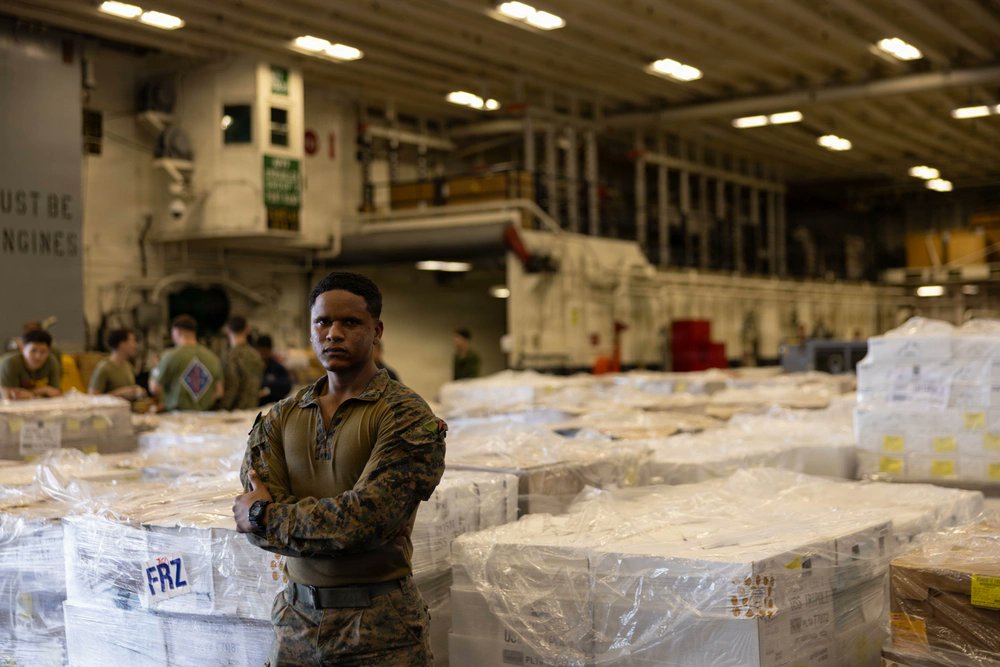
U.S. Marine with the 31st Marine Expeditionary Unit, assists during a resupply at sea aboard the forward-deployed amphibious assault ship USS Tripoli (LHA 7), April 13, 2026.
The food itself is governed by binding doctrine, not by the preferences of individual cooks or the resourcefulness of a single supply officer. The Armed Forces Recipe Service, use of which is mandatory for all general messes, provides standardized, nutrition-analyzed, scaled recipes for every item a military galley produces. The DoD menu standards require, among other things, at least 2 differently colored vegetables per meal, fish or seafood at least 3 times per week, and hot entrée options at every meal. The joint military dietary reference intake standard sets daily caloric targets at 3,400 kilocalories for men under general activity levels, rising to 4,700 kilocalories for exceptionally heavy physical work.
These are not aspirational targets. They are binding requirements reviewed by menu boards, enforced by food-service officers conducting daily walk-throughs, and documented in food preparation worksheets that create a paper trail for every meal served. A carrier galley in routine operations produces breakfast, lunch, dinner, and midnight rations on a cycle menu planned weeks in advance, with a menu review board meeting weekly to adjust for supply substitutions, crew preference, and lessons learned. The idea that this system would quietly collapse into rotten mystery meat while the CNO, the Secretary of Defense, and NavCent’s daily monitoring all failed to notice is not a claim that deserves to be treated as credible journalism. It deserves to be called what it is.
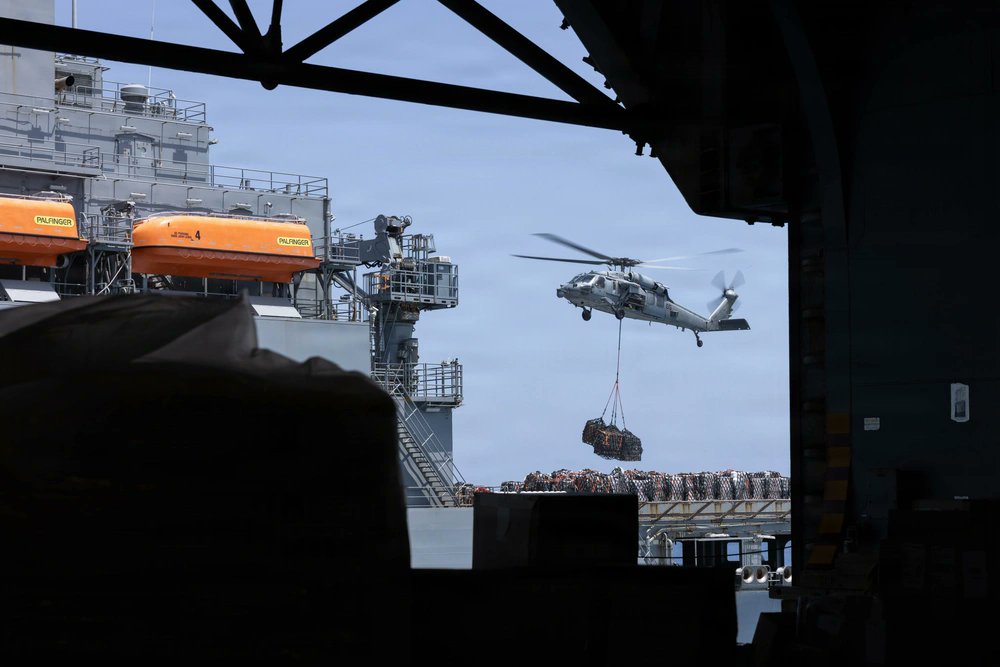
U.S. Navy MH-60S Sea Hawk transports supplies during a resupply at sea aboard the forward-deployed amphibious assault ship USS Tripoli (LHA 7), April 13, 2026.
USS Tripoli is an America-class amphibious assault ship. It is not a carrier in the flight-deck sense, but its food service architecture follows the same doctrinal framework. The ship supports a crew and embarked Marines, operating a galley system built around the same mandatory recipe standards, the same cycle menus, the same nutritional requirements, and the same resupply architecture through the combat logistics force.
Amphibious ready groups operate in close coordination with carrier strike groups precisely because logistical support, including food, fuel, and ammunition, is shared across the task force. The notion that Tripoli was running short on food while operating as part of a task force executing a major named operation, with NavCent monitoring daily logistics stats for every ship in the theater, is a claim that would require the simultaneous failure of the ship’s own supply chain, the task force logistics system, NavCent’s oversight function, and the Secretary of Defense’s team, all without anyone noticing until a Ukrainian 𝕏 account posted a photograph that turned out to be from the Iran-Iraq war. The probability of that coincidence is not something a serious person should accept.
It is worth pausing here to acknowledge what a legitimate food service problem at sea actually looks like, because conflating normal operational degradation with a propaganda-ready “scandal” is itself a tool of disinformation. In high-tempo operations like Epic Fury, a carrier’s food service system does adapt. Menus simplify somewhat. Box meals and watchstation feeding expand for personnel who cannot leave their stations during flight operations. Midnight rations may shift in timing. A fresh produce item may be substituted for a shelf-stable alternative if a particular replenishment event runs short on one category. These are not failures. They are the system working exactly as designed, trading some variety for operational tempo while maintaining caloric and nutritional targets.
Official Navy doctrine explicitly anticipates this: the preferred degradation path is from full hot-line service to modified hot menus to snack meals and box lunches, with individual ration packs like MREs authorized only if galley access is lost entirely. Even at that last stage, the doctrinal benchmark is 3,600 kilocalories per day across 3 MREs, which meets the operational ration standard. The gap between “our sailors are eating box meals during flight ops” and “our sailors are being fed rotten meat” is not a matter of degree. It is the difference between an operational adaptation and a fabrication.
The media outlets that amplified this fabrication have a responsibility to explain what verification steps they took before publishing. USA Today, CNN, MSNBC, and The Times published or promoted stories premised on photographs that a 30-second reverse image search would have debunked. The @sentdefender account, which positions itself as an open-source intelligence resource and therefore presumably understands basic image verification, amplified content that originated in a disinformation pipeline rather than from any identified sailor or official source. Open-source intelligence methodology, the discipline these accounts claim to practice, explicitly requires provenance verification, cross-referencing of claimed dates and locations, and skepticism toward material that appears suddenly in conflict-adjacent information networks. The failure to apply these basics is either gross negligence or something worse.
The deeper point is this. The purpose of the campaign was not to hold the Navy accountable. If it were, the journalists and accounts involved would have filed records requests, sought comment from NavCent, reviewed the DoD’s own documented logistics standards, and waited for responses before publishing. Instead, they published images of unknown origin, declined to verify their provenance, and watched the story spread.
The purpose was to demoralize Americans, to make the public feel that the military prosecuting Operation Epic Fury was incompetent or indifferent to its own sailors, and to generate political opposition to the operation before the facts could catch up to the narrative. This is a classic information operation objective, and it is one that adversaries of the United States, whether state actors or their proxies in Southeast Asian and Eastern European information networks, have strong incentives to pursue.
The Chief of Naval Operations said the reports were false. The Secretary of Defense said they were fake news. NavCent confirmed the logistics stats. The photographs traced back to a foreign conflict 40 years ago. And still the drive-by media presented the story as though the military’s denials were the suspicious part. That asymmetry, treating official military logistics data as inherently less credible than an unverified photograph from a Ukrainian 𝕏 account, reveals something important about where the institutional loyalties of the American press actually lie. They do not lie with American sailors. They do not lie with operational truth. They lie with any narrative that embarrasses this administration, regardless of whether that narrative was engineered by people who regard American military power as their primary adversary.
Our sailors are fed. They are eating hot meals planned to rigorous nutritional standards, replenished by a logistics network that NavCent monitors every single day, served by culinary specialists who bake bread on deployment and execute Thanksgiving dinners underway. The enemy knows they cannot beat the US Navy in a fair fight, so they are attacking the food instead, or more precisely, they are attacking the story of the food, hoping that a credulous press and a distracted public will not look closely enough to notice the difference between a photograph from the 1980s and a meal served in 2025. Some of us are looking closely. The least the American press could do is the same.
Link to the original article on X:
https://x.com/amuse/status/2045524094792196290?s=20
Here is a video I recently watched about life on an American aircraft carrier! I also saw an excellent one about feeding sailors on our submarines. They eat really well.




 Stella's Place
Wow, this was all very interesting. My father was usually on a destroyer and I remember when we used to go there on Sunday for dinner and I got the run of the ship. I was about three to seven, I guess. The racks on those ships were hammocks which I thought was so cool.
I got invited to take a family cruise on an aircraft carrier when I was grown and that was a real thrill. My ex was on submarines and so I experienced what it was like to go down on a diesel sub and later on a nuclear sub. I wish more people would read and watch videos like these to understand what it is like for these sailors.
LikeLiked by 1 person
I am absolutely shocked that this propaganda about the food being put out by USA Today, CNN, MSNBC, and The Times. I consider it traitoristic (if that is the right word).
LikeLiked by 1 person
Lying liars live to lie. We already know that the progressive Left media is America-hating and those involved remain personages of no discernment whatsoever. They want America to collapse and disappear from the earth. That’s the goal.
The incorrect information wasn’t checked out because those who disseminated it didn’t care whether it was truthful or not. If even for a few minutes people believed such tripe, that was worth it to them. Sewing seeds of doubt about the Trump Administration makes them ecstatic. There MUST be a way to make them pay.
LikeLiked by 1 person
LikeLiked by 2 people
I know that none of our useless “media” will ever pay much of a price, but I won’t be sad if a few of them go hungry when they become homeless.
LikeLiked by 2 people