
President Trump signed an executive order titled “Ending Crime and Disorder on America’s Streets,” which directs federal agencies to make it easier to involuntarily treat people with serious mental illnesses as part of a bid to address homelessness across the United States. The order makes it easier for states to remove homeless encampments and force unhoused people into mental health or addiction treatment programs.
In view of this EO, this is a repeat of a post I made in 2018.
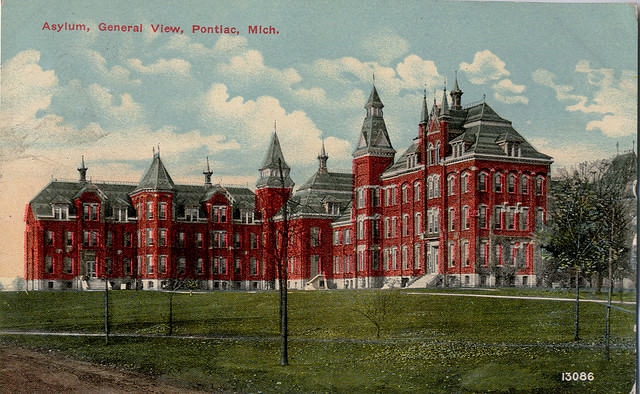
Today’s mentally ill have all but returned to the preinstitutional conditions of the 1850s and before: When not sleeping on the streets, many are again consigned to drift among a custodial system of prisons, welfare hotels and outpatient facilities.
In 1880, the severely mentally ill made up less than 1% of the U.S. prison population. A hundred years later, the percentage was 10 times greater.
The Los Angeles County Jail has become the largest de facto psychiatric inpatient facility in the U.S.; New York City’s Rikers Island is second.
For half a century, the states have closed their asylums in an effort to save money, while lawyers have routinely put up obstacles to care.
 More than fifty years ago, most of our psychiatric hospitals closed, and most of their patients released to the public. There were more than 600,000 patients in such hospitals in 1955; now there are fewer than 50,000 beds available for psychiatric patients.
Changes in the laws placed a heavier emphasis on the rights of the patient than the safety of society, to be blunt about it. There are huge legal barriers against commitment of the mentally ill. In order to be committed, the patient must be a threat to himself or others. This often means that an attempted suicide or an attack on others must occur before the mentally ill person can be restrained.
This is not a kindness to society, and it certainly isn’t kind to the mentally ill. Without care and separation from normal society, a small but significant percentage of the severely mentally ill now pose a danger to the general public. Many of America’s mass homicides have been committed by mentally sick persons whose mental illness is ignored. In many cases, families attempt to force treatment of mentally ill relations, but are unable to do so because their civil liberties trump the perceived need for their incarceration.
Mental institutions were funded and built because society had been dealing with the mentally ill in a way similar to what we see now – instead of treatment, they are thrown in jail, or live on the streets. Many are addicted to drugs or alcoholics. Some are violent, and innocent citizens are attacked or killed. The mental institutions were built by the states, dedicating funds to care for mental patients in a more caring and moral way. Were mistakes made, or patients mistreated? Sometimes, yes. But, in the long run, it was a kinder and more effective way to deal with the mentally ill in our society.
I believe that if we had a system that allowed for the mentally ill to be incarcerated in facilities that are safe, and helped them to regain their mental health if it is possible, several of the terrible mass killings we have recently seen would not have happened. I believe that people like Jared Loughner, James Holmes, Adam Lanza, and Nikolas Cruz probably would have been stopped before they perpetrated such crimes. As it is, the hands of families, doctors, and police are tied.
Police were called to the home of Nikolas Cruz 39 times in the years leading up to the massacre at his former high school. According to a local television station, administrators at Marjory Stoneman Douglas High School recommended back in January 2017 that the school board conduct a “threat assessment” on Nikolas Cruz to determine if he was a danger to the school and its students. A copy of Cruz’s discipline summary shows that Cruz was involved in an assault at the school on Jan. 19, 2017, less than three weeks before he was transferred out of the school. It was on that date that the school put in a referral for the threat assessment on Cruz. Even though the Superintendent is quoted as saying they had no warning, many students stated that they were not surprised. A typical statement by a student was, “He’s mentioned plenty of times that he wanted to shoot people and, like, that’s why he would want to go to the military.”
To understand what a parent with a mentally ill child faces every day, read the blog post written by a mother after Adam Lanza shot up the school in Newtown. Her son was 13 years old:
I live with a son who is mentally ill. I love my son. But he terrifies me.
A few weeks ago, Michael pulled a knife and threatened to kill me and then himself after I asked him to return his overdue library books. His 7 and 9 year old siblings knew the safety plan—they ran to the car and locked the doors before I even asked them to. I managed to get the knife from Michael, then methodically collected all the sharp objects in the house into a single Tupperware container that now travels with me. Through it all, he continued to scream insults at me and threaten to kill or hurt me.
Here is the link to her blog post: I am Adam Lanza’s Mother
NOTE: Her son, Michael, was eventually diagnosed with bipolar disorder, and is now doing fine on medication, lithium. Unfortunately, she is blaming Republicans for supporting gun rights, and the NRA, and for not spending enough on mental health (I agree with her there). Her February, 2018 blog post:
http://anarchistsoccermom.blogspot.com/2018/02/dear-congress-if-mental-illness-causes.html
Something must be done about mental illness in this country. The laws need to be changed.




 Stella's Place
How to address this, Stella?
With the shortage of qualified medical personnel, it’s tough enough to find qualified medical treatment for the general population. Would having these patients gathered in a specialized facility actually reduce the burden for care and thereby improve treatment? Much of the best today is a combination of medical and behavioral treatment, but ongoing patient monitoring is also needed.
I agree with you, specialized medical facilities for the mentally ill are needed. That’s why they were sometimes called mental hospitals. For those who can be treated and returned to society, it’s the doorway to a better life.
For those who cannot be, institutionalization for the long term is the only safe option for society, and them. Maintaining such facilities to a high standard of care is no easy task.
And the question no one wishes to deal with is: When does the line of insanity cross the boundaries of life or death punishment?
LikeLiked by 2 people
This is a HUGE problem, as a full-time caregiver of a mentally-ill person with many contributing complications – I grow increasingly frustrated with the lack of options for her to experience a good life despite the issues she has that she can’t help it.
I DO blame the idiocy that prevents her having the assistance she needs available in society, on the WOKE IDIOTS that predominate in the field and their attempts to manage what to do about it. (Long story with lots of factors – won’t go into it now.)
But, pointing fingers rarely goes far in terms of resolving this particular societal dilemma anyway, we need folks with good moral compasses to step up and try to reset or replace the dysfunctional aspects and get rid of those preying on the vulnerable.
Probably not really voicing this very well – but I have extensive experience with facilities such as they are, and the almost complete LACK of decent options for care. Been dealing with it myself for over 60 years via 5 different mentally ill thru that time, it’s heartbreaking. Fraud and corruption are rampant amongst almost every facility, literally almost forced to do it by the agencies who are supposed to be regulating, layer and layers of entrenched fraud….money over patient every time.
LikeLiked by 1 person