Received in email from Dr. Robert Malone

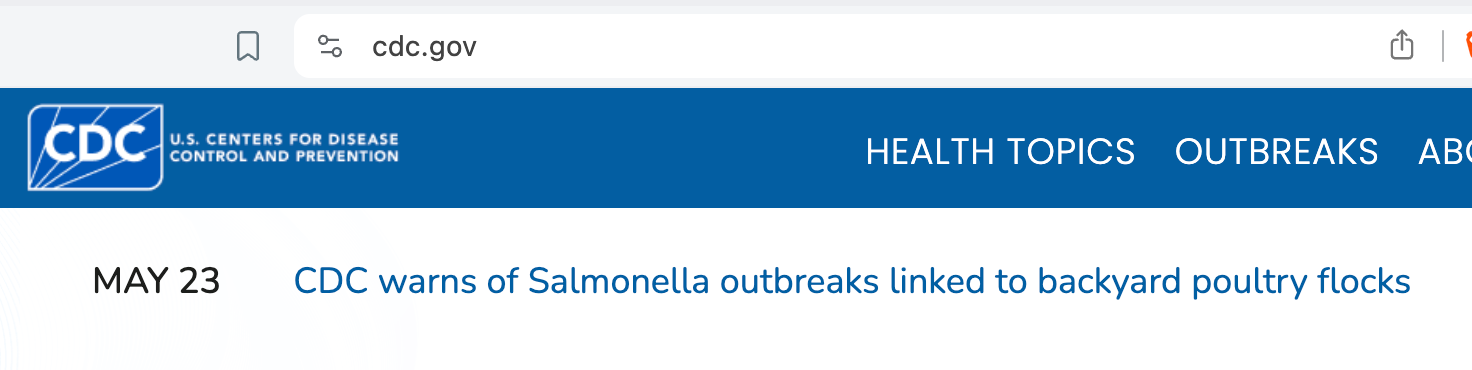
On the front page of the CDC website, is the following headline:
 |
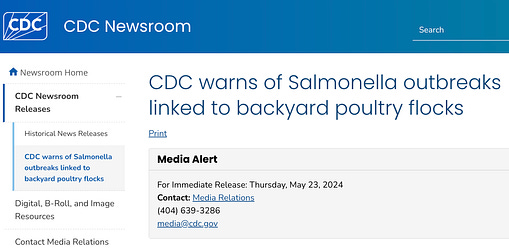
Which then opens into the following:
 |
- Are you ready to give away your chickens?
- Move from the country?
- Wear gloves and a mask when caring for backyard chickens?
- Stop buying eggs from your local farmer
- or, all of the above?
But hold your horses, reading further into the report – here are the numbers:
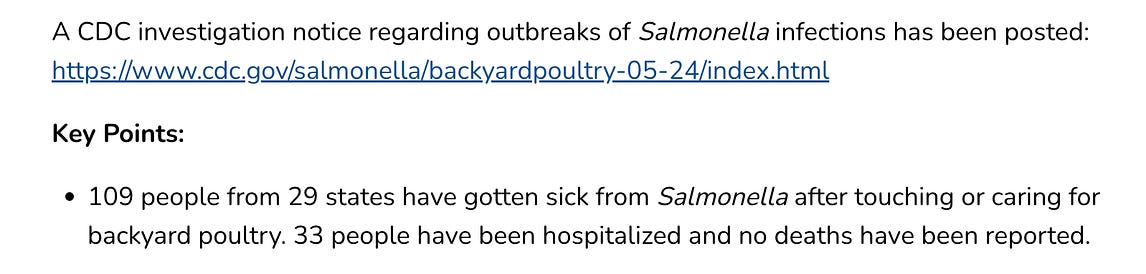 |
Out of 330 million people in the USA in 2024, 109 have gotten sick from Salmonella and have some association with backyard poultry this year.
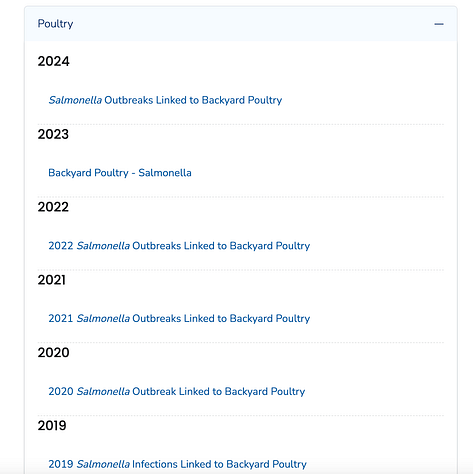
A further dig into the CDC archives reveals that for the past six years, the CDC has conducted successive investigative “reports” on Salmonella outbreaks linked to backyard poultry. In fact, they write numerous articles on the subject each year.
 |
Something fishy is going on here…
A search for poultry and salmonella on the CDC website reveals no such investigations or public reports for commercial poultry operations. There are NO reports for 2024, 2023, 2022, 2021, 2020 or 2019 (the archives stop at 2019).
The CDC estimates that Salmonella bacteria cause about 1 million illnesses, 19,000 hospitalizations, and 380 deaths each year in the U.S
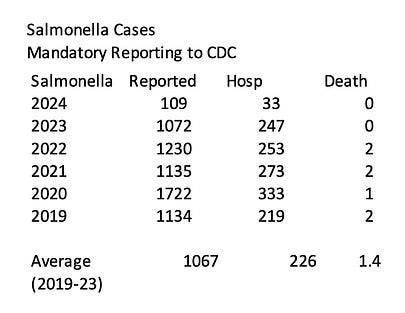
Below are the numbers for salmonella cases linked to backyard poultry, according to the CDC webpages:
 |
An extensive search on the CDC website could not find how many people are sickened by commercial poultry each year.
So I went to various AI services, which spat out answers about risk of transmission and statistics about being sickened backyard poultry. The exact same pablum that I had found on the CDC website.
So, then I went the USDA website, and from there I was able to extrapolate the answer.
 |
Therefore, according to the USDA, 1 million x .23% = 230,000 people are sickened by Salmonella associated with the consumption of chicken and turkey each year.
Out of those 230,000 infected with Salmonella from poultry a year, about a thousand people are sickened from backyard poultry (from the CDC).
THIS MEANS THAT ONE OUT OF EVERY 230 POULTRY-RELATED SALMONELLA CASES IN THE USA IS RELATED TO BACKYARD POULTRY!
One out of 230 salmonella cases, yet the CDC is completely focused on the risk of salmonella associated with backyard poultry in its public messaging and warnings.
You can’t make this stuff up.
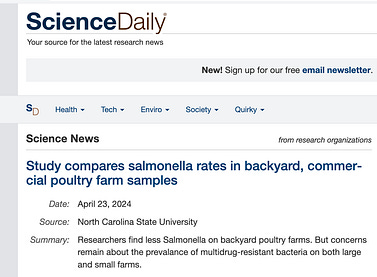
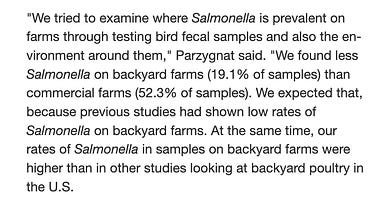
But it gets worse; recently, North Carolina State University conducted a study that documented backyard and small farm poultry operations are infected with salmonella at a much lower rate than commercial plants.
 |
 |
So, the CDC’s website has nothing to say about salmonella-related illnesses for the 229,000 people infected from commercial operations, but the website is literally flooded with dire warnings about backyard poultry for the 1067 cases per year infected from backyard flocks.
How could this be anything but intentional?
Of course, the issue of regulatory capture again raises its ugly head.
Who hires someone after they have worked for the CDC? Industry, of course. Does the person who researches the high levels of salmonella in commercial poultry houses get hired?
“As far as making people sick and posing economic threats to the meat and poultry industry, it is at the top, it is the most widespread foodborne pathogen,” said Jonathan Campbell, PhD, extension meat specialist and associate professor of animal science at Pennsylvania State University, in University Park, Pa.
Salmonella is among the most widespread foodborne pathogens in part because there are so many types, referred to as serotypes, said Jasna Kovac, PhD, assistant professor of food safety and food science at Penn State. It also easily moves from animal hosts to people.
“It can survive pretty much everywhere in the environment, but its main harborage is in warm-blooded animals,” she explained.
So, salmonella will always be a risk in our food supply, including salmonella found in plant-based foods. But why has the CDC chosen to go after backyard flocks and small farmers? Of all the health-related news in the United States, why is the minuscule number of people infected from backyard poultry news on their front page year after year after year?
By omitting the true statistics about salmonella infections derived from the commercial poultry sector and highlighting backyard birds, the CDC intentionally misrepresents the danger of salmonella found in commercially produced poultry products. Commercial poultry farming is a big business, so is the CDC protecting that industry by throwing small farmers and homesteaders under the bus?
The government does not like what it can not control or regulate. When we create our own independent food supply networks, this triggers the government.
It is also hard to tax what they can not regulate.
But beyond that, this is a war by our government on personal sovereignty.




 Stella's Place
They want us to shut up and d*e. Or at a minimum, eat their franken-food and then d*e after years of your body being destroyed by the food and the pharma.
😦
LikeLiked by 2 people
Another crisis!!!
LikeLike
Remembering D-Day. Considering this news, it might be wise now to remember the importance of the “Victory Gardens” too.
LikeLiked by 2 people
No specific definition of “backyard” farm by the CDC. That’s a hole big enough to drive a Mack truck through. And especially manipulable.
It could especially affect small-scale farms that are family owned. Many supplement their shrinking farm income by selling eggs (and other items) at farmer’s markets.
Beyond that, the entirety of cause of death is not given. Other factors may enter in, such as a compromised immune system.
Some definitions showcase the fact that back yard farming is very “green.”
Definition of backyard farm:
A backyard farm, also known as a homestead or smallholding, refers to a plot of land, typically in a residential area, where individuals or families grow their own food, raise animals, and manage their own agricultural activities. This type of farming is often characterized by a focus on self-sufficiency, sustainability, and a connection to nature.
Key characteristics:
Types of backyard farms:
Benefits:
Overall, a backyard farm is a way for individuals and families to take control of their food production, connect with nature, and live a more sustainable lifestyle.
To destroy such is to go against the “green” narrative. That’s a contradiction of official “policy”.
Large scale chicken operations are not eco-friendly.
LikeLiked by 3 people
Regarding the CDC website offerings, there is an fairly extensive treatment on how to keep poultry in smaller operations.
https://www.cdc.gov/healthy-pets/about/backyard-poultry.html?CDC_AAref_Val=https://www.cdc.gov/healthypets/pets/farm-animals/backyard-poultry.html
It links to the page Dr. Malone cited. It has the following caveat:
Overview
Below is a selected list from CDC of outbreaks of human infections linked to contact with animals and animal products in the United States. This list is not comprehensive, and outbreaks may have occurred that are not included here.
Of interest is the fact that the links there to transmission of other diseases between man and animal, are to pages that have now been removed.
And this one on the procedures that will be used to “track down” the source of the outbreak of disease in produce.
https://www.cdc.gov/healthywater/other/agricultural/on-farm-investigation.html
This link is also not in the archives. Nor were others.
CDC
cdc.gov
› healthywater › other › agricultural › on-farm-investigation.html
Considerations and Resources for Conducting an On-Farm Environmental Investigation | Other Uses of Water | Healthy Water | CDC
Intended Audience: This information can be used by the produce industry to conduct on-farm environmental investigations of foodborne pathogen contamination in the growing environment. This contamination could be detected during routine environmental monitoring or following a suspected health risk.
No new links are provided.
The CDC site is undergoing significant change with little updating of related links. Searches must be done on an A-Z listing. Even those lead to pages “not found”.
Seems they are better at link removal than updating, relying on a drop-down list of associated links which also contain removed pages.
“All around the carpenter’s bench…”
LikeLiked by 3 people
LikeLiked by 2 people
He has some similar information about things going on next door in ID. “They” don’t like us and it’s pretty clear what the intentions of our betters is. It could start to get ugly pretty soon. I’m really shocked about ID, as it’s supposedly a pretty red state, although most of their new population for the last 25 years has been from California.
https://x.com/WallStreetApes/status/1799974763475173801
LikeLiked by 3 people