

Looking up one of the assembly lines at Ford’s big Willow Run plant, where B-24E (Liberator) bombers are being made in great numbers.
“They have given their sons to the military services. They have stoked the furnaces and hurried the factory wheels.
They have made the planes and welded the tanks, riveted the ships and rolled the shells.”– President Franklin Delano Roosevelt, August 19, 1942
If WWII were to happen again tomorrow, would we be prepared? Could we build an arsenal quickly the way it was done in the 1940’s?
I think the challenge would be a different one, as I don’t believe that the United States will again fight a huge ground and air war like the one fought in WWII. I do think that the attitude and education of our citizens is crucial.
I also wonder how much of U.S. military hardware and software is still produced in the United States. After a quick internet search, it seems that the majority of military equipment suppliers are in the United States, but a significant number are also in China.
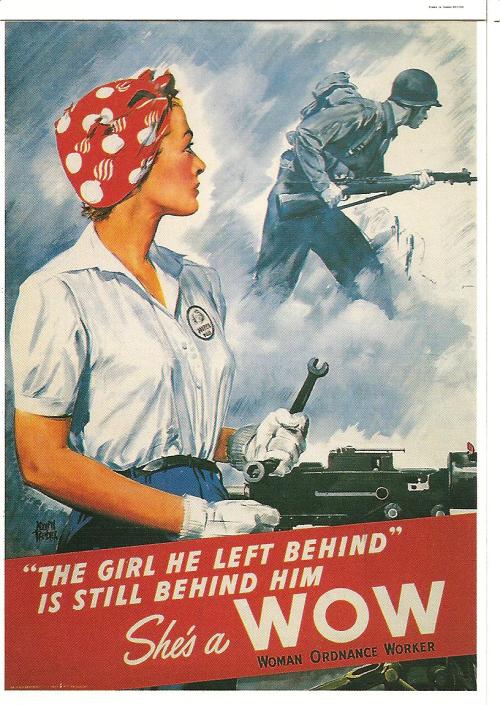
 It is impossible to exaggerate the importance of the Arsenal Of Democracy to the United States and its allies. Without the support of American industry, WWII could not have been won. America gave her all – her sons and daughters, their hard work, and years of deprivation – to win the war.
 On May 28, 1940, the phone rang in Bill Knudsen’s office in the General Motors Building. Knudsen, a Danish immigrant who had made parts for Henry Ford’s Model T in a bicycle factory in Buffalo before working his way up to become president of GM, heard a voice familiar from newsreels and radio broadcasts on the other end.
It was President Franklin Roosevelt. “Knudsen?” the voice said. “I want to see you in Washington.”
France was collapsing under the Nazi blitzkrieg. Great Britain was slated to be next. Imperial Japan’s sun was rising in the Pacific.
America had the eighteenth largest army in the world, not much bigger than Holland’s, and no defense industry — it had been dismantled after World War I, “the war to end all wars.”

You cannot just order a Navy as you would a pound of coffee, or vegetables or meat, and say, we’ll have that for dinner. It takes time. It takes organization.
—Bernard Baruch
“Our greatest need is time,” Marshall told him. Knudsen could see that, but he also needed to know exactly what equipment Marshall and the Army needed and how many, and no one could tell him. The situation in the Navy was much the same. The truth began to dawn on Knudsen. He couldn’t get a straight answer because they were waiting for him to tell them what the American economy could produce, and how much. If the country was going to make itself seriously ready for war, neither the politicians nor the generals nor the admirals were willing to take the lead. American business and industry would have to figure it out on their own.
Excerpt from the book, Freedom’s Forge: How American Business Produced Victory in World War II (Random House)

Consolidated’s Assembly Plant, Fort Worth, TX
Knudsen called upon fellow industrialists across the country, but particularly in Detroit:
Knudsen started things rolling soon after he got to Washington with a phone call to his friend K.T. Keller, president of Chrysler, to see if he thought Chrysler could build tanks. The result would be the Chrysler Tank Arsenal in Warren, where some 25,000 Grant and Sherman tanks would be built, more tanks than Nazi Germany built during the entire war.
Another call went to Knudsen’s old employer, Henry Ford, to see if he could convert part of his River Rouge plant to make aircraft engines for Britain’s Spitfire fighters. Ford said no (in 1940 the old man was still in the throes of isolationism) but Alvan Macauley at Packard Motors said yes.
Macauley and his engineers welcomed the challenge. Soon the Packard Plant on Grand Boulevard became the site of a new facility for making the 12-cylinder, 1645-cubic inch Rolls Royce Merlin engine, and for employing the thousands of young women Packard hired to make them. In the end, Packard would build more than 55,000 Merlins, not just for the Spitfire but for America’s own P51 Mustang.
Then on Oct. 29 Knudsen set up a secret meeting of auto executives at the New Center Building, where he and a then-unknown Army Air Corps Major named Jimmy Doolittle showed them the aircraft parts they needed to have made in record numbers and in record time.
Four weeks after bombs fell on Pearl Harbor, the men at that meeting formed the Automotive Council for War Production, under a dynamic young executive director. His name was George Romney. He and the ACWP pulled together a production plan that wound up making 75 percent of all the aircraft engines, one-third of the machine guns, two-fifths of the tanks, and 100 percent of the trucks and motor vehicles America used during the war, not to mention hundreds of other implements of war from artillery shells and bomb fuses to steel helmets. ….
Together they proved what Bill Knudsen’s had first told FDR, “we can do anything if we do it together.”
Some of this was taken from The Detroit News: (http://www.detroitnews.com/article/20130103/OPINION01/301030336#ixzz3XgUCIlIN)This article is no longer available on line.
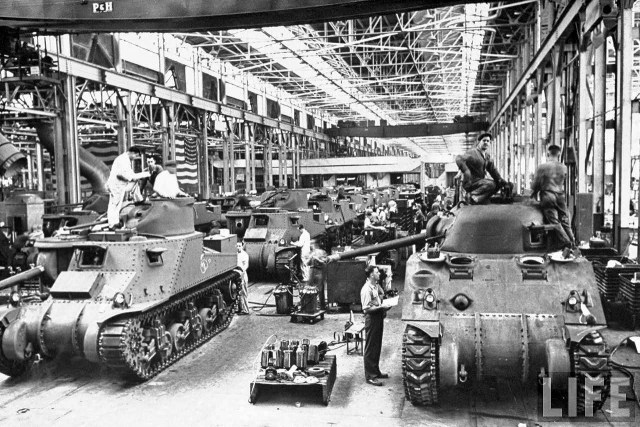
Tacom Tank Plant, Warren, MI
America is like a giant boiler. Once the fire is lighted under it there is no limit to the power it can generate. —British foreign secretary Lord Grey

Kaiser Richmond Shipyards




 Stella's Place
This is an awesome post. Thank you Stella.
LikeLiked by 4 people
Thanks! It’s a repeat. I went through a bunch of old posts and picked a few to repeat. Glad you enjoyed it.
LikeLiked by 1 person
That sort of private sector ingenuity… I’m not sure it even exists right now. Between government over regulation, corporatism and Wokism, it’s not even really allowed anymore.
LikeLiked by 2 people
I believe this next war will be fought here. The army is already inside the gates. Our government is full of traitors. The military and police have been mostly disbanded or emasculated. And, if the police are not allowed to shoot anyone who attacks them, we are lost.
LikeLike