Most of us are curious about our ancestors – who they were, what they did, what kind of world did they live in? We want to know because those who came before us determined, in great part, what and who we are today.
When you set out to dig into the past, you often find things you didn’t expect, both in the past and in the present day, too. Sometimes you find things that were hidden because nobody wanted to talk about them, and sometimes you find out that the stories you were told, or you remember, aren’t exactly what really happened.
I have been doing genealogy research regularly and fairly seriously for more than two decades. Digging through public records, family documents and photographs, talking with close family members and more distant relatives, and even shirttail relations met during the search.
My search began casually around the time of my mothers 90th birthday, in 1996, while my daughter and I prepared her birthday celebration. We had a big party with many relatives and friends, and had an attendance of about 75 people from all over the United States.
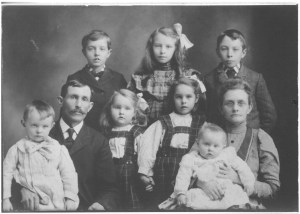
As part of that celebration, my daughter and her then fiance, now husband, and who is a graphic designer by profession, gathered pictures, stories and family letters and remembrances into a rather professional looking book that was distributed to members of the family as a keepsake. My daughter interviewed her grandmother, and went through our considerable hoard of family photos with her to identify who, what, when and where. We asked family members to write their own remembrances, which were also included in the book, and the fact that my mother wrote poems and stories about everything family made the book all that more interesting. The book is titled, “Treasures of Age”, taken from a poem that my mother wrote. This research proved to be invaluable when I began to seriously set down the facts about my family. Because of the photo id’s, I could put a face on many of them too.
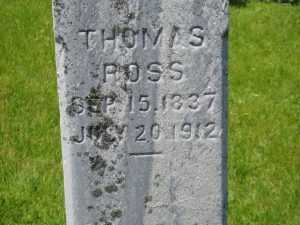
I had been photographing gravestones in our family plots, photos that my daughter refers to as my “dead” pictures, when I accompanied my mother to decorate the graves on Memorial Day. I have continued that practice over the years, expanding the list of cemeteries that I visit to search out more members of the family.
All of the preceding is to explain how I started my own family investigations, and most people do pretty much the same thing I did. Once you get a good base for your family tree, things progress more slowly, but steadily, as you find new facts and new databases become available. Without the internet, the extensive investigations of our family histories would not exist.
I personally have an Ancestry.com membership, and several family trees. My main tree now has more than 4,500 members, but it also includes my daughter’s father’s family. I also chose to include many relatives not in my direct line.
My tree exists on line, but is also synched to a copy on my hard drive, using family tree software. It is possible to download your tree data into a GEDCOM file, short for GEnealogical Data COMmunications. In simple terms it is a method of formatting your family tree data into a text file which can be easily read and converted by any genealogy software program. The GEDCOM specification was originally developed in 1985 and is owned and managed by the Family History Department of the Church of Jesus Christ of Latter Day Saints.

In case you are not aware, much of the data available on line is there because of the Mormons. The church has a huge database, and founded Ancestry.com (now a publicly- owned company). FamilySearch.org (free) is also Mormon owned. Members of the Church of Jesus Christ of Latter-day Saints, usually referred to as Mormons, place great emphasis on genealogical research. This is because their Church doctrine states that “saving ordinances” (including baptism, confirmation, endowment, and sealing-marriage) must be made available to every individual who has ever lived.
To make these ordinances available to people who did not have the opportunity while living, Mormons identify their ancestors and arrange for baptism and other ordinances to be performed for them by proxy – that is, with a living person standing in for the deceased person, in a temple. Often referred to as temple work, this search for ancestors is an important part of the Mormon faith. Some people find this odd. Personally, I’m glad to have easy access to information that would otherwise be difficult, if not impossible, to obtain.
If you aren’t currently searching for family information, but are interested in doing so, here is a beginner’s guide:
http://genealogy.about.com/cs/beginnerscorner/ht/family_tree.htm
I must warn you. You could get a big surprise while doing family research, and it might (or might not) be a happy one. You might also be one of those who becomes addicted to the pursuit of family knowledge, so that you will do research for distant relatives and even friends. Don’t ask me how I know this. You will probably also make new friends and acquaintances as a byproduct of your quest.
Every once in a while, I make a significant discovery. My father was estranged from his family for years, starting before I was born, and talked little about them, so my primary discoveries have been about his family. He died in 1976, so he wasn’t around to ask questions of when I started searching.
For years I could not find my paternal grandmother past the early 1930’s. I finally found her grave location (because it was in the same cemetery as her parents, and her record was linked to theirs), and through that (via the Find-A-Grave network), I discovered her second married name, her second husband’s identity, and when and where she died. Armed with that information, I sent away for a copy of her death certificate. I was shocked to discover that she died at the age of 62 as a result of an apparent suicide – ingesting ant poison.
I still haven’t traced my paternal grandfather past about 1933. I know he was alive in 1932, but the marriage license of one of his sons in 1933 says he is “deceased”. I have been unable to locate any information about his time and place of death. He seems to have dropped off the face of the earth. He and my grandmother divorced at the end of the 1920’s. My father married, had a family, and divorced in the 1930’s. The reasons for family estrangement are a mystery. Dad moved to a new state, met my mother, and remarried in 1941. I came along a few years after that.
In 2005, via an Ancestry.com connection, I found my two paternal half brothers, and a number of living cousins I didn’t know existed. One of my brothers, Bill, died just before the discovery, but my other brother, Glenn, and I forged a friendship, visiting each other several times over the years (he lives on the West Coast). It is a relationship that I cherished, as my two maternal half siblings both died in the 1980’s. Glenn has since died. I am MUCH younger than my siblings, but Glenn was the closest in age, being only 16 years older than I am.
Anyway, feel free to share your experiences, ask questions, or otherwise comment on the wisdom (or not) and practice of genealogy.




My mother traced our ancestry to the Battle of Bushy Run. Kinda strange how I relocated to this area without any knowledge of that battle and who was involved. I even had friends at one time that had the same last name in the area with my ancestors. I even married a girl that lived about 40 miles from where I was born and raised and never knew she was a distant cousin! After about 10 years of our marriage, while talking about my mother’s tracing with my wife’s father, that we had the same ancestor in that battle. Really strange how that worked out! What makes it tough is the last name would get changed in spelling to separate the families involved. For instance mom traced back to the Harmon family, and I was married to a Hoyman. It was the same ancestors. BTW, her dad and I were always pretty close. That explains a lot more.
LikeLiked by 1 person
Someone distantly related did a tree on my father’s relatives, going back to early 1800’s transit to America. My mother’s mother’s family had papers in a family bible going back a long way, but they were thrown out by someone doing repair work on that bible, and all was lost. I have started a few times, but lose interest before long.
LikeLike
My computer does not allow me to like on this particular site. Like^^^^ Not so on other Word Press blogs. I can like on CTH site. (Conservative Tree House). Different platform. Plus I still use the Win7 platform.
LikeLiked by 1 person
I can’t like or even comment without signing in each time on the front side of this blog either, and it’s my blog! I’m using Windows 11 now. I can’t explain why some people have problems and other don’t. I’m sorry, and wish I could help you, but I have no clue.
LikeLiked by 1 person
No problemo Stella, I just accept it. I was pointing this out to czarina as I couldn’t like anyone but I get plenty of likes back! I must sign in each time also! Just glad it isn’t Win 7 on my part. I loved win XP and Win7 is the same except it’s on steroids! When this computer peters out, Linux is next. I’m a done with Apple and Windows! I used to work for and on Apple products (OS9 & 10)
LikeLiked by 2 people
I’m able to like, I guess….don’t know why!
(my comment is very long. Sorry about that. Keep in mind nobodyhas to read it….! 🙂 )
Stella, the amount of work you have done using everything available is amazing!
I have had good information (documents, original writings, photos, letters, public and church records) going back to the middle 1800s for my family and Grant’s, although much more for mine. During the time we were in Minnesota, I spent many hours at the Otter Tail County Historical Museum and was able to locate and obtain a lot of material on his family. They had located in Otter Tail County just before the Civil War.
During our years there, we always had an eye out for Plat Maps that were often offered for sale at flea markets, etc. These plat maps were issued every ten years or so, documenting township-by-township exactly who owned each parcel of land. With the collection that we ended up with, I am able to track all of the Torgerson land holdings for well over 100 years.
That kind of material was not relevant for my family in Montana because the land I grew up on had just been homesteaded around 1900. My father and grandfather were the only owners of that acreage from the time it was first surveyed. I have all documents from that.
Three of my nephews in particular have done extensive exploration of family roots going back hundreds of years, using Ancestry and the Mormon records. One of my nephews has his Masters degree, obtained at the University of Utah, and has responsibilities for directing the University’s geneology department…I assume they have much connection/back-and-forth with the Mormons, but it is distinct and separate.
Somewhere in the family records I compiled using all of the first hand material I have, I included links to the online records done by my nephews. I find all the sourcing, etc. overwhelming. I have worked mostly with all the original stuff the collected and came into my care, being the youngest of 7 in our family.
One of my 16 blood-aunts made trips to Denmark and did research in the church records there…in the Scandinavian countries, the church registries are a very primary way of tracking names and dates. She prepared a super-detailed family tree (my mother’s side) that fills many, many pages, and the last entry is the information connecting to the major access point into Danish records for anyone that cares to check that out.
I’ve done thousands of hours of work working with raw material, but am sort of blown away with all of the web-related, computer work you have done. I think it is right and good that those of our time make whatever effort we can. The information has never been so accessible, and for those who care about it, this is the time to do what we can.
As you know, Stella, the whole reason I ever started my little (still available but inactive) blog was to have a place to document what I had on hand. So many good things to think about!!
LikeLiked by 1 person
Sounds to me like you have done the hard work, going through original documents, visiting libraries etc. It is wonderful that some of your relatives went directly to the source in foreign countries!
I have some plat maps too – but I got mine from ancestry.com. So much is available now on the internet, and I would never have gotten as far as I have without it. I also have had help from family members who have original documents, photographs, bible entries etc., that they have generously shared with me.
LikeLiked by 1 person
One of the things I found at the history museum that I would not have had access to otherwise was this: I found the ship manifest for the journey of my maternal grandfather from Denmark in the early 1890s. All the passenger names were listed, including his. That was quite a precious find!!
It is satisfying to be able to nail things down and make available to family who are interested!
LikeLiked by 2 people