
A reinvigorated Hurricane Dorian roared toward the Carolinas on Thursday, bringing tropical storm conditions along the South Carolina coast and flooding in Charleston, along with the threat of tornadoes across the region, including northward into North Carolina.
The National Hurricane Center said as of 10 a.m. that Dorian is a Category 3 storm with maximum sustained winds at 115 mph. Dorian was located about 65 miles southeast of Charleston, S.C., and 165 miles south-southwest of Wilmington, N.C., moving north-northeast at 8 mph.
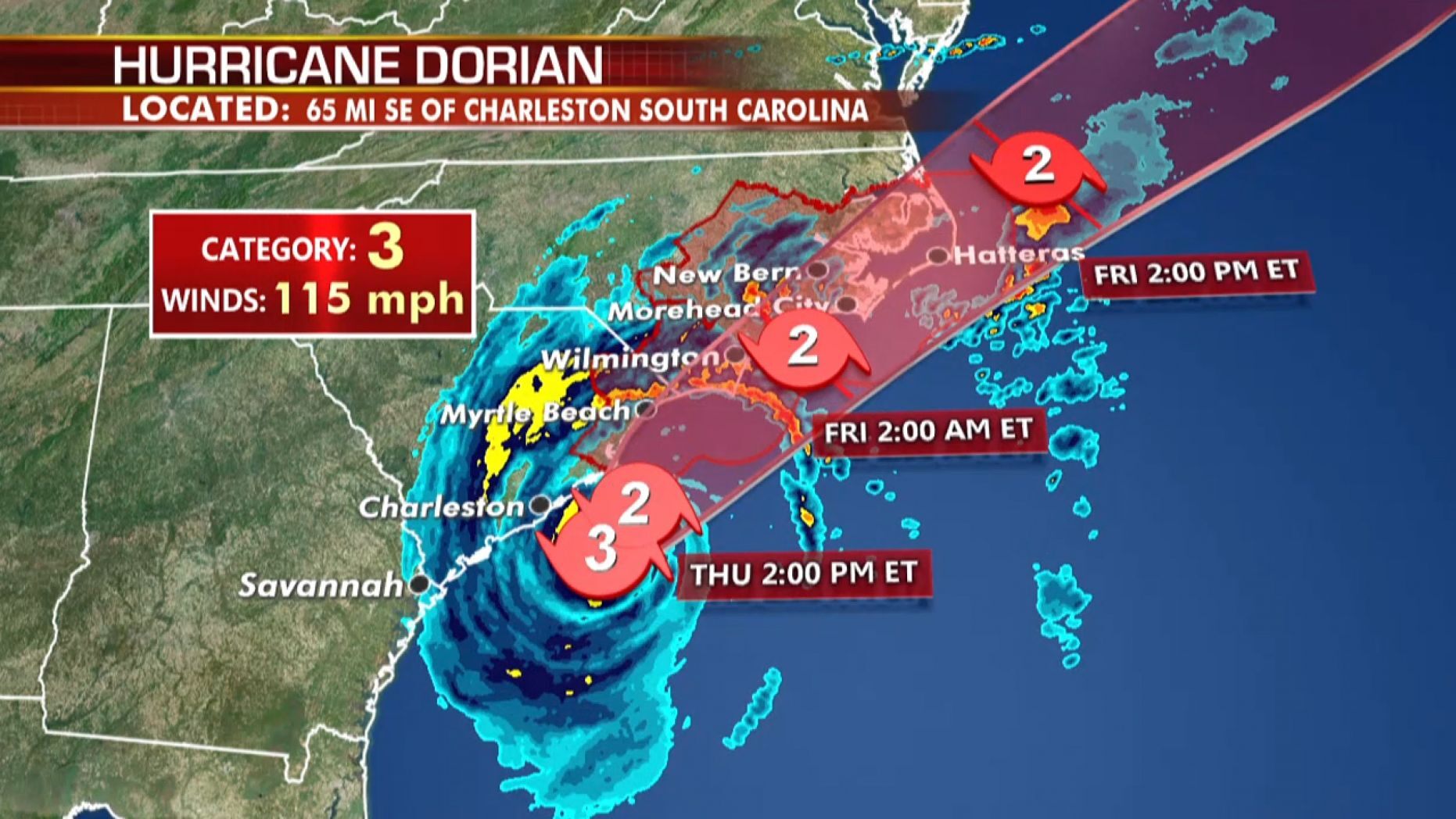 “Rain bands from Dorian producing tornadoes across northeastern South Carolina and southeastern North Carolina,” the NHC said.
As of early Thursday, the South Carolina Emergency Management Division said utilities were reporting more than 200,000 power outages statewide. Duke Energy, in a news release Wednesday, said it expected the storm to cause 700,000 outages in the Carolinas and that it brought in resources from 23 states and Canada to respond “as soon as it was safe to do so.”




 Stella's Place
My goodness, so many people have been and will be affected by Dorian.
LikeLiked by 1 person
The media will puff this up but, as those of us who live (or lived) along the coast know – it’s the price we pay for living in places where these thing happen.
As more people move to these ‘choice’ coastal areas they voluntarily place themselves into these situations and, as they redesign and pave over areas that developed as natural absorption and drainage areas, they change for their own good what nature built over eons.
Charleston has the same issue as many coastal cities – too much paved over surface. Water doesn’t move slowly over the ground, delayed by vegetation and absorbed by the soil, it speeds over solid surfaces and looks for an out. New Orleans, like most coastal cities, looks for any other reason to blame than their altering the environment for their personal use. The city’s sinking as the soil dries but the Administration blames the sea rising, evil spirits, everything except the fact that’s been pointed out that the soil under it is mostly a huge unstable compost heap and the paving’s keeping water from getting to it to keep it moistened and ‘stable’. Some years back we had an international road engineers convention in town that told the city they’d put all of their heads together as a group and come up with fixes for the city’s roads but the city curtly told them to pound sand and we’d fix our own problems. That was about 30 years ago and we’re still having road problems.
A big thing is that if you live close to the shore or the river stuff draining your way. If you pave the area that stuff that isn’t absorbed flows to you where it can’t be absorbed as it tries to reach sea level. People in coastal cities in years past knew and accepted this but modern residents seem to think they’re too special to be flooded and it must be some occurrence caused by some evil machination.
As the population increases and more people move into areas that have traditionally been ground-zero for bad weather the media feeds on it and tries to personalize the results of bad choices, making them national concerns. Their choices become our shared soap operas.
We moved from an area we knew was below sea level, had ****poor drainage and would go very deeply underwater after it did all of the above. We’d known that for decades, it was THE source of our paranoia and lurid discussion from June thru November but we stayed anyway. When Katrina happened, and Katrina wasn’t even close to the area’s ‘Worst Case Scenario’, we left and moved to an area prone to tornadoes. It’s an informed choice, we have insurance, we’ve built accordingly, we don’t expect the world to wring its hands over our plight if one does hit and we’ll pick up and go on.
LikeLiked by 2 people
Hey, Col, looks like Fayettville’s getting the **** knocked out of it – think any Old Timers there are using this as a ‘great training weather’ example?
LikeLike
Live: Hurricane Dorian pummels the East Coast
Fox News Via EXPLORE Live Cam
I’m assuming this is South Carolina but it doesn’t say specifically.
————-
As a kid we had friends who lived near the small Chino Airport. The Santa Ana winds used to come through San Bernardino County. One time in the mid-50s the wind gauge at the airport broke at 105 mph. The winds did damage, of course, but nothing really major. It was just dry, dirty wind without rain.
LikeLiked by 1 person
Wicked Son told me this afternoon NCA&T (Greensboro) is already housing students from UNCW (Wilmington). Apparently there are already mandatory evacuations for NC.
Radio host from Wilmington said they’ve not yet recovered from Matthew (2018) and Florence (2016).
Ws said the eastern sky in Greensboro was already dark at 6 p.m., the western sky was still bright, that far inland. Strange creatures, these hurricanes.
Prayers continuing for all involved.
LikeLiked by 1 person