
75 years ago today, on Tuesday, June 6, 1944, the Allied invasion of Normandy began: Operation Overlord. Better known as D-Day , it was the largest seaborne invasion in history. The operation began the liberation of German-occupied northwestern Europe from Nazi control, and led to the Allied victory in the West.
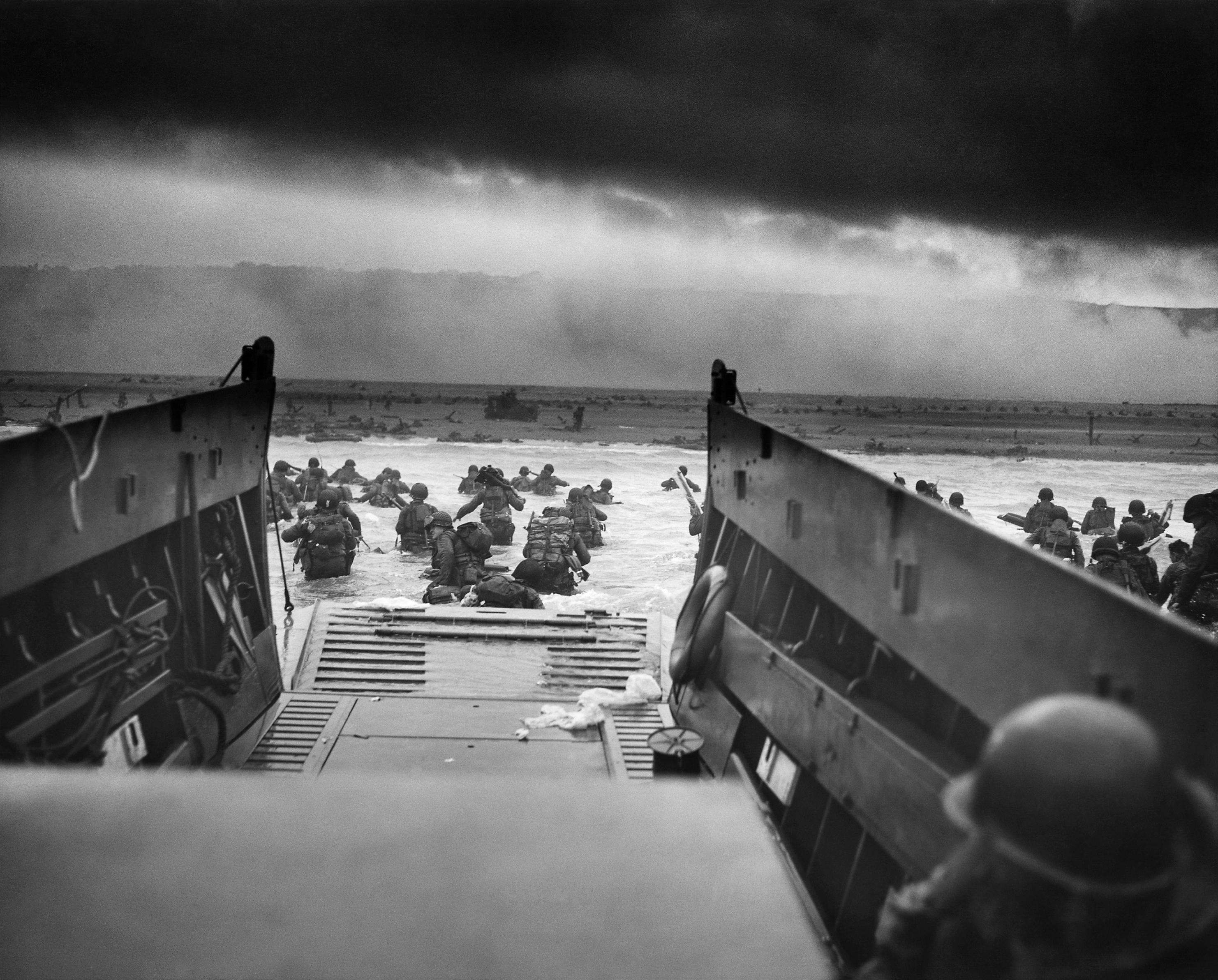
A LCVP (Landing Craft, Vehicle, Personnel) from the U.S. Coast Guard-manned USS Samuel Chase disembarks troops of Company E, 16th Infantry, 1st Infantry Division (the Big Red One) wading onto the Fox Green section of Omaha Beach on the morning of June 6, 1944. American soldiers encountered the newly formed German 352nd Division when landing. During the initial landing two-thirds of Company E became casualties.
History.com:
In November 1943, Adolf Hitler, who was aware of the threat of an invasion along France’s northern coast, put Erwin Rommel in charge of spearheading defense operations in the region, even though the Germans did not know exactly where the Allies would strike. Hitler charged Rommel with finishing the Atlantic Wall, a 2,400-mile fortification of bunkers, landmines and beach and water obstacles.
In January 1944, General Dwight Eisenhower (1890-1969) was appointed commander of Operation Overlord. In the months and weeks before D-Day, the Allies carried out a massive deception operation intended to make the Germans think the main invasion target was Pas-de-Calais (the narrowest point between Britain and France) rather than Normandy. In addition, they led the Germans to believe that Norway and other locations were also potential invasion targets. Many tactics was [sic] used to carry out the deception, including fake equipment; a phantom army commanded by George Patton and supposedly based in England, across from Pas-de-Calais; double agents; and fraudulent radio transmissions.
Eisenhower selected June 5, 1944, as the date for the invasion; however, bad weather on the days leading up to the operation caused it to be delayed for 24 hours. On the morning of June 5, after his meteorologist predicted improved conditions for the following day, Eisenhower gave the go-ahead for Operation Overlord. He told the troops: “You are about to embark upon the Great Crusade, toward which we have striven these many months. The eyes of the world are upon you.”
Later that day, more than 5,000 ships and landing craft carrying troops and supplies left England for the trip across the Channel to France, while more than 11,000 aircraft were mobilized to provide air cover and support for the invasion.
By dawn on June 6, thousands of paratroopers and glider troops were already on the ground behind enemy lines, securing bridges and exit roads. The amphibious invasions began at 6:30 a.m. The British and Canadians overcame light opposition to capture beaches code-named Gold, Juno and Sword, as did the Americans at Utah Beach. U.S. forces faced heavy resistance at Omaha Beach, where there were over 2,000 American casualties. However, by day’s end, approximately 156,000 Allied troops had successfully stormed Normandy’s beaches.According to some estimates, more than 4,000 Allied troops lost their lives in the D-Day invasion, with thousands more wounded or missing.
Less than a week later, on June 11, the beaches were fully secured and over 326,000 troops, more than 50,000 vehicles and some 100,000 tons of equipment had landed at Normandy.
[When the warship HMS Belfast fired the shot that launched the D-Day landings, it was carrying an unlikely passenger – Hollywood film director George Stevens. With Allied forces set to storm the Normandy beaches of Nazi-occupied France, Stevens was on-board making a unique 16 millimeter color film journal.]
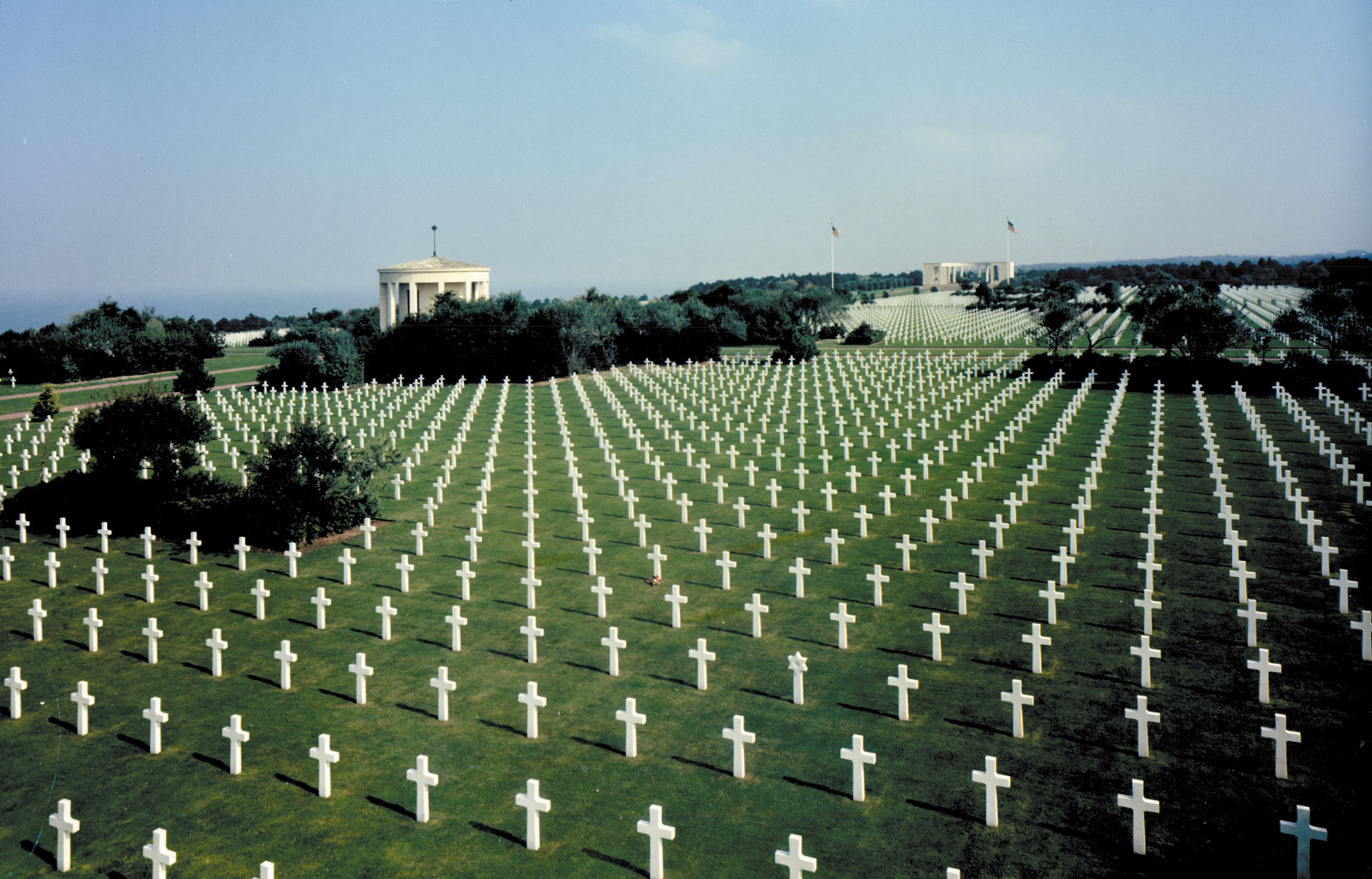
The Normandy American Cemetery, overlooking Omaha Beach and the English Channel, was established on June 8, 1944, as the first U.S. cemetery in Europe during World War II. It holds the graves of more than 9,300 U.S. servicemen who died in the D-Day invasion or subsequent missions.
 One of my favorite Reagan speeches, given on the occasion of the 40th anniversary of the Normandy invasion:
Today, 75 years later, families of fallen soldiers and veterans of the D-Day invasion will gather on the Normandy shore.
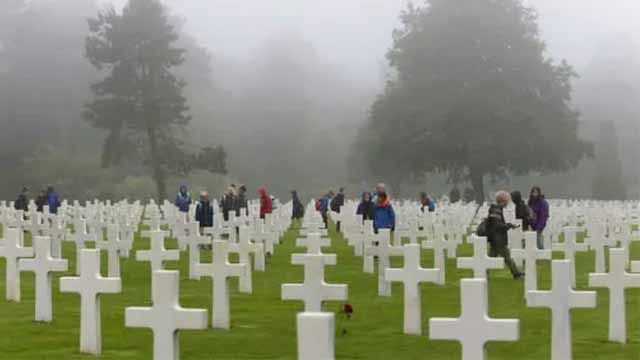
(AP Photo/David Vincent). School children visit the Colleville American military cemetery, in Colleville sur Mer, western France, Wednesday June 6, 2018, on the 74th anniversary of the D-Day landing.




 Stella's Place
Sunset on the beach of Normandy…

Normandy – Then and Now
LikeLiked by 5 people
So, it begins. The biggest gamble in the history of warfare. I have said this many times, my Dad said, just glad to see the sun come up……….
Many years ago, our SAMs class was all through Normandy. Just unbelievable how success was determined by small unit actions.
We must Never Forget Our History. On this Day Our Freedom, Today was bought and was paid for.
LikeLiked by 8 people
Thank you, Lucille. That was very interesting.
LikeLike
You’re welcome, Aus! I love those kind of comparison vids. They show a resilience and a determination for life to return to normal after times of great trial…even though the adults knew life really never would be the same.
LikeLiked by 2 people
Watch: Incredible Moment 97-Year-Old Vet Recreates D-Day Jump in Normandy
by Team Bongino – June 5, 2019
https://bongino.com/watch-incredible-moment-97-year-old-vet-recreates-d-day-jump-in-normandy/
LikeLiked by 6 people
Well done … Stella
I wanted to send my Son some historical information on the day
Thanks! 🌻
LikeLiked by 3 people
Eternal rest grant unto them oh Lord.
Excellent post Stella, thank you. May we all raise our sons and daughters to know the meaning of days such as this.
LikeLiked by 4 people
Excellent article that makes clear the kind of men and women who saved Europe in 1944.
D-Day By the Numbers, By the Men
I want you to imagine picking up every resident of a medium-sized city, everything they’ll need to eat and drink and rest for a few days, any vehicles they might need, gasoline, of course, plus lots of guns and ammo — did I mention this was a hunting trip? — and then moving them all in a few short hours a distance of anywhere from 30 to 125 miles or so.
Now imagine you have to move all those people and all that stuff partly by air, but mostly across heavy seas in foul weather.
Under enemy fire.
I should also mention that if you messed up any of the big details, a lot of your people are going to die, and then you’re going to have to figure out how to move them all back without getting too many more of them killed.
And all that is just the beginning. Because once you’ve done all that, those men on that “hunting trip” are going to have to take and widen a beachhead big enough and secure enough that you can rebuild (or build from scratch!) the ports and roads necessary to bring another million men over… plus all the additional stuff all those additional men will need.
That, in a logistical nutshell, was what the Allies had to accomplish 75 years ago on D-Day…
The preparatory air bombardment was delivered by more than 2,000 Allied bombers. The invasion fleet included 1,200 warships, 4,125 landing craft, and another 1,600 support vessels of various kinds, all courtesy of eight different Allied nations. That’s about 7,000 ships, their crews, their supplies, and the tons and tons of fuel required to run them. The official count was nearly 200,000 naval personnel.
Keep in mind though that before any of that could happen, the skies first had to be swept clear of Axis aircraft, and the Channel cleared of enemy mines. Just another note jotted down in Ike’s 87-million-page Trapper Keeper.
Three divisions worth of American and British paratroopers led the attack inland hours before the first leg infantry hit the shore. I’m not able to find solid figures on how many C-47s cargo planes and gliders were required, but a safe guess would be “a whole lot.”
https://pjmedia.com/vodkapundit/d-day-by-the-numbers-by-the-men/
LikeLiked by 4 people
The unknown, unsung heroes of many of these logistics moves were the black troops, who were segregated and not allowed to fight with the white troops.
The black soldiers were a big part of the ones who moved, set up, and kept moving all those supplies, including the new docks built – those docks were crucial.
The black soldiers were also tasked with picking up the dead on the beaches.
Can you imagine the memories these guys have?
Why they are not honored, especially considering what you wrote above, is beyond me. But they were all heroes just the same. imo
(Mom was poor white trash in Laurel, MS, living on the wrong side of the tracks. Mom heard the stories as a little girl – all her friends were mostly black.)
LikeLiked by 5 people
And yet the men and women who were discriminated against stayed in the military. President Truman basically integrated the military and today blacks have a percentage presence in the military likely larger than their percentage of the population.
Incidentally, there was a terrible accident at a West Point training maneuver this morning. Run this tape to 1:10 and you’ll see a black general (Lt. General Darryl A. Williams–1983 West Point graduate) giving the report…
“Press conference held on military training accident near West Point”
LikeLike
I love the way President Trump made it personal – hailing the efforts of individual men, and thanking them.
LikeLiked by 3 people
Wow, Stella, this was a lot of information. I had never thought about what all it took to make this happen.
LikeLiked by 2 people
I hadn’t either!
LikeLiked by 1 person
Excellent Stella, just like the first gulf war. The Loggies moved a city the size of Kansas City 15,000 miles, then set it up…….. along Pipeline Rd, there was a Corp 30 day supply of all classes of supply…… EVERYTHING…..
LikeLiked by 5 people
At Utah Beach
By Gilbert C. Frye – June 6, 2019
For this 75th Anniversary of D-Day, this grateful daughter would like to share with American Thinker readers the memories of my father, Gilbert C. “Gib” Frye, a soldier in the 4th Infantry Division, U.S. Army, who landed on Utah Beach on June 6, 1944. The following has been edited only for minor errors in punctuation and was written at the request of his family members in November 2000, eight years before Gib’s passing. — C.S. Boddie
https://www.americanthinker.com/articles/2019/06/at_utah_beach.html
LikeLiked by 1 person
https://www.romancatholicman.com/soldiers-carried-these-rosaries-during-d-day-invasion/
A little religious parallel. I’m thinking soldiers of all faiths were praying not only for courage, strength, and safety, but for victory as well.
LikeLiked by 2 people
A very unusual story. I’ve never heard this one before.
LikeLiked by 1 person
I’ve always thought that story was totally remarkable. Thanks for posting, menagerie!
LikeLiked by 1 person
Yes, if you watched the Longest Day, he was in Dukes Battalion. The plane under shot the DZ, and his company, I believe was F co, dropped on the town. Most of the paratroopers were killed. And was true, most were still hanging by wires until the next day. A good book with the Big picture, and little picture is Six Armys’ in Normandy.
LikeLiked by 1 person
Those landing craft the soldiers rode in were designed by a Louisiana ship builder, Andrew Higgins, and many were built right downtown New Orleans. There used to be (may still be) a ramp from Lakeshore drive into Lake Pontchartrain where PBY aircraft and the boats were put into the lake to be tested.
His design is a cross between boats used in the Southern swamps and an amphibious landing ship the Japanese were using in 1937 in their war with China. Over 23,000 were made but when the National World War Two Museum (nee: The D-Day Museum) in New Orleans went looking for one the only one they could find was heavily damaged. It was brought back to NOLA and restored using the exact items and from Higgins ‘original plans, it now sits stage center in the museum.
Many of the Higgins’ boat coxswains were Coast Guard, we had one boat driver who died recently, he’d come to events dressed in the same uniform and wearing the same equipment he wore as he piloted his boat back and forth on D-Day. We had a D-Day lander in our unit and had we not seen his record in his 201 file we’d never known, he never talked about it and the others never asked. We had four WW2 personnel in our unit well into to 80s.
BTW, each boat was designed to take a platoon (~36 members) in. The boat had a flat bottom and had a very shallow draft so that it could easily navigate shallow waters but that made the boat unstable in the waves and caused many to get seasick on the way in. To make the boat light, cheap and fast-ish the back and sides were made out of plywood while the ramp was metal. The ramp provided some relief from bullets and shrapnel but incoming would go right through the plywood if the boat were unlucky enough to be hit. The plywood also contributed to their not being more than a handful left when the WWII museum tried to find one.
Tat little plywood boat went a long way towards winning the war in both Europe and the Pacific. Prior to it troops attacking a beach amphibiously had to jump over the sides and/or the bow to get on shore and the boats were prone to getting stuck. Higgins’ design changes made it possible to land and get off of beaches in shallow water and for troops to leave far faster and with a wee bit more safety than before. So y’all plan an at least day-long trip to the National WW II museum and see stuff from WWII preserved for a now largely uninterested nation.
LikeLiked by 1 person
Czar, I read this a while ago. Just now I started watching the Ingraham Angle from last night and there is a segment on it about these very boats. I was glad I had seen your post and it showed the boats and told how they were built. I haven’t been able to find a video of it, but there is probably one somewhere. I will keep looking.
LikeLiked by 1 person
Search for ‘higgins boat’ on Youtube and visit the WWII museum in NOLA
LikeLiked by 1 person
That museum looks really interesting.
LikeLike
It is. It has both European and Pacific exhibits and eats up a couple of blocks.
LikeLiked by 1 person
I found this. It gives even more info.
LikeLike
Center row 3rd boy from the front. A boy. Maybe 15 if that. So many were boys. God Bless them each and every one.
LikeLiked by 1 person
My much older brother was 17 when he joined the Navy in 1943. So very young.
LikeLiked by 1 person
So very young. It both breaks my heart and simultaneously makes it swell with pride for the young men who believed in a cause bigger than themselves.
LikeLiked by 1 person
I look at those young faces and I think of my own grandson who is almost 19 years old now, and I can’t imagine him going to war. Perhaps it was a different time; our young men are very sheltered now.
LikeLiked by 1 person
My father was 17 when he joined the Navy. He had to have his parent’s permission. It was during the Depression.
LikeLiked by 1 person
So did my brother.
LikeLike
My aunt Lola was a nurse who went in after the soldiers to take care of the wounded. She was about 30 years old.
LikeLiked by 1 person