
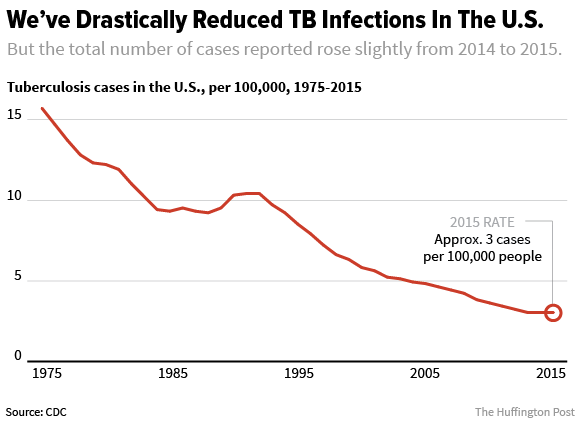
 In 2015, for the first time in 23 years, the CDC has seen an uptick in the number of cases of tuberculosis per 100,000. The number of cases in the United States has steadily decreased, due to diligent screening, and treatment of the disease when it is found.
Today is World TB Day, and there is quite a bit in the news about the disease, including information about the much higher rates of TB in other countries. According to the Centers for Disease Control:
- In 2013, 65% of all TB cases and 90% of multidrug–resistant TB cases in the United States occurred among people born in other countries.
- Nearly 50% of these individuals were born in just five countries.
The CDC also points out a loophole in the screening of legal immigrants, those of temporary foreign workers:
Under the Immigration and Nationality Act, TB screening is required for persons seeking permanent residence in the United States (i.e., immigrants and refugees), but it is not routinely required for nonimmigrants who are issued temporary visas for school or work (3). A portion of the U.S. tourism industry relies on temporary visa holders to accommodate seasonal and fluctuating demand for service personnel (4). This report describes three foreign-born persons holding temporary visas who had infectious TB while working at tourist destinations in the United States during 2012–2014. Multiple factors, including dormitory-style housing, transient work patterns, and diagnostic delays might have contributed to increased opportunity for TB transmission. Clinicians in seasonally driven tourist destinations should be aware of the potential for imported TB disease in foreign-born seasonal workers and promptly report suspected cases to health officials. ….
This report documents three incident cases of infectious TB among foreign-born, temporary workers. In addition to vacation resorts and national parks, sectors of the U.S. tourism industry that rely on temporary visa holders to accommodate the fluctuating and seasonal demand for service personnel include amusement parks, ski lodges, and cultural or historical sites (4). Although the cases described here were counted for the purposes of national TB surveillance, TB incidence among temporary visa holders is difficult to estimate, in part because TB cases are not included in official case counts when a person is in the United States for <90 days (2). Despite this exclusion, approximately two thirds of TB cases in the United States occur among foreign-born persons, and their corresponding TB incidence in 2014 (15.4 cases per 100,000 population) was >10-fold higher than that among U.S.-born persons (1.2 cases per 100,000 population) (2).
TB screening is not routinely required for persons entering the United States as nonimmigrants (3). During 2013, the U.S. Department of State granted temporary admission to approximately 600,000 students and 400,000 temporary workers and their families (7). The length of stay for these students and temporary workers ranged from months to years, depending on visa type (7,8).
Considering the cases we do know about, and the correspondingly much higher rates of infection among the foreign-born when compared to U.S.-born persons, just how many persons who come into the United States illegally are infected with tuberculosis, particularly the drug-resistant strains?
I recently watched a program on American Experience (PBS) called, The Forgotten Plague.  You can watch it on line HERE. Summary provided by PBS:
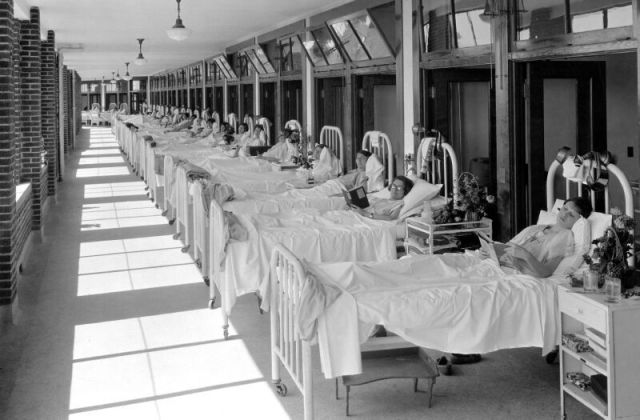
By the dawn of the 19th century, the deadliest killer in human history, tuberculosis, had killed one in seven of all the people who had ever lived. The disease struck America with a vengeance, ravaging communities and touching the lives of almost every family. The battle against the deadly bacteria had a profound and lasting impact on the country. It shaped medical and scientific pursuits, social habits, economic development, western expansion, and government policy. Yet both the disease and its impact are poorly understood: in the words of one writer, tuberculosis is our “forgotten plague.”
I study genealogy, and recently many more old death certificates became available through Ancestry.com. I was struck – just this week – by the number of my ancestors who died of diseases/conditions that are not considered to be serious today, because medical science has discovered their causes, and been able to provide the drugs (primarily) to cure or control them. Tuberculosis (known in the old days as Consumption) was one of the deadliest.
As disease-resistant strains of tuberculosis become more prevalent in the United States, will we once again battle the Forgotten Plague?
 See Also:




 Stella's Place
We’ve managed to quash a number of public health threats, the damages from diseases that are now just footnotes in history are staggering. In 1878 a yellow fever epidemic in Memphis killed some 5000 residents. Now it’s returning to South America, Central America and the Caribbean.
My wife’s hospital has a TB detection program for ll employees due to the incidences of drug resistant TB and when you consider the numbers of physical connections between NOLA the Caribbean and South/Latin America, plus the city’s HIV infection rate, one could presume the city would be a an ideal buffet for these infectious diseases.
Then again I’m just an alarmist at heart.
LikeLiked by 5 people
Those with HIV are the most susceptible to TB infection. I like alarmists. Like the town criers of old.
LikeLiked by 4 people
Anyone with a compromised immunosystem, and folks on steroids ratchet up their susceptibility too. I’ve had docs poo-poo my requests for booster shots for yellow fever, plague, typhoid, they say these diseases are history and shots aren’t needed. Ah well, that 75 mile oneway trip to get those shots at the public health can be worked into a nice seafood lunch on the beach…
LikeLiked by 4 people
I often think about smallpox, too. A weaponized version.
LikeLiked by 3 people
Russians made thousands of gallons of smallpox and not all of it was accounted for when the USSR folded. Thing is that you could make a lot of really effective stuff like salmonella in a reasonably equipped home lab. May not be as immediately effective as small pox but is easier to get hands-on and has a pretty good casualty and social shock rate. Where there’s a will…
LikeLiked by 3 people
No kidding.
LikeLiked by 3 people
Yeah, for decades during the Cold War there were calls from the prog left for the West tovdestroy the very small amounts of small pox virus they had stored. The Us and Russia both claimed small amounts to ge used in case there was ever an outbreak, we could produce vaccine again.
The truth was hidden from the public that the Russians had brewed up a lot more than they claimed to have on hand and every U S president through Bush refused the call to destroy our stocks. Little did we know just how frighteningly large was the the amount they brewed until well after the old regime fell. The good Lord knows who’s brewing up what now.
LikeLiked by 3 people
Why doesn’t that surprise me?
LikeLiked by 3 people
In hindsight, especially how they planned on using it, there wasn’t much we could have done about it so why gove the public more to worry about?
LikeLiked by 3 people
It IS good to know, considering that there will be others who push to have the CDC destroy our stockpile ….
LikeLiked by 3 people
Yes, and they haven’t vaccinated “kids” in over 30 years. Our children will get it – and their’s, guaranteeing the no population growth that the globalists aspire to.
LikeLiked by 3 people
I can’t “like” that comment, WW. I hope that’s wrong. Anyway, our vaccinations are no doubt no longer effective either.
LikeLiked by 3 people
I know that, but I don’t particularly care about ME – the “future” is NOT BEING VACCINATED.
And I know you know what I mean. 😦
LikeLiked by 4 people
VACCINATED or not, introducing people that have not, removing public sanitation practices, and introducing recycled food waste for people to garden in their bathtub, is almost guaranteed to kill of a big swath of public educated city folk..
LikeLiked by 4 people
Exactly.
LikeLiked by 3 people
Was just listening to Dr. Savage. He was talking about just this subject. He said the majority of cases are coming from Asian immigrants. He said that the Philippines is a major breeding ground for TB. He said the same thing about temporary workers. They had some problems on Mackinac Island in Michigan. It is a major tourist destination in the summer and they hire a lot of temporary workers for the restaurants and hotels. One of the cooks from Asian went to California when the season was over and was diagnosed there with TB. They tried to trace the other employees, but most of them had left for parts unknown. The ones they did find, 13 of them showed to be basically pre TB infected. They were able to treat those 13.
LikeLiked by 3 people
From what I’ve read, the Phillipines has a bad problem with TB. If you look into the CDC data, though, Hispanics have TB at five times the rate of white in the United States.
LikeLiked by 4 people
They also have a vaccine resistant version of it. That is what scares me.
LikeLiked by 3 people
Totally resistant. At least the cases that turned up in TX the last couple of years.
LikeLiked by 4 people
I hope it runs rampant in Hi-wi-ya next year when the dillweed heads over there. 😡
LikeLike