First posted in May of 2014, and updated in 2015, this is more relevant than ever. What the government is doing with public lands is planned and, although not new, has been stepped up under the Obama administration.
Particularly pay attention to the information about the Department of the Interior, and the EPA.

“I happen to be one who cheers and supports the Sagebrush Rebellion. Count me in as a rebel.” Ronald Reagan

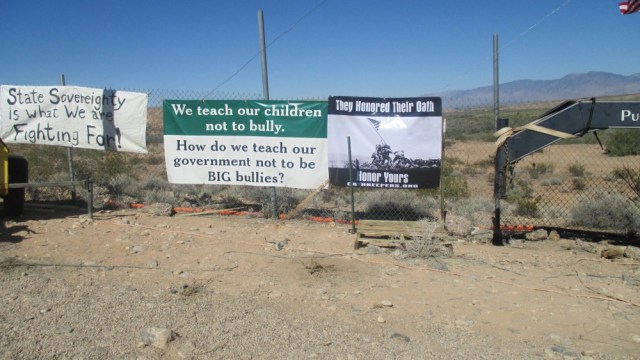
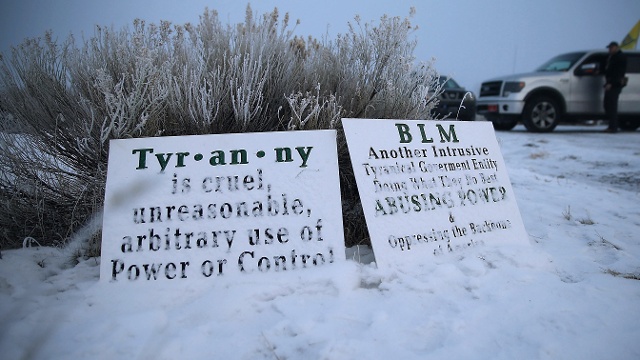
Watching the drama recently on the Bundy ranch and surrounding public land in Nevada, and at the Malheur Wildlife Refuge in Oregon, we may be forgiven if we didn’t remember, or even know, that these are only the most recent skirmishes in a years-long battle over local control of public lands.
The Sagebrush Rebellion began in the late 1970’s as a grass-roots movement of independent ranchers, miners, and other land-working men and women in opposition to the encroachment by tyrannical Federal bureaucrats and increasingly ridiculous federal environmental regulations.
Reagan believed the federal government’s ownership of acres of land is “contrary to the Constitution, it’s contrary to the basic law when the 13 Colonies first came into the Union.” He thought that the ownership of the land should go to the states where local governments can either protect the land, or use it for urban or industrial growth.
Here is a recording of an interview with Reagan in 1976 regarding energy and environmental policy:
A 2014 article at the Reno Gazette Journal, puts the present-day events into perspective. This is a well-known example:
If there’s a poster boy for the Sagebrush Rebellion, it’s arguably Wayne Hage, a Nevada rancher who, along with his survivors, waged a legal battle with the federal government that spanned more than 20 years. His story began in 1991 after the government, contending Hage had defied grazing regulations in Humboldt-Toiyabe National Forest and refused to pay fines for violations, impounded some of his cattle.
Hage sued, insisting the government had violated his right to freely graze on public land and thus had threatened his livelihood. The case wound its way through the courts and, in 2008, two years after Hage’s death, U.S. Claims Court Judge Loren Smith agreed, concluding Hage’s rights had been violated. The judge ordered the government to pay the rancher’s family $4.4 million in what was heralded by many as a major victory for the Sagebrush Rebellion.
That victory, however, was shot down in July 2012 when a three-judge panel of the Federal Circuit Court of Appeals in Washington, D.C., overturned the ruling. Hage’s attorneys are now attempting a new appeal in the case.
“It’s not done yet,” said Mark Pollot, attorney for the Hage estate.
Here is a December, 2015, post about the Hage case in the Environmental Law Prof Blog.
Indeed, it is not done yet.
Neither the Hage case, nor the encroachment by radical environmentalists – not just into public lands in the West, but private lands all over the United States.
As William Perry Pendley said in April 2014 at a Hillsdale College event in Colorado Springs, CO:
What has been most lacking in the reporting on these stories is the background of the disputes. And it should be stated up front, in all fairness, that the Obama administration is not unique in pursuing policies anathema to Westerners. On that score, it has simply followed the examples of the Carter and Clinton administrations.
In the late 1970s, President Carter’s “War on the West” spawned what came to be known as the Sagebrush Rebellion, which Ronald Reagan embraced during his campaign for president in 1980: “I happen to be one who cheers and supports the Sagebrush Rebellion,” candidate Reagan proclaimed in a speech in Salt Lake City. “Count me in as a rebel.” The uprising was spurred by the fact that, more than any other region, the American West had been victimized by the environmental policies implemented—utterly regardless of their destructive economic and human consequences—during the previous two decades. Reagan had seen firsthand the transformation of the environmental movement from one of conservation and stewardship, in which the part played by human beings and technology was vital, to a movement in which humans and technology were understood to be enemies of nature. As articulated by Reagan, opposition to extreme environmentalism represented a return to true environmentalism.
Mr. Pendley explains very well how the Federal Government and radical environmentalists work hand in hand to restrict use of public lands:
A typical way these policies get implemented is for environmental interest groups to sue a government agency under either the National Environmental Policy Act (NEPA) or the Endangered Species Act (ESA), and for the agency then to settle the lawsuit in the interest group’s favor. Sometimes—as in a 2008 lawsuit filed against the U.S. Forest Service by three environmental groups to prevent oil, gas, and mineral extraction in Pennsylvania—the government not only settles the lawsuit but also pays the interest groups for their complaints (in that case paying out nearly $20,000). Just last month, Oklahoma Attorney General Scott Pruitt filed a lawsuit against the Interior Department and the U.S. Fish and Wildlife Service over such “sue and settle” tactics following an ESA lawsuit by a group called Wild Earth Guardians that sought to restrict land use for agriculture, oil and gas drilling, wind farms, and other activities in a five-state area—Oklahoma, Texas, Colorado, New Mexico, and Kansas—inhabited by the lesser prairie chicken. “These settlements,” Pruitt said in a statement, “impose tougher regulations and shorter timelines than those imposed by Congress,” and thus violate the rule of law. “Oklahoma has indicated its willingness to protect the lesser prairie chicken,” he added, “but it seems increasingly clear this issue isn’t about sound science or saving endangered species.”

Lesser Prairie Chicken
These tactics are used today primarily to hamper oil and gas exploration and extraction throughout the country. Mr. Pendley reports that:
According to the Congressional Research Service, from 2009 through 2013, oil and natural gas production on private land was up 61 percent and 33 percent, respectively; on federal lands, by contrast, oil production was down eleven percent and gas production was down 28 percent. This is no mere coincidence. The Monterey/Santos oil field in California is estimated to hold more than twice the oil of the Bakken oil field in North Dakota and the Eagle Ford oil field in west Texas combined, but its development is on hold because federal lands are involved.
Now, Department of Interior Secretary Sally Jewell has spoken publicly, inferring that the Obama administration would use the Antiquities Act of 1906 to unilaterally designate new National Monuments without Congressional approval or local input, the intent being to prevent economic activity on said lands. Jewell’s most extreme and outrageous act to date was to sign off on a decision by the EPA to put a million acres of Wyoming land—including the entire town of Riverton, Wyoming, with a population of over 10,000—into the Wind River Indian Reservation, despite the indisputable historical fact that this land was ceded to the U.S. in a 1904 agreement between the United States and the Tribes See NewsMax report.
If you have any doubt about the tactics used by the EPA, please watch this video of an EPA training session:
Text of the video is as follows:
“But as I said, oil and gas is an enforcement priority, it’s one of seven, so we are going to spend a fair amount of time looking at oil and gas production. And I gave, I was in a meeting once and I gave an analogy to my staff about my philosophy of enforcement, and I think it was probably a little crude and maybe not appropriate for the meeting but I’ll go ahead and tell you what I said. It was kind of like how the Romans used to conquer little villages in the Mediterranean. They’d go into a little Turkish town somewhere, they’d find the first five guys they saw and they would crucify them. And then you know that town was really easy to manage for the next few years. And so you make examples out of people who are in this case not compliant with the law. Find people who are not compliant with the law, and you hit them as hard as you can and you make examples out of them, and there is a deterrent effect there. And, companies that are smart see that, they don’t want to play that game, and they decide at that point that it’s time to clean up. And, that won’t happen unless you have somebody out there making examples of people. So you go out, you look at an industry, you find people violating the law, you go aggressively after them. And we do have some pretty effective enforcement tools. Compliance can get very high, very, very quickly. That’s what these companies respond to is both their public image but also financial pressure. So you put some financial pressure on a company, you get other people in that industry to clean up very quickly. So, that’s our general philosophy.”
I urge you to read Mr. Pendley’s complete presentation, and you may find the contents shocking. He says in conclusion:
It is little wonder that there is talk of another Sagebrush Rebellion like that embraced by Ronald Reagan in the late 1970s. Westerners know they deserve better, and that they and their states can be better stewards of their land than federal bureaucrats.
Indeed. There is little wonder at all.






 Stella's Place
I wish this information was in everybody’s hands.
LikeLiked by 3 people
I’ve been looking for months now a stack of papers I have that list every farmer/rancher in every state that has faced the wrath of the government, environmental groups and animal rights group, dating back to the 70’s.
When we bought our current place I misplaced it somewhere in the move. It’s just my own collection of newspaper clippings, magazine articles and information passed out at meetings over the years.
I didn’t come by my distrust of government, these groups and yes many in LE on a conspiracy theory. It is why I always tell people to know who the heck in your county is wearing a badge because they often are the people who either out of ignorance or malice will carry out the orders. If government or one of these groups target you then you are found guilty without a trial and the media will help them all convict you and take everything you own in the process.
What we’re seeing now with the Bundys is just the latest victims.
LikeLiked by 3 people
It shall continue until laws are changed, repealed and not replaced. That is going to take a long time. If ever. Trump is a starting point. The legislature has surrendered much authority to the executive. He is the best bet to address this stuff quickly. The Bundy’s have raised attention to it but will end up in jail and court for years. Bad tactics, good issue. They should study the law first, then take every advantage of it. Even if a law is “unconstitutional” it is binding if it is enforceable, until repealed or overturned. But there are always exceptions and ways to fight. Legally. IMO.
LikeLike
That is the problem it has been fought legally in the courts for over 30 years. Numerous ranchers have taken that route. Ranchers have tried, like many of us to elect politicians that made empty promises.
It will never change using the courts, that has been proven over and over, even when they win court battles the EPA or the BLM or their partners in crime, groups becoming rich off taxpayers money continue their illegal ways on top of finding new “issues” to sue over.
When those on the government side break the law that is not only unconstitutional but criminal according to the current laws they are rewarded. When ranchers do things legally, like the Hammonds they are put in jail. When men like the Bundys, I guess who break the law, although technically following the constitution they are jailed and killed.
Meanwhile, more ranchers and more farmers disappear. Big ag who have the money to buy off politicians grows larger. Not that I’m saying there isn’t a place for big ag because even at current numbers there are not enough farmers and ranchers to feed everyone. I’m not even saying all big ag is bad.
Make no mistake though this isn’t just a battle in the West where the government holds so much land. This battle is not just waged on cattle ranchers. To be perfectly honest the government has won over half of that battle, the ranchers in the west have became a very small few compared to 40 years ago.
LikeLike
I’ve read what seems to be hundreds of articles about this sue and settle crap it makes my blood boil. Yet not one red-blooded republican has really stood up and said anything about it since Ronaldus Magnus.
LikeLiked by 2 people
If they do not “impede” the feds from their normal work they can stay on BLM land for two weeks at a time legally in one spot. They they have to move to another spot.
LikeLike
Just part of the Obama/Clinton/RINO/gGlobalist/Leftist War on America.
LikeLike
Don’t forget Russia, Hillary and uranium.
Cash Flowed to Clinton Foundation Amid Russian Uranium Deal
The headline on the website Pravda trumpeted President Vladimir V. Putin’s latest coup, its nationalistic fervor recalling an era when its precursor served as the official mouthpiece of the Kremlin: “Russian Nuclear Energy Conquers the World.”
The article, in January 2013, detailed how the Russian atomic energy agency, Rosatom, had taken over a Canadian company with uranium-mining stakes stretching from Central Asia to the American West. The deal made Rosatom one of the world’s largest uranium producers and brought Mr. Putin closer to his goal of controlling much of the global uranium supply chain.
But the untold story behind that story is one that involves not just the Russian president, but also a former American president and a woman who would like to be the next one.
At the heart of the tale are several men, leaders of the Canadian mining industry, who have been major donors to the charitable endeavors of former President Bill Clinton and his family. Members of that group built, financed and eventually sold off to the Russians a company that would become known as Uranium One.
Beyond mines in Kazakhstan that are among the most lucrative in the world, the sale gave the Russians control of one-fifth of all uranium production capacity in the United States. Since uranium is considered a strategic asset, with implications for national security, the deal had to be approved by a committee composed of representatives from a number of United States government agencies. Among the agencies that eventually signed off was the State Department, then headed by Mr. Clinton’s wife, Hillary Rodham Clinton.
Someone might want to save both articles.
LikeLike