
 Last week I got my DNA results from ancestrydna. Not too many surprises, but some. For instance, about 2% of my regional origins seems to be the Caucasus. Probably the results of a war fought by a long dead ancestor; spoils and all that. Also some of the old folks seem to hail from Italy and/or Greece. Still, the biggest contributors to ME came from Germany, Scotland, England and Ireland, which was no surprise.
Most of us are curious about our ancestors – who they were, what they did, what kind of world did they live in? We want to know because those who came before us determined, in great part, what and who we are today.
When you set out to dig into the past, you often find things you didn’t expect, both in the past and in the present day, too. Sometimes you find things that were hidden because nobody wanted to talk about them, and sometimes you find out that the stories you were told, or you remember, aren’t exactly what really happened.
I have been doing genealogy research regularly and fairly seriously for at least ten years now. Digging through public records, family documents and photographs, talking with close family members and more distant relatives, and even shirttail relations met during the search.
My search began casually around the time of my mothers 90th birthday, in 1996, while my daughter and I prepared her birthday celebration. We had a big party with many relatives and friends, and had an attendance of about 75 people from all over the United States.
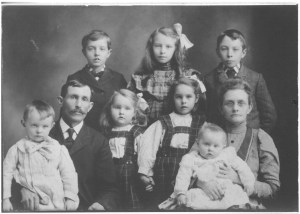
As part of that celebration, my daughter and her then fiance, now husband, and who is a graphic designer by profession, gathered pictures, stories and family letters and remembrances into a rather professional looking book that was distributed to members of the family as a keepsake. My daughter interviewed her grandmother, and went through our considerable hoard of family photos with her to identify who, what, when and where. We asked family members to write their own remembrances, which were also included in the book, and the fact that my mother wrote poems and stories about everything family made the book all that more interesting. The book is titled, “Treasures of Age”, taken from a poem that my mother wrote. This research proved to be invaluable when I began to seriously set down the facts about my family. Because of the photo i.d.’s, I could put a face on many of them too.
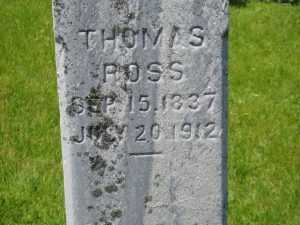
I had been photographing gravestones in our family plots, photos that my daughter refers to as my “dead” pictures, when I accompanied my mother to decorate the graves on Memorial Day. I have continued that practice over the years, expanding the list of cemeteries that I visit to search out more members of the family.
All of the preceding is to explain how I started my own family investigations, and most people do pretty much the same thing I did. Once you get a good base for your family tree, things progress more slowly, but steadily, as you find new facts and new databases become available. Without the internet, the extensive investigations of our family histories would not exist.
I personally have an Ancestry.com membership, and several family trees. My main tree now has more than 3,500 members, but it also includes my daughter’s father’s family. I also chose to include many relatives not in my direct line.
My tree exists on line, but is also synched to a copy on my hard drive, using Family Tree Maker software. It is possible to download your Tree data into a GEDCOM file, short for GEnealogical Data COMmunications. In simple terms it is a method of formatting your family tree data into a text file which can be easily read and converted by any genealogy software program. The GEDCOM specification was originally developed in 1985 and is owned and managed by the Family History Department of the Church of Jesus Christ of Latter Day Saints.

In case you are not aware, much of the data available on line is there because of the Mormons. The church has a huge database, and founded Ancestry.com (now a publicly- owned company). FamilySearch.org (free) is also Mormon owned. Members of the Church of Jesus Christ of Latter-day Saints, usually referred to as Mormons, place great emphasis on genealogical research. This is because their Church doctrine states that “saving ordinances” (including baptism, confirmation, endowment, and sealing-marriage) must be made available to every individual who has ever lived.
To make these ordinances available to people who did not have the opportunity while living, Mormons identify their ancestors and arrange for baptism and other ordinances to be performed for them by proxy – that is, with a living person standing in for the deceased person in a temple. Often referred to as temple work, this search for ancestors is an important part of the Mormon faith. Some people find this odd. Personally, I’m glad to have easy access to information that would otherwise be difficult, if not impossible, to obtain.
If you aren’t currently searching for family information, but are interested in doing so, here is a beginner’s guide:
http://genealogy.about.com/cs/beginnerscorner/ht/family_tree.htm
I must warn you. You could get a big surprise while doing family research, and it might (or might not) be a happy one. You might also be one of those who becomes addicted to the pursuit of family knowledge, so that you will do research for distant relatives and even friends. Don’t ask me how I know this. You will probably also make new friends and acquaintances as a byproduct of your quest.
Every once in a while, I make a significant discovery. My father was estranged from his family for years, starting before I was born, and talked little about them, so my primary discoveries have been about his family. He died in 1976, so he wasn’t around to ask questions of when I started searching.
For years I could not find my paternal grandmother past the early 1930’s. Recently, I found her grave location, and through that (via the Find-A-Grave network), I discovered her second married name, her second husband’s identity, and when and where she died. Armed with that information, I sent away for a copy of her death certificate. I was shocked to discover that she died at the age of 62 as a result of an apparent suicide – ingesting ant poison.
I still haven’t traced my paternal grandfather past about 1935. He seems to have dropped off the face of the earth during the depression. He and my grandmother divorced at the end of the 1920’s. My father married, had a family, and divorced in the 1930’s. The reasons for family estrangement are a mystery. Dad moved to a new state, met my mother, and remarried in 1941. I came along a few years after that.
In 2005, via an Ancestry.com connection, I found my two paternal half brothers, and a number of living cousins I didn’t know existed. One of my brothers, Bill, died just before the discovery, but my other brother, Glenn, and I have forged a friendship, visiting each other several times over the years (he lives on the West Coast). It is a relationship that I cherish, as my two maternal half siblings both died in the 1980’s. I am MUCH younger than my siblings, but Glenn is the closest in age, being only 16 years older than I am.
Anyway, feel free to share your experiences, ask questions, or otherwise comment on the wisdom (or not) and practice of genealogy.




 Stella's Place
Fascinating. My MIL has been addicted to her ancestry.com tree, too. It led my DH to delve into military records to find out what really happened to a relative who died in a bombing raid over Germany. (He was an AF bombing crew member) so he got the bug, too. We also found out when my DH started researching applying for Polish citizenship, that his grandparents were not born in Poland, as we always thought, but in New Jersey and were taken back to Poland when they were toddlers, only to return when they were teens and met in New York. So he found out his American roots go back further than he thought and that even though born in the US, Polish was their first language and the language they spoke at home, so my DH always assumed (as did his Dad) that they were born in Poland and immigrated here later.
I do have one question – what is a “shirt tail” relative?
LikeLiked by 2 people
Shirt tail (to me) is someone who is related, but that I don’t know very well. Like my second cousins (I now know some of them, but didn’t when I was growing up). We had the same great grandparents.
LikeLiked by 3 people
Thanks for clearing that up.
LikeLiked by 1 person
The earliest family name male in my line died in Craven County, South Carolina in 1745. The courthouse that housed previous records was burned during the Revolutionary War so no one in the family has been able to trace back any further.
Our family married into the Witherspoon family in the late 1770’s and you can trace that family tree back to the 1200’s easily.
Robert the Bruce
John Knox
so on and so on
LikeLiked by 2 people
Very cool. On my mom’s side, they are Loyalists who lived in Virginia/Maryland and had to flee to Canada. So when I went for my interview for my Green Card, I asked why I had to do all this paperwork … I was just here to collect our “stuff” we were promised we could come back and get as part of the Treaty of Versailles. 😉 Luckily my interviewing officer had a sense of humor.
LikeLiked by 1 person
Two branches on my mother’s side were Loyalists (Scots) who left New York for eastern Ontario after the Revolution. Incidentally, both had also fought with the English at the Battle of Montreal.
LikeLiked by 1 person
This is interesting, I spent 17 years working on the wrong branch of the family. Finally found a copy of the book, and we were not listed. So back to square one the last 10 have been reveling, four brothers arrived in Baltimore 1734, migrated north and west. Now I’m working on supporting documents in order to write the history.
LikeLiked by 3 people
Getting the supporting documents that far back is difficult, particularly if you have a common name. I can get back to 1792 on my maternal grandfather’s side, but no further.
LikeLiked by 1 person
Colonel is a pretty common name, especially for those who spend a lot of time in the military. 😉
LikeLiked by 3 people
Hi Stella! I like your new place!
A quick word on research for veterans or those seeking information on departed family veterans…
The national archives http://www.archives.gov/veterans/ has more than you’d imagine…
The American Battlefields Monuments commission has…. https://www.abmc.gov/database-search
And there is always the FOIA route… try http://www.muckrock.com to get a start on the process and how to go about it. My tip is, “ask specific questions”. Ask questions that are reasonably within purview. Understand that some records have been destroyed or damaged over time. For instance, don’t hold your breath trying to find records from the last few months of WW2 in Germany.
I wish you all the best in your cozy new digital cabin!
-PZ
LikeLiked by 2 people
Thank you for your good wishes, partyzantski! And for the good information too.
LikeLiked by 1 person
Stella,
The FOIA information that came back for the search for what happened to my Uncle was quite detailed.
Copies of notes from surviving crewmembers, graves registration information, POW information and more.
I learned quite a bit about WW2 German air defenses and how they organized. I was able to actually sort out what pilot and unit shot down the B-24. Apparently, the gun camera footage was captured at the end of the war and resides in the National Archives.
I have tracked down the graves of all the men as a sort of coda to the whole. Still can’t find one of them.
This was a task of filling an incompleteness. I cannot say that it was joyful, but I felt a debt to the men and hope that in some small way I can preserve their memory. A cousin of mine has done much work that was foundational.
There is a museum of the 8th Air Force, http://mightyeighth.org/ in Pooler, Georgia just east of I-95. Perhaps I’ll visit it sometime.
LikeLiked by 2 people
So…. (Trump voice here) I had a cousin contact me tonight about a long-gone great uncle. The short story of his BEING there is very interesting. He was a Methodist preacher in the throes of the Depression He took a job as a prison guard to support his wife, 4 daughters, his sister and her daughter on a cruddy island called Alcatraz.
No need for condolences or any of that crap – this is just the back-story of how teh Momma spent a year or so on the Island where Al Capone could baby-sit and make ya’z a jewelry box and the snails were the size of your head.
http://www.bop.gov/about/history/hero_cline.jsp?i=6
LikeLiked by 2 people
I’ve heard some pretty good stories in my day, but that is something else.
LikeLiked by 2 people
I’ve got a picture of teh Momma about 3-4ish, taken by Al Capone. He was a trustee (they din’t know about syphilis, I guess….. 🙄 ) Don’t have a scanner. Yet.
But! Since Uncle Royal was the woodworking guru at the time I do have pics of the poor jewelry box as it exists today. Since I’m sittin’ here looking at it.
Inlay all over, obviously in bad shape. I’m not into wood restoration because I don’t know how.
The End.
LikeLiked by 2 people
I got nothin’ for that. Nor can I work wood. Never been much of a criminal either. My printer/scanner ain’t workin’ right now either. What’s the point of it all. 😉 🙄
LikeLiked by 2 people
Gimme a minute…..
Here’s the top –
And, here’s the body of it – real bad shape. But, hey. Teh Momma didn’t get Valentine’s Day’d over it.. 😀 Her – he liked.
LikeLiked by 3 people
That is awesome! 😀
LikeLiked by 1 person
This is one o’ them “this is no _ _ _ _ you guys,” stories that nobody ever believes. Iz OK. I am SURE I am much healthier for it. I iz still breathing.
LikeLiked by 1 person
Blaeu Atlas Maior, 1662-5
This stunning Atlas is the latest fully zoomable addition to our online archive.
Joan Blaeu’s Atlas Maior of 1662-1665 is one of the largest and most splendid of the multi-volume Dutch world atlases. Its 594 maps and 3,368 pages of text spread over 11 volumes collectively presented the state of geographic knowledge of the world in the mid-17th century.
The Atlas Maior was the most expensive book that could be acquired in the mid-17th century — a lavish and splendid item for display by its wealthy customers.
http://maps.nls.uk/atlas/blaeu-maior/
LikeLiked by 1 person