
 This is a post originally done in 2013.
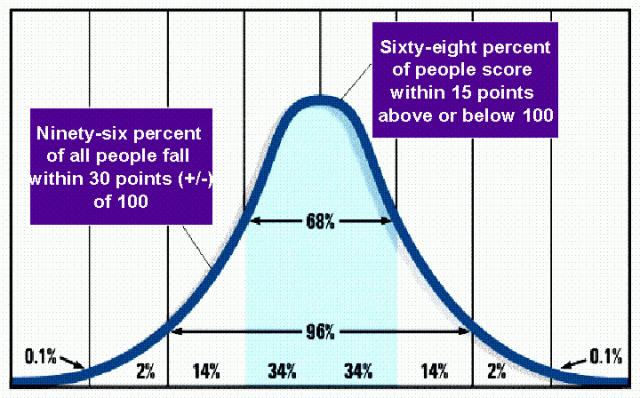
I say, “The Truth Will Set You Free”, and ask the question, as does the author of this Politico piece, Why Can’t We Talk About IQ?
The author, Jason Richwine, is a public policy analyst in Washington DC, and wrote his Harvard Ph.D. dissertation about IQ test results of various ethnic/racial groups. As he explains it, In brief, my dissertation shows that recent immigrants score lower than U.S.-born whites on a variety of cognitive tests. Using statistical analysis, it suggests that the test-score differential is due primarily to a real cognitive deficit rather than to culture or language bias. It analyzes how that deficit could affect socioeconomic assimilation, and concludes by exploring how IQ selection might be incorporated, as one factor among many, into immigration policy.
Remember Larry Summers? He was the president of Harvard University, who said in 2005 that women might not be as naturally gifted in math and science as men. As a result of this remark, an uproar occurred, eventually leading to him being ousted from the university.
Mr. Richwine continues –
Because a large number of recent immigrants are from Latin America, I reviewed the literature showing that Hispanic IQ scores fall between white and black scores in the United States. This fact isn’t controversial among experts, but citing it seems to have fueled much of the media backlash.
And what a backlash it was. It started back in May when I coauthored an unrelated study that estimates the fiscal cost of granting amnesty to illegal immigrants. Opponents seeking to discredit that study pointed to my dissertation, and the firestorm was lit. Reporters pulled the dissertation quotes they found “shocking” and featured them in news stories about anti-immigration extremism. Well-established scientific findings were treated as self-evidently wrong — and likely the product of bigotry.
The media reporting is useless, as they know nothing about the science, don’t want to know, have their fingers in their ears and hands over their eyes, don’t bother to check the science, and use the reporting of studies such as this one as a platform for editorializing about racism and to throw ad hominem attacks at the scientists who do the studies and have the temerity to report them.
He continues,
But it’s difficult to have a mature policy conversation when other journalists are doing little more than name-calling. It’s like convening a scientific conference on the causes of autism, only to have the participants drowned out by anti-vaccine protesters.
For too many people confronted with IQ issues, emotion trumps reason. Some are even angry that I never apologized for my work. I find that sentiment baffling. Apologize for stating empirical facts relevant to public policy? I could never be so craven. And apologize to whom — people who don’t like those facts? The demands for an apology illustrate the emotionalism that often governs our political discourse.
Why tell the truth about IQ difference between ethnic/racial groups? As the author says, Cognitive differences can inform our understanding of a number of policy issues — everything from education, to military recruitment, to employment discrimination to, yes, immigration. Start treating the science of mental ability seriously, and both political discourse and public policy will be better for it. Continue Reading Jason Richwine at Politico
Something else I read recently (HT to Philip N. at Facebook). The myth of “they weren’t ever taught….”
The question here is, are teachers not doing a good job of teaching math concepts, or are the kids not intellectually able to understand and retain what has been taught?
The author, a math teacher, explains:
They see progress in the areas they review—until they realize that the kids now have lost knowledge in the areas that weren’t being taught for the first time or in review, much as if the new activity caused them to overwrite the original files with the new information.
At some point, all teachers realize they are playing Whack-a-Mole in reverse, that the moles are never all up. Any new learning seems to overwrite or at best confuse the old learning, like an insufficient hard drive.
That’s when they get it: the kids were taught. They just forgot it all, just as they’re going to forget what they were taught this year.
All over America, teachers reach this moment of epiphany. Think of a double mirror shot, an look of shocked comprehension on an infinity of teachers who come to the awful truth.
End Stage One and the algebra specificity.
Stage Two: At this point, some teachers quit. But for the rest, their reaction to Stage One takes one of two paths.
The two paths taken? The first is to blame the students. The second is acceptance. The author has taken the second path. He continues:
Here, I do not refer to teachers who show movies all day, but teachers who realize that Whack-a-Mole is what it’s going to be. They adjust. Many, but not all, accept that cognitive ability is the root cause of this learning and forgetting (some blame poverty, still others can’t figure it out and don’t try). They try to find a path from the kids’ current knowledge to the demands of the course at hand, and the best ones try to find a way to craft the teaching so that the kids remember a few core ideas.
On the other hand, these teachers are clearly “lowering expectations” for their students.
And concludes, as follows:
Teachers know something that educational policy folk of all stripes seem incapable of recognizing: it’s the students, not the teachers. They have been taught. And why they don’t remember is an issue we really should start to treat as a key piece of the puzzle.
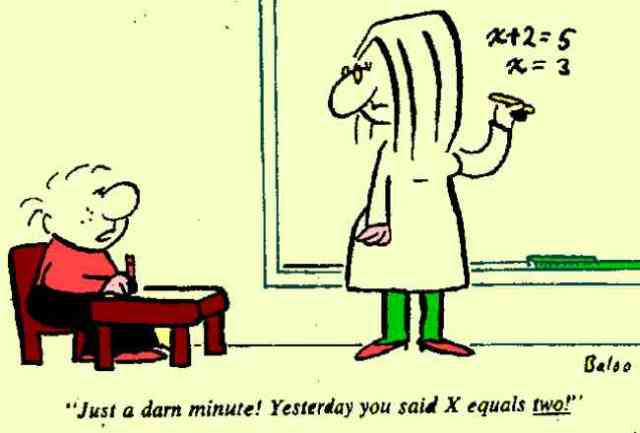
A year later, the author continues with this piece, Two Math Teachers Talk.
The problem, as outlined in his original piece, is going to be “solved” by Common Core (yes, the author finds this idea as abhorrent and amusing as we do):
“Jesus, Ed, I’ve wondered why we’re pulling this Common Core crap, but not in my deepest, most cynical moments did I think it because they thought we teachers just might not know what to teach the kids.”
“That’s not the most depressing, cynical thought. Really cynical is that everyone knows it won’t work but the feds need to push the can—the acknowledgement that achievement gaps are largely cognitive—down the road a few more years, and everyone else sees this as a way to scam government dollars.”
“New textbooks! New PD. A pretense that technology can help!”
For more on this subject, read about The Bell Curve: Intelligence and Class Structure in American Life
a 1994 book by American psychologist Richard J. Herrnstein (who died before the book was released) and American political scientist Charles Murray. Its central argument is that human intelligence is substantially influenced by both inherited and environmental factors and is a better predictor of many personal dynamics, including financial income, job performance, chance of unwanted pregnancy, and involvement in crime than are an individual’s parental socioeconomic status, or education level. The book also argues that those with high intelligence, the “cognitive elite”, are becoming separated from those of average and below-average intelligence, and that this is a dangerous social trend with the United States moving toward a more divided society similar to that in Latin America.




 Stella's Place

Back in the late 1980’s I had a very wise and observant boss, quite a fine mentor for me. He told me that in his opinion the world had always had plenty of blue collar workers who were very intelligent and able craftsmen. He observed that those intelligent workers, those who could think and work independently and produce high quality results, were in short supply then, and going to be harder and harder to find in the future. He said there were going to be fewer workers who could oversee jobs, get results, and almost no true artisans like the old stone cutters and masons German immigrants used to be so famous for. He predicted that white collar supervises with inadequate knowledge of trades would have to step in to supervisory positions, and that truly capable and knowledgeable craftsmen would be in demand and short supply in a generation. I think he has been proven right.
Not exactly on point with your post, but that’s the memory it stirred for me.
LikeLiked by 4 people
I think that most public school systems have wandered further and further from the practical education of the students who are entrusted to them. So many schools are pushing everyone on a college track, while ignoring the need of those students who would be better suited to a trade.
There just are not enough jobs for those who have little or no training, too few jobs for the college liberal arts graduates, and too few skilled workers. Our educational “professionals” have let down the students in their charge.
LikeLiked by 2 people
I don’t know, Stella – even when I was a kid in elementary school they were “dumbing down” the brighter few in the class in order to attempt to let the laggards catch up. Later on, when “magnet” schools came into being it wasn’t much better as now they must teach in Spanglish. It’s something my mother griped about the entire time that we were in publick schooling.
I could read, write (simply) and practiced cursive before I went to first grade, as did my child. Both of us were told to sit down, shut up and were basically ignored the rest of the year until the others learned not to pee in their desk seats, not to eat the crayons and not to comment when the noob teacher refreshed her makeup during naptime.
I must make a disclaimer on my part – I came from one parental unit and two grandparental units being teachers – I didn’t have a chance! 😀
LikeLiked by 2 people
My DD could read in kindergarten (well). When she hit first grade, she and another young girl were like fish out of water (like you). Since it was a private (Baptist) school, they would go to the 3rd grade classroom for reading lessons, rather than holding them back. They didn’t like it much (because of the social aspect), but it was the best solution at the time.
LikeLiked by 3 people
I’ll add that my original comment was made thinking of high school level, rather than grade school.
LikeLiked by 3 people
And the current system has no recognition for different learning styles and aptitude. My brother is wicked smart and got accepted into one of Canada’s top engineering schools to study computer science waaaay back when, at the time before computers as an everyday household item had yet to take off. They were still pricey and geared towards industry and business.
Anyway, he quit after the first semester and went to a trade school, studying instrumentation and other skills tangential to computers. He built a small business building custom computers in his garage for clients. Etc. Anyways, he’s a college dropout but far more successful than the majority of our extended family who have useless college degrees from the “right” schools. They also earn significantly less than he does.
I’m of the mind that we need to go more to the German-Swiss model: there are academic institutions for esoteric theoretical learning, technical universities for the hard sciences, including medicine and engineering, and a wide variety of apprenticeships and directed learning for skilled trades.
LikeLiked by 5 people
My husband has an uncle by marriage that was basically a lifetime student. He was a college professor before he finally retired, but he also continued also taking college courses and has several degrees. It’s honestly a good thing for him that he could work as a professor because that’s about all he could ever do. He could up until a few years ago still recite just about anything from a book, yet he couldn’t apply that to actually doing it. If it wasn’t for my husband’s aunt he literally would not have even been able to tie his shoes. He is probably the strangest person I’ve ever met.
He could tell you every part in a washing machine and how each part made the machine work, yet he couldn’t figure out how to turn it on. The same with a lawnmower, yet he couldn’t start a push mower no matter how many times you showed him how.
Once when they were moving he had to call and ask for help because he couldn’t understand how to unhook his washing machine or how to go about moving them with a dolly.
Trying to have a normal conversation with him was impossible.
What is strange though is my husband’s father always said that when his sister married him he wasn’t that way, he could actually do things for himself, but the more educated he became the more stupid he became.
LikeLiked by 4 people
The cultural marxists have done a great job of making any discussion about IQ and race a heresy, as part of the plan to further foment resentment and division.
What I do know that as we do more and more research, our understanding of the genetic differences between groups is increasing, and we are becoming more aware that there are profound and meaningful differences.
When we deny these differences and how they impact individuals, we create a whole lot of misery. In the academic sphere, this translates into what has been termed “academic mismatch”.
I agree that we need to return to a system where people are matched more appropriately to their ability level as well as their interests, and to stop the fiction that if you don’t have a college degree, you’re a failure. We would all be much better served if people found work that matched their temperment and cognitive strengths so everyone felt they were making a contribution to the community at large. Work, paid and volunteer, and contributing, is important to one’s sense of self not only for monetary reasons, but for social ones as well.
The first colony in Jamestown in the 1600’s is a wonderful example. The aristocrats and their academic entourage were struggling to survive because everyone was a theortician. In the end, they were forced to compromise their high-falutin’ “principals” and import skilled tradesman “others” from Poland, who had the skill set required for the colony to thrive – glass-making, brickmaking and laying, agriculture, milling, etc. In spite of this, the Poles were never fully integrated into the Jamestown colony and denied opportunities to run for political office, etc because they were Catholic and non-English. However, had it not been for the Poles and their knowledge base of practical skills, the colony would not have survived.
http://www.polishamericancenter.org/FirstSettlers.html
On the black-white divide in American politics, Rushton and Jensen were both excoriated for their work in this area, however, their analysis has held up over time:
Click to access Rushton-Jensen-reply-to-commentaries-on-30years.pdf
LikeLiked by 4 people
All day I’ve been coming back to this thread with the intent to write something, but then I realize it’s going to be loooooong and most likely TMI.
So in short, public education has become increasingly worse since the Prussian/German model was copied and inflicted upon the US in the late 1870’s. By the 19-teen’s all states had laws forcing children into public schools. First it was just completing grammar school (I think kids still get a diploma after 5th grade in some states), and they began pushing high school completion, stating you couldn’t get a good job without a HS diploma (just like they do with a college degree now). Then HS completion became mandatory by law.
Progressives educated in one generation have found work in education and create the next generation of even worse progressives.
LikeLiked by 2 people
When this discussion comes up with folks in the real world, I ask them why are Americans so advanced, why have we invented so much in such a short period of time when so many civilizations that have been around so much longer are still third world countries. After some hand ringing the answer is usually our natural resources, I hear even the early Americans had easy access to fresh water and other plentiful resources.
Then I ask “Then why the heck didn’t Native American’s have the wheel and axel or make significant use of domesticated animals?”
LikeLiked by 2 people
This topic is like a hot coal for me.
The industrial education complex is not designed to educate, it is designed to pass funds to select constituencies.
Consider all the reworking of instruction… common core, “new math” and all that tripe. Paradoxically, the less the children learn, the more teachers and administrators are needed…. mass immigration drive new schools getting built, which are an inescapable tax burden.
Math does not change. Physics, Chemistry… The building blocks are the same throughout time. Obfuscation and confusion as a matter of policy is unconscionable.
LikeLiked by 3 people