
“Right” and “Wrong” are only seldomly relevant in the analysis, and the law has a tolerance for alleged “mistakes” by law enforcement in fast moving and confusing situations.
Before anyone can FAIRLY evaluate the death of Alex Pretti in Minneapolis, a THOROUGH understanding of the law on the question of “excessive use of force” is necessary. Facts are evaluated in light of the law, not the other way around — the law is not molded to fit the facts.
Before even looking at the facts — disputed and otherwise — regarding the Minneapolis shooting, what the law considers important must be understood.
There is no shortage of legal precedents on “use of force” claims. The level of force used by law enforcement is irrelevant — the question is always distilled down to whether the use of force was “reasonable” from an objective point of view — would a “reasonable officer” faced with the same circumstances have reacted in the same manner?
Two aspects of this question are of the utmost importance:
The review cannot benefit from the application of “20/20 hindsight.”
In almost every situation there is more than one “reasonable” reaction.
The factual scenario here is that several officers were involved in an effort to subdue a subject while in the process of placing him under arrest. During the course of that conduct, one or more officers resorted to the use of deadly force.
The fact that deadly force was used does not alter the analysis — it is no different than if a level of non-lethal force was used that resulted in the subject suffering a broken arm. The analysis remains “Was the force used reasonable under the totality of circumstances, as viewed from the objective perspective of a reasonable officer?”
In 1989 the Supreme Court decided Graham v. Connor, a case involving a “detention” of Graham where he alleged an excessive level of force was used against him by a collection of officers. Graham suffered a broken foot, cuts on his wrists, a bruised forehead, and injuries to his shoulder. After several minutes in detention, Graham was released when the officers’ investigation revealed he had not been involved in any suspicious activity.
Prior to Conner, excessive force claims were often reviewed as part of a “substantive due process” analysis, one part of that involved the state of mind of the officer — was he acting in “good faith” in the choice of what force to use, or was the level of force used “maliciously and sadistically for the very purpose of causing harm.”
Connor rejected that approach, eliminated the subjective intentions or motives of the officer involved in the use of force, and substituted a “reasonable officer” standard who is faced with the same set of circumstances — how would that person respond?
The circumstances here are simple in this regard — the use of deadly force by law enforcement in the process of making an arrest is a “seizure” under the Fourth Amendment. Connor v. Graham placed all “excessive force” claims under the Fourth Amendment — no longer recognizing a generic “constitutional” right to be free from excessive force as part of “substantive due process.”
Today we make explicit what was implicit … and hold that all claims that law enforcement officers have used excessive force — deadly or not — in the course of an arrest, investigatory stop, or other “seizure” of a free citizen should be analyzed under the Fourth Amendment and its “reasonableness” standard…. not the more generalized notion of “substantive due process,” must be the guide for analyzing these claims.
Determining whether the force used to effect a particular seizure is “reasonable” under the Fourth Amendment requires a careful balancing of “the nature and quality of the intrusion on the individual’s Fourth Amendment interests’” against the countervailing governmental interests at stake…. Our Fourth Amendment jurisprudence has long recognized that the right to make an arrest or investigatory stop necessarily carries with it the right to use some degree of physical coercion or threat thereof to effect it…. Because “[t]he test of reasonableness under the Fourth Amendment is not capable of precise definition or mechanical application,” … however, its proper application requires careful attention to the facts and circumstances of each particular case, including the severity of the crime at issue, whether the suspect poses an immediate threat to the safety of the officers or others, and whether he is actively resisting arrest or attempting to evade arrest by flight….
The “reasonableness” of a particular use of force must be judged from the perspective of a reasonable officer on the scene, rather than with the 20/20 vision of hindsight.
It is important to recognize the requirement of “balancing” of the governmental interest against the interest of the subject to not be subjected to “unreasonable” seizures. In Tennessee v. Garner the Supreme Court recognized that the intrusiveness of a seizure by deadly force is “unmatched.” But “reasonableness” is still determined base on a “balancing” against it of the governmental interests. Where “reasonable,” the use of such force is justified.
With respect to a claim of excessive force, the same standard of reasonableness at the moment applies: “Not every push or shove, even if it may later seem unnecessary in the peace of a judge’s chambers,” … violates the Fourth Amendment. The calculus of reasonableness must embody allowance for the fact that police officers are often forced to make split-second judgments — in circumstances that are tense, uncertain, and rapidly evolving — about the amount of force that is necessary in a particular situation.
Hence, the standard has a tolerance for mistakes made in “circumstances that are tense, uncertain, and rapidly evolving….”
The outcome of Connor v. Graham was that the case was remanded because the lower courts had used the wrong basis for review — the “substantive due process” standard rather than a Fourth Amendment standard. So the Supreme Court did not give its view of whether the force directed against Graham was “reasonable” under the totality of circumstances.
Minnesota is in the Court of Appeals for the Eighth Circuit. As is true in most other circuits, there are many prior case decisions involving alleged use of excessive force, many involving the use of deadly force. In Nance v. Sammis, a 2009 decision, the Eighth Circuit explained in a similar case with a fast moving sequence of events leading to a shooting that:
Because a reasonableness review of the officers’ conduct requires an examination of the sequence of events surrounding the shooting, we begin our analysis by examining the facts in the record…. The issues of disputed fact include whether the officers identified themselves as police, whether they saw Farrow with a gun in his hand, whether they had reason to fear for their safety at the time of the shooting, and whether they gave warnings before using deadly force.
As most of the opinions note, this is a “fact-bound” inquiry — the “reasonableness” determination turns on the facts of each case, and rarely are there two cases so identical that the outcome of the prior case is determinative of the outcome of the latter case. The above quote is an example where, in that case, there were four questions about the incident that needed to be assessed by examining the evidence. The case involved a subject who was shot by police while in possession of a toy that resembled a handgun. The disputed fact was whether the toy remained tucked into his waist band when they encountered the police, or if he had it in his hand and pointed it in the direction of the police. It posed no actual threat, but that did not answer the question of whether the police officers reasonably perceived a threat that justified the use of deadly force — depending on what version of events was believed.
The shooting of Alex Pretti can only be properly evaluated by an “examination of the sequence of events” that would have been the “totality of circumstances” that MIGHT have been known to a reasonable officer in making a decision to use deadly force to subdue Mr. Pretti.
But there is a key dynamic in these “multiple-officer” cases that arises from this “objectively reasonable” standard that does NOT consider what the officer who used force knew or did not know himself — this is the issue of “shared communications” and “unshared information.”
Videos of the shooting of Pretti captured fairly clear audio of more than one BP Officer shouting “GUN” or “He’s got a gun” during the course of the struggle to control Pretti on the ground. Because more than one officer shouted it, it is going to be impossible under a “totality of circumstances” test to exclude that from the circustances known to the officer(s) who fired. So that “fact” — not the fact that Pretti was armed, but that Officers involved shouted out for the benefit of others who hadn’t seen the gun — is going to be significant to the information that a reasonable officer would have had.
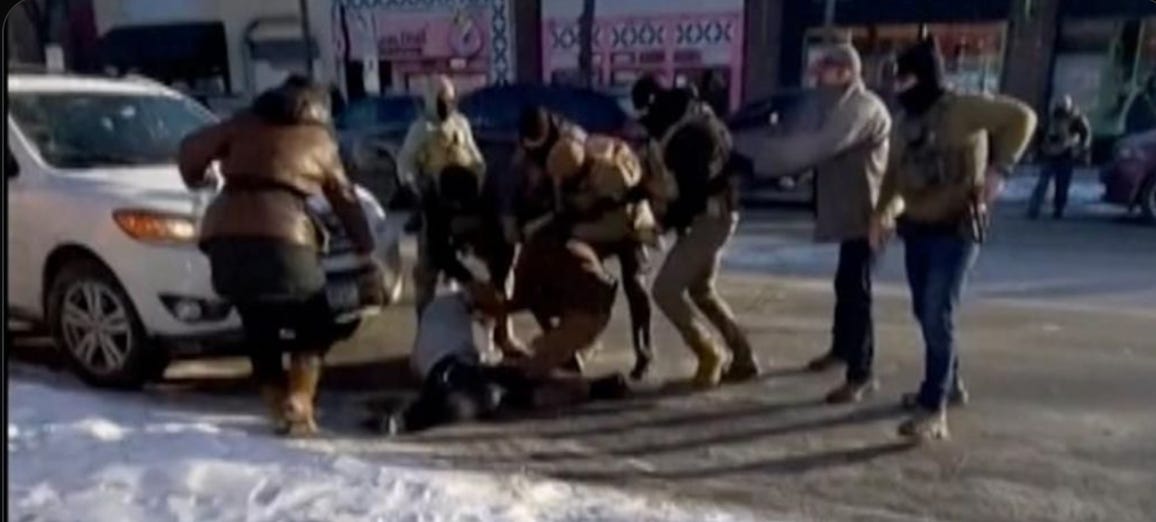
But the videos also show clearly that one BP officer — in the gray jacket below — approached the scrum seemingly without an intention to join in the effort. He hovered between two other officers momentarily, and then inserted himself between them while reaching in as part of an effort to grab something.
After 2-3 seconds he withdrew, turned his back to the scrum, and ran away holding a semi-automatic handgun in his right hand. But between the gray jacketed Officer reaching and then turning away to leave with the gun, the Officer on his feet to the left side of the image pulls out his firearm. The fact that he reached for and withdrew his weapon establishes that he recognized the potential deadly threat to himself and others at that moment — he either heard the warning or he saw a weapon.
What is important in this image is that while the Officer with the gun now has his back to the scrum and is running away, only 2 Officers are on their knees trying to control Pretti’s two arms.
While there are 6 Officers in a poximity of less than 5 feet — including the one who reaches for and grabs the gun — there are only two Officers on the ground attempting to control both of Pretti’s arms. Pretti has his knees drawn up under him, and is bent over forward at the waist while attempting to keep his arms drawn in close as he RESISTS their efforts to control him.
ALL THROUGH THIS TIME, up to the moment the gun was removed, Pretti was an armed suspect for whom there was probable cause to believe he had committed a felony involving an element of violence against federal law enforcement officers. I’ll return to this “felony” at the end.
The next image shows a change in circumstances with regard to “control” over Pretti:
There are still only 2 Officers on their knees trying to control Pretti’s arms. The Officer on the right side of the image has ahold of Pretti’s left forearm and is trying to pull it away from his body while Pretti is resisting.
The Officer on the left side of the image has used one of his legs to push off as he attempts to pull Pretti’s right hand and arm away from his body and back to control it. This gives Pretti a chance to get his torso back to upright and continue to resist by pulling his arms in tight to his torso.
The Officer who had drawn his weapon is the one in green bent over and looking down as the Officer who took Pretti’s handgun now has his back turned completely and is moving away.
In the image above you can see that at this point the Officer on his knees on the right has almost lost control of Pretti’s left arm. Keep in mind that in the cold weather everyone is wearing gloves and Pretti has on multiple layers of clothes.
You can see Pretti’s right arm now extended down at his side as he appears to be turning to his right, away from the effort by the Officer with the camo backpack to control his his right arm.
The next image is important:
Just prior to the first round being fired, you can see that the Officer on his knees on the right has lost control of Pretti’s left arm, and Pretti has managed to put his right arm behind his back in the direction where his firearm had been holstered. That hand is completely free at this point.
In real time, this entire sequence of events — from the first image above to the last — plays out in less than 5 seconds. Just prior to the first image above, the Officer who ends up drawing his weapon and firing has his back to Pretti and the scrum. He’s not even observing the scrum until the moment reflected in the first image above which was from the moment that he turned around:
During the course of this struggle, Pretti’s jacket had been pulled up to expose the holstered handgun in his waistband at the small of his back. That is when the Officer who removed the handgun from the holster moved in.
While Pretti was “disarmed,” up to that point the Officers were all operating under the “shared” information that Pretti was armed with a handgun.
But unless there is evidence that the Officer who removed the handgun clearly and unequivocally communicated having done so to the other Officers wrestling with Pretti, that is going to be “unshared information.” If it was “unshared” then it was not part of the “totality of circumstances” known to any of the other Officers, including the Officer(s) who fired at Pretti.
But the Officer who eventually drew his gun and fired was looking right at the struggle as the Officer who disarmed Pretti and left did so. Just prior to that happening, the same Officer drew his weapon from his holster — whether that was because of the shouted “Gun” warning or his own observations is something that only that Officer can say. It might be the case that the Officer who drew his weapon was also the same Officer — maybe the first — to shout out the warning.
More likely it came from the Office who moved in to remove the handgun while the Officer who drew his weapon still had his back turned to the scrum.
The fact that Pretti was disarmed is not particularly relevant to the legalities of the use of force unless that information was known to the Officer(s) who fired. If the last item of information they had was “GUN” and/or “He’s got a gun,” then the threat they perceived him to be to their lives was unchanged.
It is no different than the fact that the toy gun was not a threat to the Officers in the Nance case referenced above — if the Officers didn’t know it was a toy gun when it was pointed at them (disputed), their perception of a threat their lives was reasonable and their decision to fire on the subject there was justified.
If it is established — and there is no basis for doubt now — that multiple officers called out the FACT that Pretti had a gun, and any officer who did not know Pretti had been disarmed would have still been justified in believing Pretti was armed while engaged in the struggle with him on the ground. Just like the Officers in Nance, they would have been justified in treating Pretti as representing a threat to their lives right up to the moment of using deadly force.
The DHS use of force policy did not require them to personally see a weapon or personally see Pretti in possession/control of the weapon for them to perceive a threat and respond.
One point I have mentioned on X is the very real possibility that the removal of Pretti’s handgun, if not communicated, created a potentially tragic factual scenario from the possibility of a mistaken conclusion by any Officer who saw the holster empty. A firearm in a holster is a POTENTIAL threat given that the subject has not yet removed it to possibly make use of it. But when an Officer knows himself there is a gun, or a warning to that effect has been shouted out, when the holster is seen empty, the possibility that the subject has now removed the firearm and is preparing to use it is introduced into the mix of information. It that’s a mistake — as would have been the case here — as noted above in Connor, the law in this area tolerates a range of mistakes.
It is certainly true that the videos show the Officer who fired being in a position to see the gun being removed and the Officer who removed it moving away from the scrum with the handgun.
BUT, that is not the same as saying he actually did see that happen. His eyes may have been focused on some other aspect of the struggle — like where Pretti’s hands were and whether he had anything in them that might be a weapon. At that moment, the only things known about Pretti were that he was initially obstructing the operation, then he was resisting efforts to place him under arrest, and he was armed with a handgun. There was no obligation for the Officers to assume the handgun in his holster was his only weapon, and once dispossessed of it he was unarmed.
He was simply “armed” — what he was armed with and how many weapons he might be in his possession were still unknowns. Once “armed” he is not “unarmed” until he is arrested and searched, confirming he has no weapons on him that he can access. That had not happened while he struggled to keep his arms and hands away from the control of the Officers AFTER it was known that he was armed.
There has been much speculation online about the question of whether or not Pretti’s handgun had an “unintended” discharge of one round as the Officer who removed it had turned and was moving away from the scrum. So far as I know, the Government has not commented on that issue. Forensic examination of the weapon will show whether it had been discharged. If so, there would have been a shell casing at the scene different from the shell casings from the rounds fired by the Officer(s). But given the chaotic nature of the aftermath, whether or not any such shell casing was recovered is not yet known.
If there was an unintentional discharge — and the make and model of this particular semi-auto handgun are well know for such issues — the sound of the discharge would have been known to the Officers. The sound of one shot often creates a scenario of what is called “contagious shooting.” That sound of gunfire and its startling effect cause others to fire without themselves perceiving the threat. This kind of use of force is not “justified” based on the fact another officer has fired alone, but it is among the totality of circumstances that can be considered in evaluating reasonableness.
It remains to be seen if there was an unintended discharge, and whether the sound of that gunshot would factor into a judgement as to the objective reasonableness of an officer to shoot under the combination of circumstances present at the Pretti shooting.
As for whether Pretti was engaged in acts constituting a federal felony prior to being shot, there law is very clear — and unforgiving for individuals acting in the manner Pretti acted.
At the outset he was standing in the middle of the street approximately 40 feet where federal immigration officers were engaged in enforcement activity. There were officers in the street attempting to maintain a perimeter, and Pretti was directing cars to drive towards him — a path that took them through where the Officers were standing. Pretti did not find himself there by happenstance — he was there through the efforts of a group he was affiliated with that seeks out the location of such operations and then attempts to hinder them. They were in uniform, they were performing their official duties, and Pretti’s actions were taken on account of those facts.
Title 18 UCS Sec. 111 makes it a crime — misdemeanor or felony depending on the facts — to “forcible assault, RESIST, OPPOSE, IMPEDE, intimidate, or INTERFERE” with such officers while they are in the performance of their official duties.
There is no “protester’s privilege” and this statute has withstood innumerable challenges based on alleged First Amendment protected activity.
When one of the Officers pushes another protester to the ground as part of an effort to move her out of the street, Pretti approaches and attempts to insert himself between the officer and the other protester. The Officer then uses pepper spray against Pretti to ward him off.
A Sec. 111 violation is a misdemeanor until one of two things happen — there is “physical contact” with an Officer, or there is an intent to commit another felony thereafter. Any physical contact will do — there is no “intent to injure” required, nor is there any requirement of “injury”. You simply do not get to bump or push or in any other way come into contact with a federal law enforcement officer while they are in uniform and doing their job unless it is accidental. When there is such contact, the misdemeanor becomes a felony punishable by up to 8 years in prison.
Even after this first incident where he was coming to the aid of the protester who had been pushed down, the scrum on the ground is a second and separate sequence of events where Pretti engaged in conduct that violated Sec. 111.
While on the ground Pretti was “resisting,” “opposing,” and “interfering” with their efforts to detain and arrest him — on account of the fact that they were attempting to detain and arrest him in the course of their official duties.
There is no relief from this statute because you are engaged in a noble cause, nor because your resistance or opposition was minor. The misdemeanor version of this statute only applies in the ABSENCE of any physical contact — and that was certainly NOT the case involving Mr. Pretti.
A police officer may not seize an unarmed, non-dangerous suspect by shooting him dead….
…. Where the officer has probable cause to believe that the suspect poses a threat of serious physical harm, either to the officer or to others, it is not constitutionally unreasonable to prevent escape by using deadly force. Thus, if the suspect threatens the officer with a weapon or there is probable cause to believe that he has committed a crime involving the infliction or threatened infliction of serious physical harm, deadly force may be used if necessary….
Tennessee v. Garner, U.S. Supreme Court, 1985.
The use of deadly force by law enforcement is always a sad and sickening sight. But “lawful” and “unlawful” uses of lethal force are not the same as public notions of “right” and “wrong.” A court of law is not a court of public opinion.




 Stella's Place
Thx, Stella. This was a very good, detailed explanation. I think it covered everything.
LikeLiked by 1 person
LikeLiked by 1 person