
The Monroe Doctrine is a United States foreign policy position that opposes European colonialism in the Western Hemisphere. It holds that any intervention in the political affairs of the Americas by foreign powers is a potentially hostile act against the United States.
The Monroe Doctrine, first outlined in a speech to Congress in 1823, had President James Monroe warning European powers to not attempt further colonization, military intervention or other interference in the Western Hemisphere, stating that the United States would view any such interference as a potentially hostile act. Over the centuries, the Monroe Doctrine policy has become a cornerstone of U.S. diplomatic and military policies.
By the early 1820s, many Latin American countries had won their independence from Spain or Portugal, with the U.S. government recognizing the new republics of Argentina, Chile, Peru, Colombia and Mexico in 1822.
Yet both Britain and the United States worried that the powers of continental Europe would make future attempts to restore colonial regimes in the region. Russia had also inspired concerns of imperialism, with Czar Alexander I claiming sovereignty over territory in the Pacific Northwest and banning foreign ships from approaching that coast in 1821.
Though Monroe had initially supported the idea of a joint U.S.-British resolution against future colonization in Latin America, Secretary of State John Quincy Adams argued that joining forces with the British could limit future U.S. opportunities for expansion, and that Britain might well have imperialist ambitions of its own.
Adams convinced Monroe to make a unilateral statement of U.S. policy that would set an independent course for the young nation and claim a new role as protector of the Western Hemisphere.
[. . .]
During the Cold War era, President John F. Kennedy invoked the Monroe Doctrine during the 1962 Cuban Missile Crisis, when he ordered a naval and air quarantine of Cuba after the Soviet Union began building missile-launching sites there. In the 1980s, President Ronald Reagan similarly used the 1823 policy principle to justify U.S. intervention in El Salvador and Nicaragua, while his successor, George H.W. Bush, similarly sanctioned a U.S. invasion of Panama to oust Manuel Noriega.
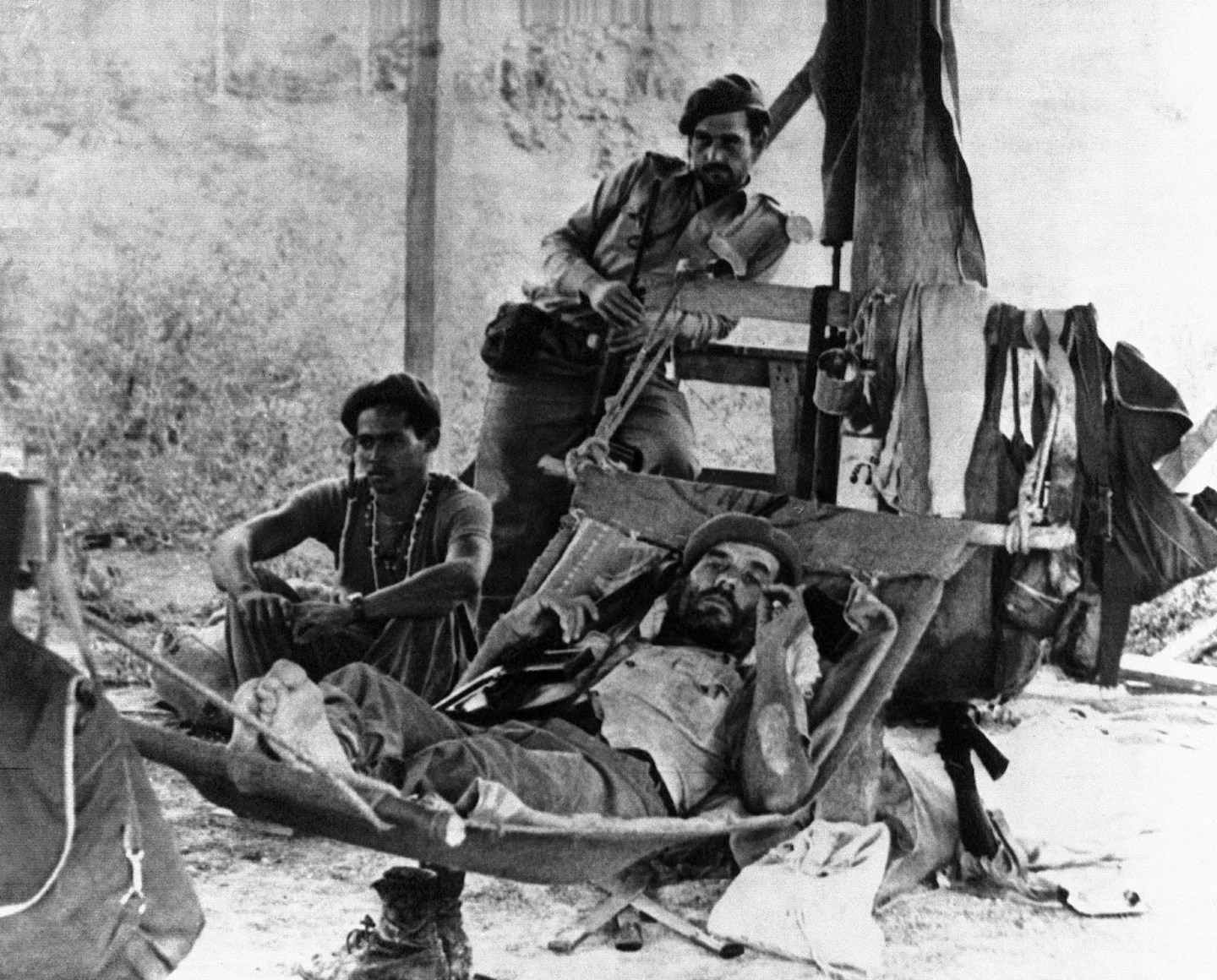
1961. Fidel Castro’s militia members
Now President Trump has arrested Maduro, the illegitimate “leader” of Venezuela (my opinion). Does the Monroe Doctrine and our history in the western hemisphere support this action?
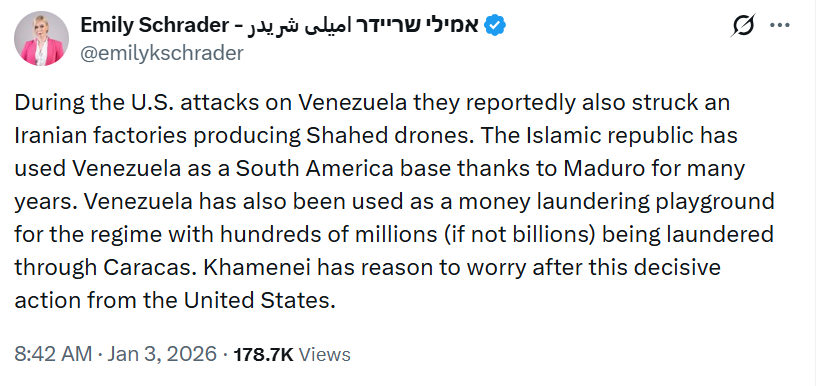
We know that foreign intervention does indeed exist – by Iran, Russia and China. For example:
You decide!
Here’s a blast from the past:
Before Venezuela, US had long involvement in Latin America
Venezuelan President Nicolas Maduro accuses the United States of trying to orchestrate a coup against him, and that allegation has resonance among many in a region where Washington has a long history of interventions — military and otherwise.
Ever since President James Monroe announced a sort of protectorate over the hemisphere in the early 19th century known as the Monroe Doctrine, the United States has involved itself in the daily affairs of nations across Latin America, often on behalf of North American commercial interests or to support right-leaning forces against leftist leaders.
That military involvement petered out after the end of the Cold War, although the U.S. has been accused of granting at least tacit backing to coups in Venezuela in 2002 and Honduras in 2009.
The Trump’s administration leading role in recognizing Juan Guaido as the interim president of Venezuela returns the U.S. to a more assertive role in Latin America than it has had for years.
Some of the most notable U.S. interventions in Latin America:
1846: The United States invades Mexico and captures Mexico City in 1847. A peace treaty the following year gives the U.S. more than half of Mexico’s territory — what is now most of the western United States.
1903: The U.S. engineers Panamanian independence from Colombia and gains sovereign rights over the zone where the Panama Canal would connect Atlantic and Pacific shipping routes.
1903: Cuba and the U.S. sign a treaty allowing near-total U.S. control of Cuban affairs. U.S. establishes a naval base at Guantanamo Bay.
U.S. Marines repeatedly intervene in Central America and the Caribbean throughout the first quarter of the 20th century, often to protect U.S. business interests in moments of political instability.
1914: U.S. troops occupy the Mexican port of Veracruz for seven months in an attempt to sway developments in the Mexican Revolution.
1954: Guatemalan President Jacobo Arbenz is overthrown in a CIA-backed coup.
1961: The U.S.-backed Bay of Pigs invasion fails to overthrow Soviet-backed Cuban leader Fidel Castro but Washington continues to launch attempts to assassinate Castro and dislodge his government.
1964: Leftist President Joao Goulart of Brazil is overthrown in a U.S.-backed coup that installs a military government lasting until the 1980s.
1965: U.S. forces land in the Dominican Republic to intervene in a civil war.
1970s: Argentina, Chile and allied South American nations launch brutal campaign of repression and assassination aimed at perceived leftist threats, known as Operation Condor, often with U.S. support.
1980s: Reagan administration backs anti-Communist Contra forces against Nicaragua’s Sandinista government and backs the Salvadoran government against leftist FMLN rebels.
1983: U.S. forces invade Caribbean island of Grenada after accusing the government of allying itself with Communist Cuba.
1989: U.S. invades Panama to oust strongman Manuel Noriega.
1994: A U.S.-led invasion of Haiti is launched to remove the military regime installed by a 1991 coup that ousted President Jean-Bertrand Aristide. The invasion restores Aristide.
2002: Venezuelan President Hugo Chavez is ousted for two days before retaking power. He and his allies accuse the U.S. of tacit support for the coup attempt.
2009: Honduran President Manuel Zelaya overthrown by military. U.S. accused of worsening situation by insufficient condemnation of the coup.

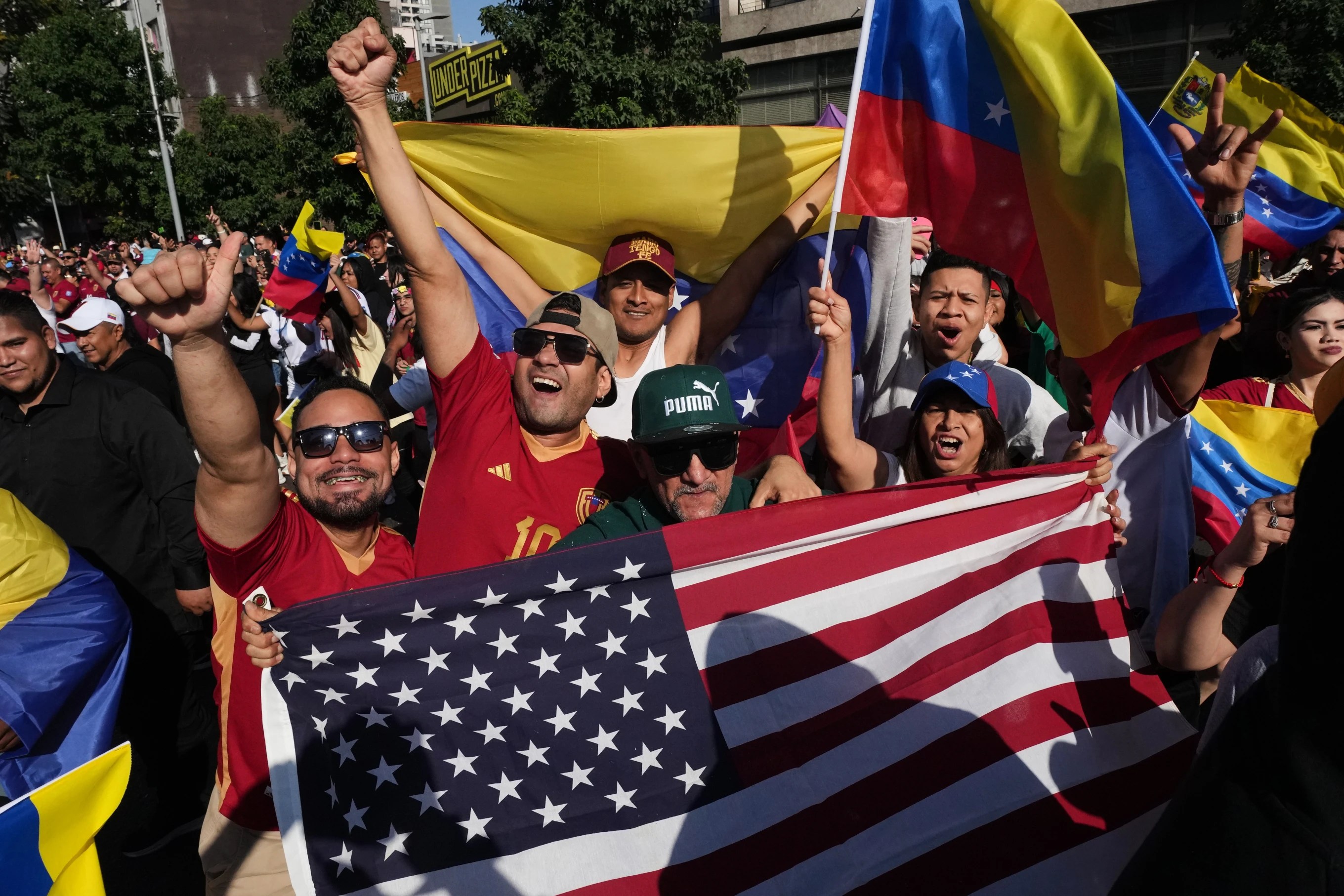
Venezuelans celebrate



 Stella's Place
Follow the breadcrumbs to the groups organizing the protests against the arrest of Maduro:
LikeLiked by 3 people
https://www.foxnews.com/politics/second-front-how-socialist-cell-us-mobilized-pro-maduro-foot-soldiers-within-12-hours
Second front: How a socialist cell in the US mobilized pro-Maduro foot soldiers within 12 hours
As the U.S. military carried out a daring operation to capture Venezuela’s Nicolás Maduro, a second front opened up within minutes in the United States an information warfare, psychological and propaganda operation run by a hardened cell of self-described Marxist, socialist and communist leaders.
For years, this cell has fomented anti-American hate in the U.S. under the cover of “anti-war” protests, rallying activists after the 9/11 attacks to condemn the U.S. response, appropriating “anti-racism” protests after the 2020 killing of George Floyd, marching with Antifa agitators, organizing antisemitic campus encampments after the Oct. 7, 2023, attack on Israel by Hamas and activating “working-class Americans” to support Maduro and his regime in a war against “U.S. imperialism.”
A Fox News Digital analysis of their minute-by-minute moves overnight reveals how this network activated a coordinated ideological and information warfare campaign, moving through digital social media channels with quickly produced posters to mobilize foot soldiers to the streets for an “EMERGENCY DAY OF ACTION” in New York City; Washington, D.C.; and an estimated 100 other cities, moving with the speed and discipline of an organized military operation.
LikeLiked by 3 people
The art of honest reporting is getting faster on its feet!
And it wasn’t See BS.
LikeLiked by 1 person
More interesting info.
LikeLiked by 2 people