
Jesus warned that those who persecute His followers will believe they are serving God by doing so. He stated, “Indeed, the hour is coming when whoever kills you will think he is offering service to God”.
This verse describes a state of spiritual and moral confusion where individuals or societies invert fundamental values, perceiving sinful actions as acceptable or positive and righteous actions as negative or oppressive.
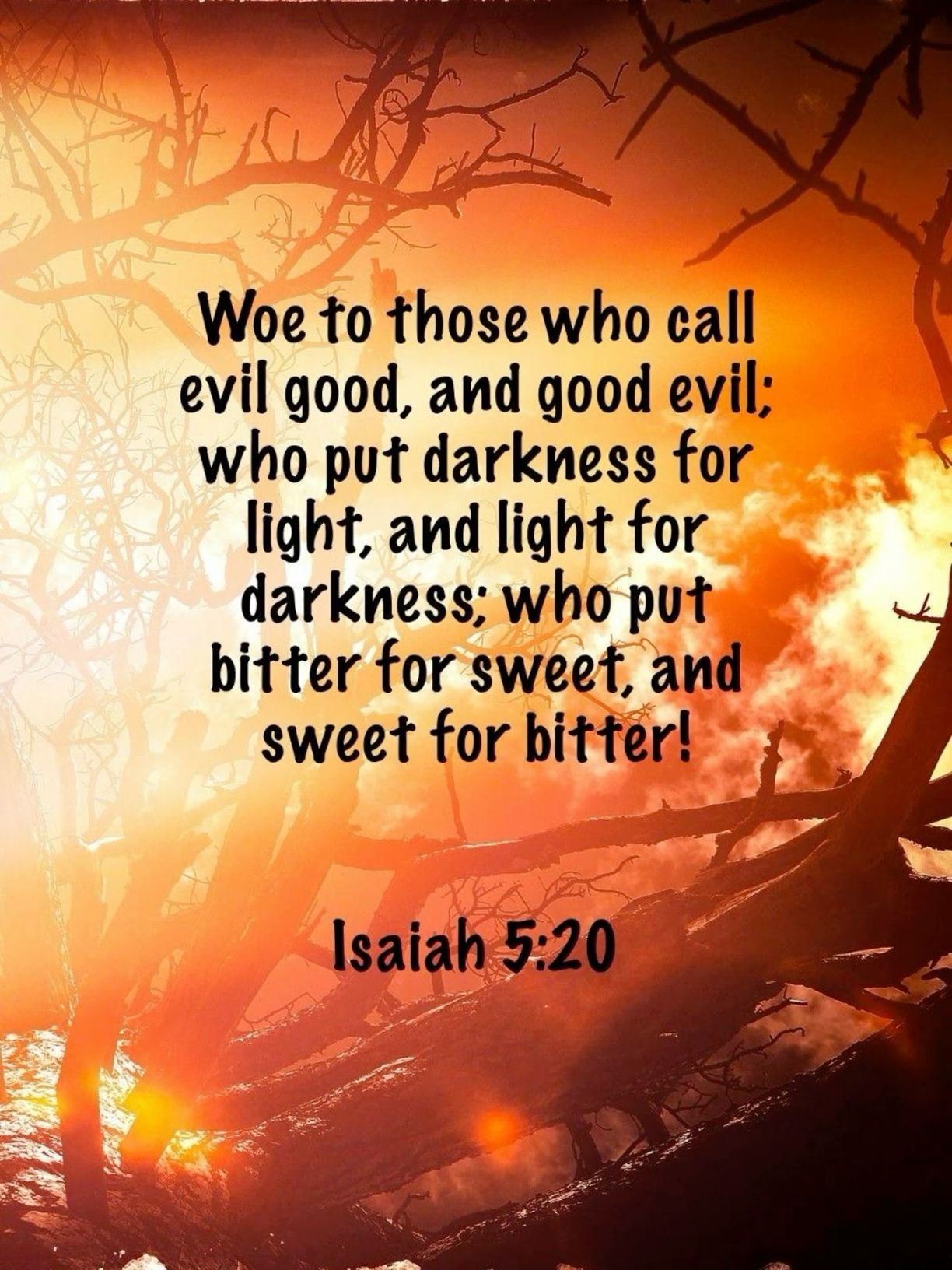
Isaiah 5:20 is a prophetic declaration of woe pronounced against those who deliberately invert moral and spiritual truths. The verse states, “Woe to those who call evil good and good evil, who put darkness for light and light for darkness, who put bitter for sweet and sweet for bitter!”.
This passage serves as a profound warning against moral relativism and the rejection of absolute truth, highlighting the dangerous consequences of distorting fundamental distinctions between right and wrong, truth and falsehood, and righteousness and sin.
The imagery of light and darkness symbolizes the dichotomy between good and evil, truth and falsehood, while the reversal of bitter and sweet represents a perversion of moral values and a loss of discernment.



 Stella's Place
I see two basic problems that cause this. People do not know God’s teaching. They have no more accurate idea of what’s in the Bible than they do about what Charlie Kirk believed. They know a few cherry picked passages by heart, lifted out alone, and often out of context. In the teachings of Jesus, the Apostles, and the old prophets, context matters. Not only the before and after verses and chapters, but often other passages and books altogether. The deep meaning comes from centuries of devoted and prayerful scholarship, being able to seek out the whole picture. People don’t even want the kool aid teachings, they want the sound bite.
Second, when you don’t believe there is Truth, when you believe that your own interpretation of what Jesus said is more valid than what he actually consistently taught throughout the Scriptures, then even Christians have lost the ability to make good decisions.
All of us want to tell ourselves it’s okay, our own personal sins. We want to pacify ourselves rather than examine our conscience against the teachings of the ancient Word made flesh.
LikeLiked by 3 people
People do not know the Bible in its fulness, as you state, Menagerie.
But the fault is not that of the congregants alone.
The Bible repeatedly calls to task those who are leaders of the people as well.
Many do sincerely search.
LikeLiked by 1 person