
This article is an important one by Victor Davis Hanson. As I’m sure you know by now, I admire Tucker Carlson and usually watch his interviews, which are engaging and informative. The interview of so-called historian Darryl Cooper is an exception. Here Dr. Hanson explains why.
I will post summaries of the various points. I urge you to go to the original article to read all of the details.
Germany and its fascist allies started the war. They felt empowered to do so not because of supposed Allied aggression, but because of Western appeasement and isolationism.
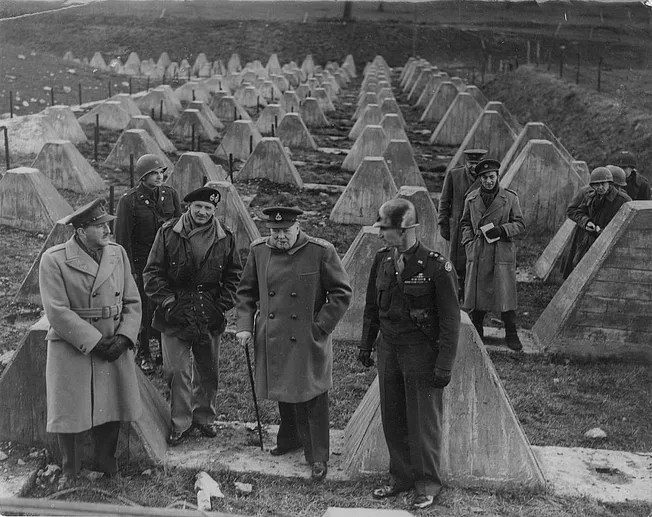
In a recent and now widely seen Tucker Carlson interview, a guest historian named Darryl Cooper casually presented a surprising number of flawed theories about World War II. He focused his misstatements on the respective roles of Winston Churchill’s Britain and Adolf Hitler’s Germany—especially in matters of the treatment and fate of Russian prisoners, the Holocaust, the systematic slaughtering of Jews, strategic bombing, and the nature of Winston Churchill.
Because of the size of the audience Carlson introduced him to, and because of the gravity of Cooper’s falsehoods, his assertions deserve a response.
On the Treatment of Russian Prisoners
It is simply not true, as Cooper alleges, that Hitler’s Wehrmacht was completely surprised and unprepared for the mass capitulation of the Red Army and some two million Russian prisoners who fell into German hands in summer 1941.
The virtual extinction of these POWs in the first six months of the war was a natural consequence of a series of infamous and so-called “criminal orders” issued by Hitler in spring 1941 to be immediately implemented in his planned “war of extermination” in the East.
[. . .]
Who Was Responsible for Starting World War II?
As for Cooper’s claim that the Allies were to blame for starting a world war, nothing could be further from the truth. Hitler may have been frustrated that Britain and France declared war on him after his unprovoked invasion of Poland on September 1, 1939. But he had been warned by some advisers that the two allies would be finally forced to war, given that he had broken almost all his prewar promises to them about ceasing his serial territorial acquisitions.
Incidentally, the much-maligned Versailles Treaty was nevertheless far more lenient to Germany than what the Kaiser had envisioned in 1914 under the Septemberprogramm memorandum for a conquered France, the German-imposed peace on a defeated Bolshevik Russia under the Brest-Litovsk Treaty of March 1918, or any of Nazi Germany’s postwar treatments of conquered nations.
[. . .]
On Britain’s Supposed Warmongering
Britain was, in fact, the only one of the six major belligerents in World War II that went to war on the principle of a third-party nation’s territorial integrity, without either invading another country or being itself invaded. Britain was also the only major power that saw World War II through from the first day to the very last. And of the victorious Big Three, it alone foresaw well before the war that it would likely end any cataclysmic war strategically diminished, its empire gone, and without its centuries-long global stature.
After the fall of France in June 1940, and the occupation and de facto control of most of Europe, there was discussion again in London, as during the phony war between October 1939 and April 1940, of finding a way for the British Empire to survive—given it was without any help from a now-occupied Europe, an isolationist America, and a collaborationist Russia.
So as early as late May 1940, after the German Ardennes invasion seemed unstoppable, some British and desperate French leaders advised the new Churchill government to seek out Mussolini to craft a modus operandi with Hitler.
Initial peace feelers followed. But all were quickly revealed to be impossible, given the buoyant and hubristic German-Italian agenda for a newly conquered Europe. That entailed a likely end of ongoing British rearmament, the surrender or flight to Canada of the British fleet, and fears that “peace” likely meant at worst something like a Nazi-imposed Oswald Mosley Quisling dictatorship, and at best a David Lloyd George Pétain-like collaborationist government—with a ceremonial role for the abdicated-but-still-lurking Edward VIII.
[. . .]
On Churchill, the Supposed Warmonger and Terrorist
Cooper describes Churchill as a supposed terrorist and warmonger. Yet in the dark days of late May and June 1940, to avoid factionalism among his new war cabinet, Churchill was willing to allow his colleagues temporarily to sound out peace possibilities through the intervention of Mussolini. But he darkly predicted that any ensuing humiliating Axis terms would likely shock even the more malleable and naive of his war cabinet.
In fact, by May 1940 Churchill had proved very magnanimous to the disgraced Chamberlain, whom he insisted stay on in his wartime cabinet, believing either that a naive or misguided Chamberlain might have sincerely sought to delay Hitler at Munich in order for Britain to find time to rearm, or blindly but genuinely thinking Hitler had no additional territorial agendas in Western Europe.
In any case, by May 1940, a once disgraced, chastised, and now far more realistic Chamberlain was well treated by an ally of Churchill and opposed any further obsequious concessions to Hitler. Chamberlain knew from bitter experience trusting Hitler would not bring peace but just guarantee war and a weaker and ultimately defeated Britain.
[. . .]
Victor Davis Hanson is an American classicist, military historian, and conservative political commentator. He has been a commentator on modern and ancient warfare and contemporary politics for The New York Times, Wall Street Journal, National Review, The Washington Times, and other media outlets.
He is a professor emeritus of Classics at California State University, Fresno, the Martin and Illie Anderson Senior Fellow in classics and military history at the Hoover Institution, and visiting professor at Hillsdale College.
Hanson received a B.A. in classics and general Cowell College honors from the University of California, Santa Cruz, in 1975 and his PhD in classics from Stanford University in 1980.



 Stella's Place
I had read part of this earlier today. I am about to put Tucker Carlson in the box with Candace Owens. I don’t know what crack he’s smoking, but he seems to think he’s so powerful, so persuasive, that he can push this stuff out and remain untarnished. Maybe, but I don’t think so.
LikeLiked by 3 people