
On May 6, 1937 at 7:25 p.m., the German airship LZ 129 Hindenburg burst into flames while attempting to moor at Naval Air Station Lakehurst, in New Jersey. Of the 97 persons aboard, 35 were killed. One member of the ground crew also perished. Considering how quickly the craft was destroyed, it seems like a miracle to me that so many passengers and crew survived.
The images, film, and reporting by Herbert Morrison of the huge fireball consuming the Hindenburg, shocked the world. It marked the beginning of the end of the era of the airship and is one of the most famous disasters in aviation history.
After the crash, the U.S. Navy reacted quickly to rescue survivors, treat the wounded, and secure the site, even as the wreckage continued to smolder.
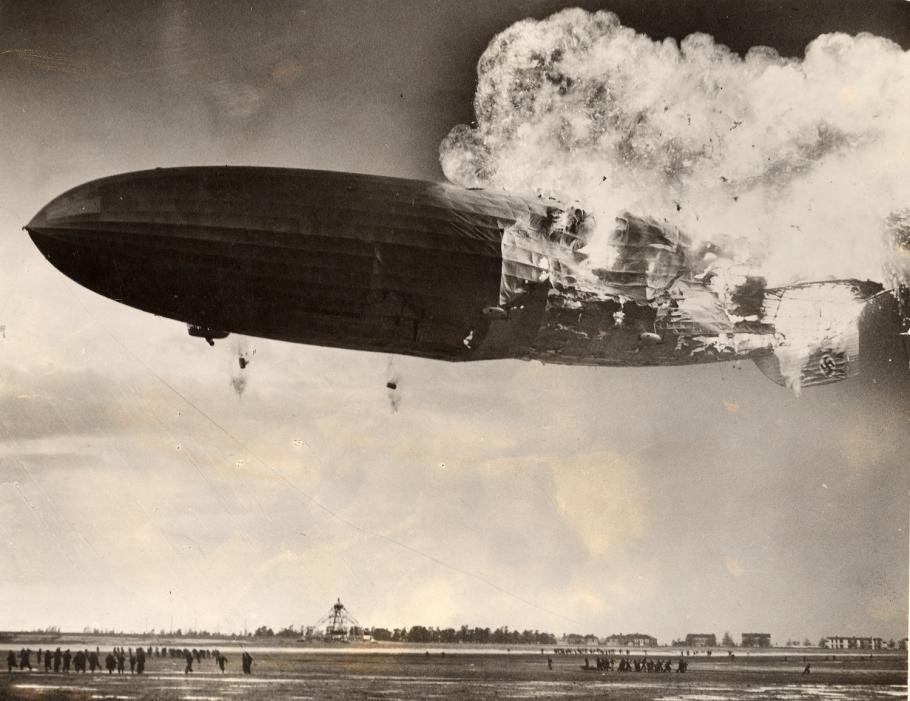
German airship Zeppelin LZ 129 Hindenburg burning upon its approach to Naval Air Station Lakehurst, New Jersey, on May 6, 1937. U.S. Navy sailors, preparing to grab for tether lines on the ground, run for safety as they watch the airship fall to the ground with its rear half engulfed in flames. (Smithsonian Institution, NASM 73-8701)
The rigid airship, often known as the “zeppelin” after the last name of its innovator, Count Ferdinand von Zeppelin, was developed by the Germans in the late 19th century. Unlike French airships, the German ships had a light framework of metal girders that protected a gas-filled interior. However, like Giffard’s airship, they were lifted by highly flammable hydrogen gas and vulnerable to explosion. Large enough to carry substantial numbers of passengers, one of the most famous rigid airships was the Graf Zeppelin, a dirigible that traveled around the world in 1929. In the 1930s, the Graf Zeppelin pioneered the first transatlantic air service, leading to the construction of the Hindenburg, a larger passenger airship.
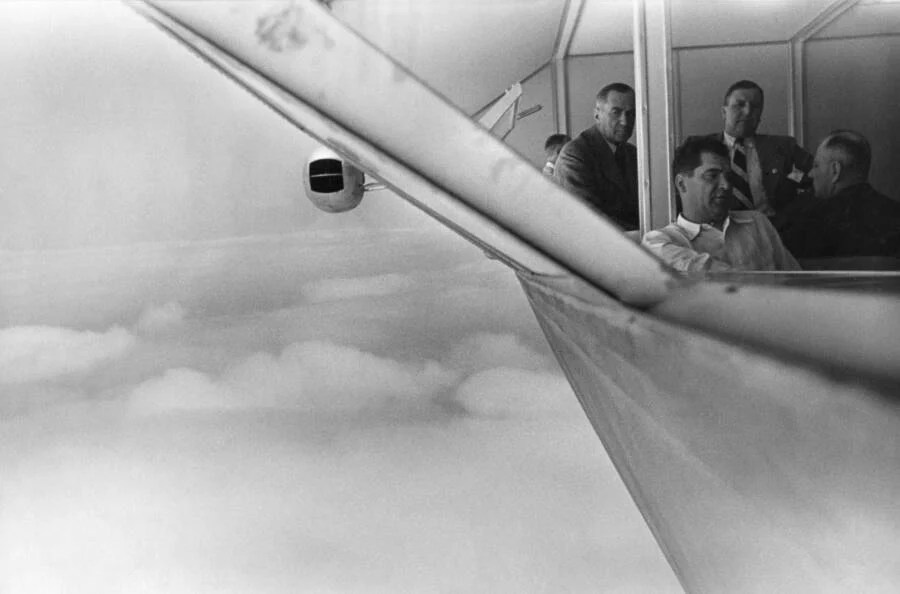
On May 3, 1937, the Hindenburg left Frankfurt, Germany, for a journey across the Atlantic to Lakehurst’s Navy Air Base. Stretching 804 feet from stern to bow, it carried 36 passengers and crew of 61. While attempting to moor at Lakehurst, the airship suddenly burst into flames, probably after a spark ignited its hydrogen core. Rapidly falling 200 feet to the ground, the hull of the airship incinerated within seconds. Thirteen passengers, 21 crewmen, and 1 civilian member of the ground crew lost their lives, and most of the survivors suffered substantial injuries.
Lighter-than-air passenger travel rapidly fell out of favor after the Hindenburg disaster, and no rigid airships survived World War II.

On a lighter note, here is an account of what it was like to travel and dine on the Hindenburg (thanks, again, to Max Miller):




 Stella's Place