Have you just realized that the Event Of The Year (so far) is tomorrow? While you have been gardening/spring cleaning, it seems that everyone else has prepared for the Big Event. Now you want to see it too, but don’t have the slightest notion of what you need to do.
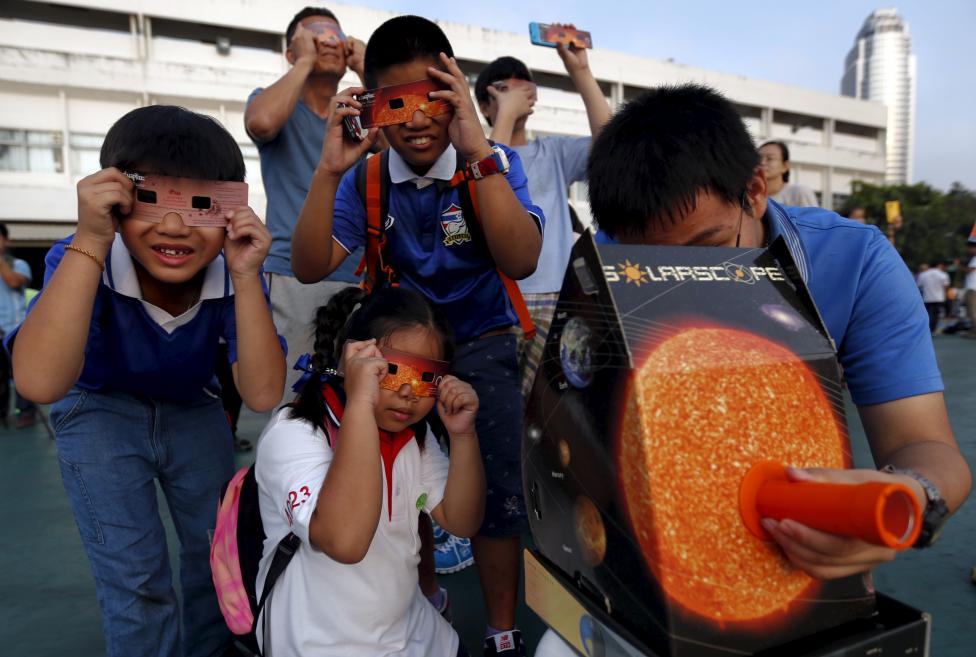
Students watch the solar eclipse through solar viewers in Bangkok, Thailand, March 9, 2016. REUTERS/Chaiwat Subprasom
What happens during a solar eclipse?
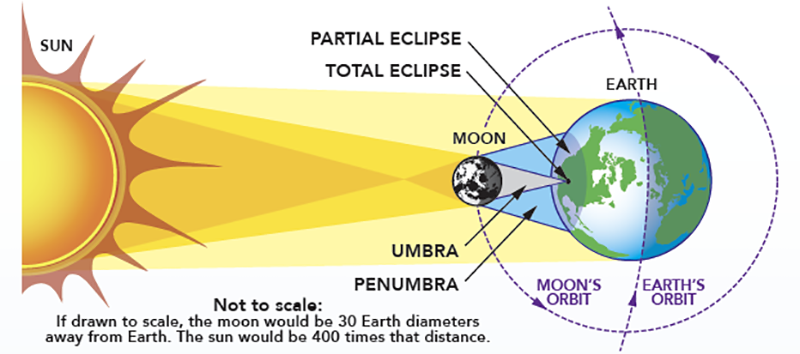
The moon passes between the sun and Earth and blocks all or part of the sun for up to about three hours, from beginning to end, as viewed from a given location. For this eclipse, the longest period when the moon completely blocks the sun from any given location along the path will be about two minutes and 40 seconds.
The places where the eclipse will be total (area of totality) are shown on the map (below), and the time the totality will begin.
 The closer you live to the line, the more total the eclipse will appear to you. Most of the United States will have a pretty good view.
If you are thinking of going to the closest place to you to see the total eclipse, you should know that all hotels/motels/campgrounds will probably already be sold out. If you do find a place, it will cost a lot. Traffic will be terrible.
You will most likely decide to watch from home or work. What is safe? Refer to an earlier post here about potential damage to your eyes if you don’t take proper precautions:
For complete safety information from NASA, READ THIS This is a short version of NASA’s safety guidelines. Read at the link for complete information.
Looking directly at the sun is unsafe except during the brief total phase of a solar eclipse (“totality”), when the moon entirely blocks the sun’s bright face, which will happen only within the narrow path of totality. The only safe way to look directly at the uneclipsed or partially eclipsed sun is through special-purpose solar filters, such as “eclipse glasses” (example shown at left) or hand-held solar viewers. Homemade filters or ordinary sunglasses, even very dark ones, are not safe for looking at the sun; they transmit thousands of times too much sunlight. Refer to the American Astronomical Society (AAS) Reputable Vendors of Solar Filters & Viewers (link is external) page for a list of manufacturers and authorized dealers of eclipse glasses and handheld solar viewers verified to be compliant with the ISO 12312-2 international safety standard for such products.
Do not look at the uneclipsed or partially eclipsed sun through an unfiltered camera, telescope, binoculars, or other optical device. Similarly, do not look at the sun through a camera, a telescope, binoculars, or any other optical device while using your eclipse glasses or hand-held solar viewer — the concentrated solar rays will damage the filter and enter your eye(s), causing serious injury.
Experts suggests that one widely available filter for safe solar viewing is welders glass of sufficiently high number. The only ones that are safe for direct viewing of the Sun with your eyes are those of Shade 12 or higher. These are much darker than the filters used for most kinds of welding. If you have an old welder’s helmet around the house and are thinking of using it to view the Sun, make sure you know the filter’s shade number. If it’s less than 12 (and it probably is), don’t even think about using it to look at the Sun. Many people find the Sun too bright even in a Shade 12 filter, and some find the Sun too dim in a Shade 14 filter.
If you are unable to locate eclipse glasses or viewers, another alternative is a pin hole projector. Pinhole projectors and other projection techniques are a safe, indirect viewing technique for observing an image of the sun. These provide a popular way for viewing solar eclipses.
Be safe, and have fun!



 Stella's Place
In Dallas, have my glasses from the library, a good place to view everything, and a couple of science experiments to play with. I’ll keep you posted
LikeLiked by 1 person
My daughter’s family is going to Indianapolis to visit friends and view the eclipse from there. I am staying here, and we will have 99% coverage. My daughter sent me a pair of glasses so that I can look if I choose to.
LikeLiked by 2 people