Oregon enforces laws to shut down small farms in the name of water conservation, affecting many farmers.
This woman’s “farm” is a little over 1/2 acre!
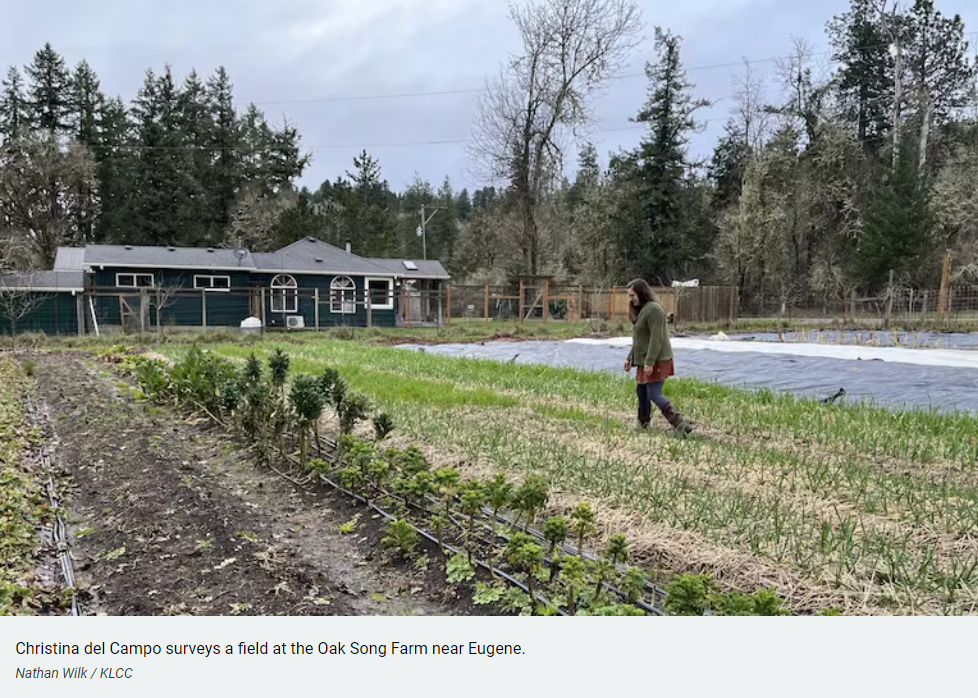
This is Oak Song Farm, a property located off Lorane Highway near Eugene, with just over half an acre dedicated to agriculture.
For seven years, del Campo has used well water to grow vegetables here, which she’s sold at farmers markets and to her neighbors. She said that’s been her primary source of income.
“It’s like a convenience store,” said del Campo. “People can stop in. I see a lot of people come on Sunday mornings to grab fixings for breakfast.”
However, everything changed last September. That’s when Oak Song Farm received a letter from the regional office of the Oregon Water Resources Department. It was a notification that the farm couldn’t irrigate its commercial crops without a water right.
Del Campo said this came as a complete surprise. Today, she said her business has been essentially destroyed.
“I don’t know why growing food is illegal,” she said. “That’s what doesn’t make sense to me.”
Water is a publicly-owned resource in Oregon, meaning property owners need government approval for many of its uses.
“It’s a finite resource,” said Mike McCord, the Northwest Region Manager with the Oregon Water Resources Department. “The system of appropriation has been in place since 1909 in Oregon. It allows us to better manage the resource by having a permitting system.”
There are some exemptions, as those without a water right can use up to 5,000 gallons a day for commercial or industrial purposes. However, this doesn’t include irrigation, McCord said.




 Stella's Place
Hm. Can’t use water to grow food, but I bet it is ok to grow weed.
LikeLiked by 1 person
I’ll bet you are right. Makes no sense.
LikeLiked by 2 people
We do know that they want to starve us out and also they want to control every part of our lives.
LikeLiked by 3 people
Insane!
LikeLiked by 2 people
“Water rights” are a big problem out west, and are complicated by traditions, laws, and government. Treaties require extensive negotiation and trying to change what seem to be stupid and easy rules is nearly impossible.
Some try “dry farming”, which means not using any irrigation. My mother grew up with that, and said she’d starve.
LikeLiked by 1 person
“Water is a publicly-owned resource in Oregon,………”
I can go along with that. And I will add to it that the farmer in question is using the public’s (that would be me) water to grow my food. My water, my food. Simple concept. And since that farmer is doing all the work to grow my food with my water I will even give her some of my money for her efforts when I go to pick up my food. Does that sound like an OK arrangement?
LikeLiked by 1 person