
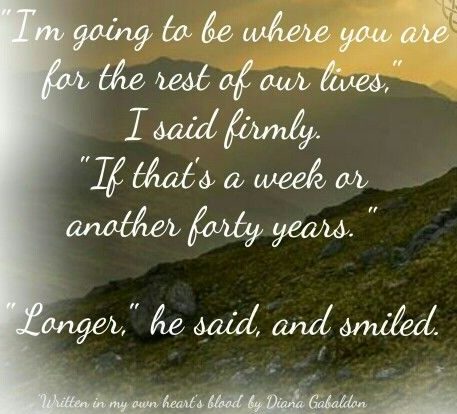
I read this exchange on the internet as a series of comments to a passage from Diana Gabaldon’s book, Written In My Own Heart’s Blood, that she posted today. The character, Brianna, is musing about time travel, and what might cause/allow it to be. I won’t quote the entire passage here, but this is the pertinent section:
“I sing the Body Electric,” she said softly. “The armies of those I love engirth me.”
Now, there was a thought. Maybe Walt Whitman had been onto something . . . because if the electric attraction of the armies of those I love had an effect on time-traveling, it would explain the apparent effect of fixing your attention on a specific person, wouldn’t it?
She thought of standing in the stones of Craigh na Dun, thinking of Roger. Or of standing on Ocracoke, mind fixed fiercely on her parents—she’d read all the letters now; she knew exactly where they were. . . . Would that make a difference? An instant’s panic, as she tried to visualize her father’s face, more as she groped for Roger’s . . .
The expression of the face balks account. The next line echoed soothingly in her head. But the expression of a well-made man appears not only in his face;
“It is in his limbs and joints also, it is curiously in the joints of his hips and wrists;
It is in his walk, the carriage of his neck, the flex of his waist and knees—dress does not hide him;
The strong, sweet supple quality he has, strikes through the cotton and flannel;
To see him pass conveys as much as the best poem, perhaps more;
You linger to see his back, and the back of his neck and shoulder-side.”She didn’t remember any more, but didn’t need to; her mind had calmed.
“I’d know you anywhere,” she said softly to her husband, and lifted the remains of her glass. “Slàinte.”
This is the series of comments that followed. They touched me very much. I can’t imagine how it must feel to read them as the author of the words that evoked them.
S: Thank you Diana Gabaldon – I lost my own Jamie three years ago next week to Cancer and you do a lovely job here of explaining how you know the people you love – their faces are just a part of it, but gestures, gait, the way they used to cock their head when giving you a smile – all beautiful things that only those who love them remember. You’ve given me a healing topic for my journal on this difficult week. Thank You
 K: How do you cope? My husband has Stage IV Colon Cancer was released from Infusion Therapy and given 6 mos to live. He is a veteran of the Vietnam War and I can’t imagine life without him after 40 years of marriage. My heart goes out to you.
S: There is no coping- just survival. Here are a few things I wish someone had told me, things that will help later – turn off the auto delete setting on your phone right now if you have text or voicemails from your husband, make any final plans together while he can help even if it is painful, get in- home health care or hospice support ASAP and take advantage of all they will offer- once that is all done, put all that away and stop trying to take care of everything, stop worrying about the clean house, or even your families needs as hard as that may be – and just spend time with him. If he can get out visit favorite places, if he can’t sit in a chair next to him and hold his hand, when he can’t talk play music and just be there – the memories from the last few months when all the worries of life have washed away will sustain you more than your realize. Most people don’t have the chance to say all the things they feel – even with a full lifetime, it is a blessing to take. If you are religious pray what he and you need, if you are just spiritual ask the universe for what you need, if none of these apply to you let your own heart give you what you need. Sorry this is so long but I always wish someone had given me this advice, so I try and pass it on when I can. My husband is with me always – even three years later, I miss him and speak to him daily, but I’ve also realized that living well is the most important way to honor his memory, and I do believe I will see him some day.
R: K, S gives great advice. I would like to add to it. While your husband is still with you, say whatever you want to say and give him a chance to do the same so there will be no regrets. So many terminally ill people get cut off when they try to talk about the harder subjects or even excluded from conversation not focused on them/their illness. And the best advice I got when I lost my loved one: don’t let ANYONE tell you how to grieve and give this same grace to the others who are grieving. That first Christmas, I couldn’t deal. I told everyone well in advance I would not be celebrating it. There was a lot of pushback but I did not decorate, did not shop, did not go to the family dinner and I turned off my phone. (So thankful for that last one.). I had movies and books and food on hand and did not leave the house on Christmas Day. On Christmas Eve, I attended a midnight service at a church I had never visited, not being able to bear the thoughts of the boundless sympathy waiting at my own church. It has been four years, and I am still so thankful that I spent that particular holiday this way. However, others who were also grieving my loved one found their own comfort in throwing themselves wholeheartedly into everything that Christmas. And that was fine. Let it be about you. It is the only way you can start to heal.
This is such good advice that I felt a need to pass it on here today. It may not be the only or the complete answer, but if it is of some help to someone, I am glad. I thank these women for their thoughtful answers to another who is going through a difficult time, with more ahead of her.




 Stella's Place
Very touching and helpful advice.
LikeLiked by 4 people
This is kind of a strange column that I read days ago, and it left me feeling a little unsettled. I have come to think that the things that leave us with that feeling are good in that they have shaken things up and they won’t resettle in the same old way, maybe leading us on a little journey or nudging a little growth.
https://www.wordonfire.org/resources/blog/bringing-death-into-light-because-everyone-suffers/24349/
LikeLiked by 3 people
A very good column. I strongly believe that we should be exposed to death from a very early age.
As the youngest of the maternal first cousins, I was taken by my mother to many funerals of great aunts and great uncles, from the age of about five. Funny the things we remember, but I do remember vaguely the funeral in 1952 of my great aunt Jess, my grandmother’s sister, and my mother’s namesake. A sharp memory from that is her husband, uncle Joe, who looked lost and smelled vaguely of urine. Not a very pretty memory, but it has stayed with me all of these years.
I also particularly remember the funeral of my great aunt Mary, who was laid out at home in the parlor, taken to the Presbyterian church that all of the family had attended for her funeral and then to the country graveyard on a hill amid the farmers’ fields. After that, we all went back to the house for lunch, and I sat approximately where her casket had been just a couple of hours before. I was 10 years old.
My daughter, being one of the youngest of her generation, had a similar experience, attending many funerals of my mother’s siblings and their spouses, and her own grandfather. When my dad died, she was eight years old, and sat with us in the funeral home for many hours. He died on a Thursday, and wasn’t buried until Monday, so there were three days of visitation. She whispered to me at one point, “Grandpa’s wearing makeup”, and asked if she could touch him. I told her she could.
When my aunt Anna died, she was 11 years old. In a typical dramatic expression of a girl of that age, she exclaimed, “I’m so sick of funerals!”
Some people think they should shield their children from the dying and death process. It’s a part of life, so I can’t see why, unless they express fear or anxiousness. Children aren’t usually afraid, just curious. The rituals of death are a way of preparing the living for the rest of their lives.
LikeLiked by 3 people
I agree with you. I think it is best that they are exposed to life and death is a part of it.
LikeLiked by 2 people
I agree. My mother shielded me from not only death when i was young, but from spending any time with dying family members. I had an uncle who was the anchor of my childhood, the person I loved most dearly, and who really loved me, and helped me.
My mother refused to allow me to see him for months before he finally died. She said I should remember him as he had been, but I was smart enough to know that his story wasn’t ended and she was costing both my uncle and me something irreplaceable. I still resent it.
My kids were very young when my father was dying. His health was horrible their whole lives. I never shielded them from it.
I also hate the whole funeral home thing, even though I am not old enough to remember having visitations at home. I just hate the whole open casket thing, and I even more hate the new picture stuff.
I just want to be given a funeral mass and buried. I really hope my husband, if he outlives me, and sons honor that wish and put me in hallowed ground ASAP.
LikeLike
I had a cousin who died in her 80’s who said she did not want an open casket because she didn’t want people looking up her nose. She was always so funny. There was a lot of laughing at her funeral with people quoting her.
LikeLiked by 2 people