
MARCH 9: SEE THE COMMENTS SECTION FOR UPDATES FROM THE TUNDRA PA!
UPDATE FROM THE TUNDRA PA, MARCH 7, 2016:
Good morning Stellar Friends! Time for an Iditarod update. I did not get anything written yesterday due to a heavy schedule. The actual start of the race happened smoothly yesterday, beginning at 2:00 pm Alaska time in the town of Willow, Alaska. A word about the Ceremonial Start/Restart thing. Back in the early years of Iditarod in the 1970s, Alaska had no freeways. Mushers started in downtown Anchorage and drove their teams all the way to Nome. With the building of a controlled-access freeway from Anchorage to Fairbanks, there was no way to mush directly from Anchorage into the Alaska Range. Thus the Restart, which is now the real beginning of the race.
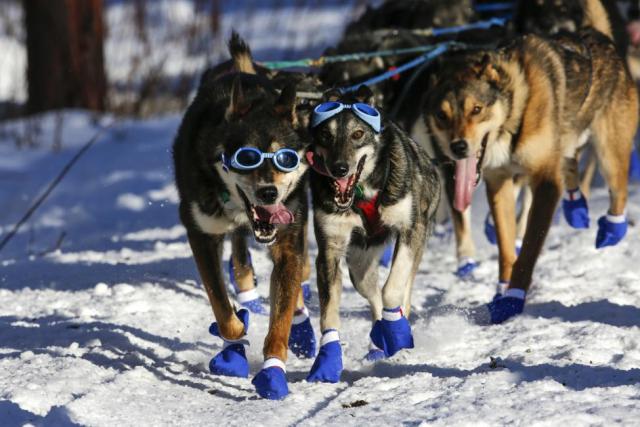
Cody Strathe’s team leaves the restart of the Iditarod Trail Sled Dog Race in Willow, Alaska. REUTERS/Nathaniel Wilder
The Ceremonial Start is required, but does not count as part of the race. The teams take off one at a time in Anchorage with throngs of fans cheering from the sidelines and a blitz of media interviewing, broadcasting and recording. The sleds are empty of any supplies and only 12 dogs are in harness. There is an auction for people to be “Iditariders” who get to ride in the musher’s sled for those few Anchorage miles, with some paying a couple of thousand bucks to be in the big-name sleds. At the end of these few miles, dogs and sleds are loaded into the musher’s trucks and driven to the Restart, this year in Willow but some years in other towns, to begin the real race on Sunday. Aliy Zirkle had a Go-Pro camera mounted just behind her on the follow sled (only used for the Ceremonial Start, to give extra control in the congested city) which gives a great sense of the fun and hoop-la of this media event. You can watch here: http://spkenneldoglog.blogspot.com/2016/03/id-ceremonial-start-videos.html
Yesterday’s Restart went off without a hitch. The Restart is also one team at a time leaving every 2 minutes. Mass starts, where all teams line up together and take off at once, are a recipe for disaster when there are more than a half dozen teams. There are 85 teams competing in this year’s race, so it took almost 3 hours to launch all the teams. Those time differences will be compensated for at the 24-hour mandatory rest somewhere near the race midpoint; this is a major factor in comparing relative positions during the early race.
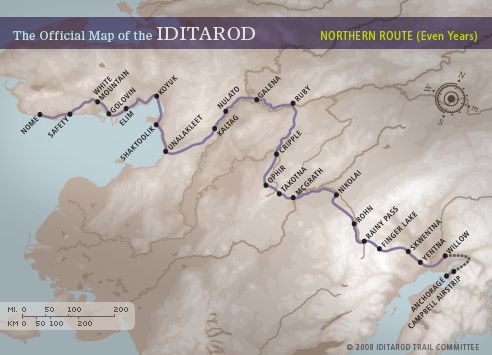
There are 22 checkpoints in the race, about 100 miles apart. Each musher sends supplies out ahead of time to be retrieved when they arrive–dog food, musher food, clothing, gear, even a whole different (much lighter) sled for the last leg of the race. Dogs who are not doing well for any reason can be “dropped” at any checkpoint and will be flown back to Anchorage where they are cared for until retrieved by the mushers or their handlers.
The front of the race has just reached the 3rd checkpoint. Aliy is in 2nd place right now (which doesn’t mean a whole lot at this early point, but is always encouraging to see). The first team to scratch has done so at the 2nd checkpoint, so we’re down to 84 teams. I expect as many as two dozen teams may scratch before the race is over. Anything can happen out there, and often does. In 1985, the great Susan Butcher had to scratch when her team was attacked by a moose on the trail who killed several dogs and injured many more as Susan watched, helpless to stop it. Forever after that, she carried a rifle in the sled, which is not required. That was the year that Libby Riddles went down in history as the first woman to win. Without that moose, I believe Susan Butcher would have held that honor. She went on to win in four of the next five years. No woman has won the race since.
Buckle up, race fans! We’re just getting started. In case you’d like a little extra dog mushing entertainment, I highly recommend the book Winter Dance: the Fine Madness of Running the Iditarod by Gary Paulsen. Thigh-slapping hilarity.
 FIRST POSTED IN FEB, 2015, UPDATED WITH INFORMATION FROM The Tundra PA.
Today, the 2016 Iditarod race begins. The Iditarod is an exciting dog-sled race from Anchorage to Nome – a total distance of 975 miles. It is exciting even in our modern, perhaps jaded, view, but the story behind this race is historic.
Tundra says, March 5, 2016:
It is 20 and snowing lightly here in south central Alaska, and today’s the BIG day. In less than an hour the 2016 Iditarod begins! Dog mushing fans everywhere are ecstatic. Iditarod is The Last Great Race on Earth and is Alaska’s premier dog mushing event, a thousand miles of wilderness trail, big mountains, wind-swept coastline and a great big river. This year 85 teams will compete for the championship, making it a much bigger race than its sister race, the Yukon Quest.
Today is the Ceremonial Start in Anchorage. This is a media event to showcase the mushers and teams. The teams leave the start one-by-one in 2 minute intervals and run about 10 miles over groomed trails through Anchorage with lots of cameras rolling. Local coverage will be on Channel 2 KTUU and Channel 11 KTVA, both of which should have live-streaming on the internet. The Outdoor Channel also usually carries it. The actual race starts tomorrow in Willow, Alaska.
Alaska in winter can be a treacherous place. The modern race is as safe as it can be made, with regular checkpoints, where supplies have been pre-placed, and mushers and their dogs can rest along the way.
The original “Iditarod” was another matter, indeed.
In 1925, long before there was an Alaskan Highway, Nome was isolated for months out of the year. The only way to get to Nome was by dog sled. No ships or planes or cars or trucks could get to Nome in winter.
In the late 1890′s and early 1900′s, settlers had come to Alaska following a gold strike. They traveled by boat to the coastal towns of Seward and Knik and from there, by land into the gold fields. The trail they used is today known as The Iditarod Trail, first surveyed by the Alaska Road Commission in 1908 and now one of the National Historic Trails as so designated by the Congress of the United States. In the winter, their only means of travel was by dog team.
The Iditarod Trail soon became the major “thoroughfare” through Alaska. Mail was carried across this trail, people used the trail to get from place to place and supplies were transported via the Iditarod Trail. Priests, ministers and judges traveled between villages via dog team.
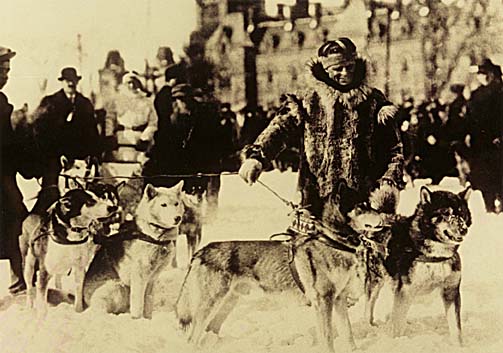
The dogs and sleds were there long before the settlers came from the lower states, of course. The native population had used them for centuries. According to “Dog Sledding’s History and Rise (dogsled.com),
It is believed that dog sledding has started in the arctic region. These regions are covered in ice and no transportation was possible. Horses could not last in the harsh arctic region. But the dogs were better solution to this problem. Dogs’ endurance was much greater than the endurance of a horse and they could survive treacherous terrain much better. A team of six dogs could handle 500 to 700 pounds on one sled. That’s why dog sledding became popular in arctic region. Archaeological evidence shows dog sledding in Canada, North America, and Siberia originated 4000 years ago. The Inuit used dog power for traveling from one place to another. They were also used for hunting and monitoring trap lines in the Canadian arctic wilderness. Inuit invented the dog sled which was pulled by the dogs. This sled was made of a mid range floating basket and a piece of wood. It was known as “komatik”.
Back to the story of the original, 1925, Great Race to Nome:
In December 1924, the first diphtheria-like illness was reported in the native village of Holy Cross, just a few miles away from Nome. The two-year old boy died the next morning. His parents, who were native Inuits, would not allow his body to be autopsied. As a result, three more children in the same area died with similar symptoms before the local doctor, Dr. Curtis Welch, could diagnose their illness as diphtheria.
On January 20, 1925, a three-year old child was properly diagnosed with diphtheria. Dr. Welch had six thousand units of antitoxin in his office, but it was six years old. He feared it was too old to be useful. The child died the next day.
The following day, a seven-year-old girl was diagnosed with diphtheria. She died later the same day. It was clear to Dr. Welch that the town of Nome was facing an epidemic. Dr. Welch called a town council meeting to discuss the situation. He told city officials he needed at least one million units of serum to hold off the spread of diphtheria. Telegrams were sent to Governor Scott Bone and the U.S. Public Health Service in Washington, D.C. asking for assistance in obtaining the antitoxin. By January 24, there were two more deaths and twenty more confirmed cases. The epidemic promised to wipe out the entire city of Nome if the medicine didn’t arrive. Finally, serum was found in Anchorage. Governor Bone was faced with the difficult decision of how best to safely deliver it to Nome.
There were only two choices: deliver it by airplane or by dogsled. In their book, The Cruelest Miles, Gay and Laney Salisbury say that many Alaskans believe their state would not have developed were it not for sled dogs. They quote a sled driver as saying, “A man is only as good as his dogs when he is on the trails of Alaska…and a dog is only as good as his feet.”
Governor Bone weighed the risks of both choices. The bush planes available in Alaska had open cockpits and water-cooled engines. Flying an airplane in fifty degree below zero weather was too big a risk. The Board of Health also rejected the use of an airplane. They voted unanimously for the dogsled relay. Governor Bone enlisted the most experienced dogsled racers to help get the serum from outside Anchorage to Nome. Only expert dogsled racers could make this journey of mercy in the middle of the worst winter since 1905. All told, there were twenty men and 150 dogs called upon to make the run. These brave drivers would have to drive a team of dogs day and night over 674 miles to bring the life-saving serum to Nome.
On Tuesday, January 27, 1925, a musher named “Wild Bill” Shannon left Nenana on the first leg of the race. He was a fearless mail driver who was known to take risks, no doubt an explanation for his nickname. He was handed the twenty-pound package at the Nenana train station. He and his nine-dog team would bring the serum from Nenana to Tolovana, where another musher would take over. Because the temperature was approaching fifty below zero, by the time Shannon arrived at the first roadhouse, (a small shack where he and the dogs could rest) he had severe frostbite on his face. After resting four hours, he headed back into the storm to bring the serum to Tolovana. Three of his dogs had to be left at the roadhouse because the below freezing temperature had taken its toll on them. Shannon arrived at the roadhouse in Tolovana at 11 A.M on January 28th. The temperature was 62 degrees below zero.
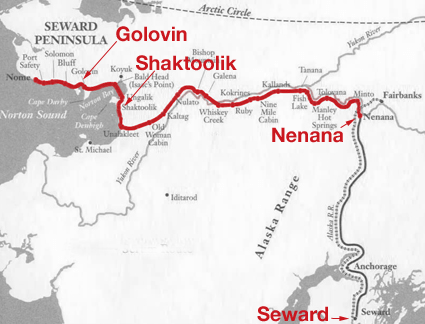
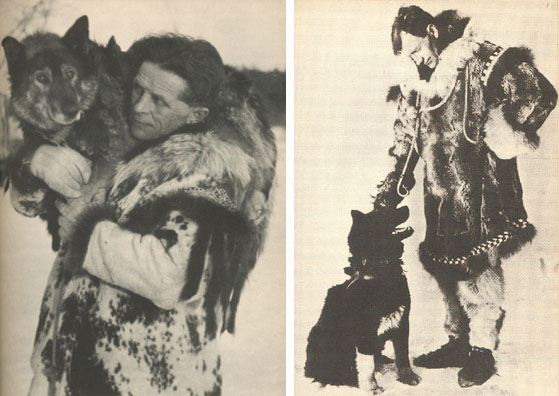
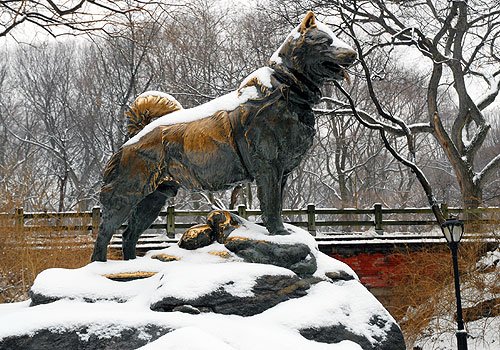
Mushers and about 150 sled dogs relayed the antitoxin 674 miles (1,085 km) by dog sled across the U.S. territory of Alaska in a record-breaking five and a half days, saving the small city of Nome and the surrounding communities from an incipient epidemic. Both the mushers and their dogs were portrayed as heroes in the newly popular medium of radio, and received headline coverage in newspapers across the United States. Balto, the lead sled dog on the final stretch into Nome, became the most famous canine celebrity of the era after Rin Tin Tin, and his statue is a popular tourist attraction in New York City’s Central Park. The publicity also helped spur an inoculation campaign in the U.S. that dramatically reduced the threat of the disease.
Further report on the 2016 race from The Tundra PA:
My good friend Aliy Zirkle and her husband Allen Moore will be running the race for the 15th year. Aliy has finished 2nd twice, but never won. I hope this will be her year! Allen will be running the puppy team, giving them experience but not pushing them to be competitive. Aliy will be going all out.
I’ll also be watching two young mushers who are friends from the Bethel area, Pete Kaiser and Mike Williams, Jr. Pete just won this year’s Kuskokwim 300 sled dog race in Bethel for the second year in a row. I’m hoping for a top-10 finish from Pete and a top-20 finish from Jr.
All the big-name mushers will be on 4th Ave. in Anchorage this morning–Jeff King, Dee Dee Jonrowe, Martin Buser, Mitch Seavey, Dallas Seavey, Paul Gebhardt, Lance Mackey, John Baker, Hugh Neff.
Starting order is drawn from a hat, and most mushers hope for a low number. Each team will start with 16 dogs in harness; that’s 1,360 dogs leaving the start. By the 20th team or so, the snow is chewed up and more like soft sand. It is much easier to be at the front of such a dog crowd while the surface is still packed and easier to run on. Aliy drew Bib #13 and Allen drew Bib #5–both great starting spots.
So if you need an occasional break from politics, check in on Iditarod for the next 9 days. Excitement galore!
iditarod.com has lots of info and free videos
Alaska Dispatch News (liberal rag, but ok on dog mushing) will have articles and links every day. This piece was interesting: http://www.adn.com/article/20160304/here-are-five-iditarod-musher-strategies-watch-early-race
Aliy and Allen’s blog will have multiple daily posts with videos and photos (done by their handlers, they are too busy mushing): http://spkenneldoglog.blogspot.com/ Two years ago Aliy mounted a gopro camera on her sled for the Ceremonial Start for a you-are-there kinda feel.
Aliy looked great at the start. The announcer said her bib number, #13, is the luckiest in the Iditarod; more winners have worn #13 than any other number. Go Aliy!
And small correction: Aliy has finished 2nd in 3 previous Iditarods, 2012, 2013, and 2014. Last year she finished 5th.
My now-defunct blog, Tundra Medicine Dreams, has lots of dog mushing posts like this:
http://www.tundramedicinedreams.blogspot.com/2009/01/dog-mushing-season-in-full-swing.html
and this:
http://www.tundramedicinedreams.blogspot.com/2006/05/dog-mushing-and-ice-fishing.htmlOnline streaming from the main Iditarod channel in Anchorage:
http://www.ktva.com/stream/



 Stella's Place
Wow, Stella, that’s awesome! Thanks! I love the story of Iditarod’s history. When I had a sled dog team, one of my best dogs was named Balto. I’ve been to Anchorage for the start of the race, but I’ve never been to Nome for the finish; hope to do that some day.
LikeLiked by 4 people
Glad you like it, Tundra.
LikeLiked by 3 people
Tundra, read your update! Hope Aley wins!!!
LikeLiked by 5 people
It’s Aliy!!! My fat fingers and new glasses.
LikeLiked by 4 people
Thanks, Colonel! Me too! A woman hasn’t won since Susan Butcher’s final victory in 1990. Aliy is a truly outstanding person, and a great musher. Her care of dogs is impecable. And it doesn’t hurt that she is a 6 foot tall gorgeous Amazon who is incredibly strong. She bench presses 150 easily. Go Aliy! This is your Iditarod year!
LikeLiked by 2 people
6:30 update. Holy cow! Hugh Neff, who just won the Yukon Quest 2 weeks ago, is playing jack rabbit and has already made it to Rohn checkpoint. He is chased by a pack of 30 teams ranging from 2 to 5 hours behind him. Aliy is in the middle of this pack.
Trail conditions have been good so far, with a hard pack and a light skiff of snow, so more teams in front of you has less degrading effect on the trail surface. They have climbed steadily up the eastern flank of the Alaska Range to Rainy Pass. The white knuckle grip time comes between Rainy Pass and Rohn. The Dalzell Gorge and the Happy River Steppes are part of a rapid descent down the western flank. Switchbacks, big drops, ice breakthroughs–it is treacherous, sled-busting and bone-busting. Taking a dog team around a switchback corner without getting flung into a tree takes amazing skill, even with very well trained dogs.
Darting out in front this early has rarely been shown to be an effective strategy for this very long race. The Norweigan musher Robert Sorlie did it successfully a few years back, but no one has repeated that. Perhaps Hugh Neff’s team is so incredibly conditioned after winning the Quest that they are simply powerhouses. Time will tell.
A word about checkpoints. They are beehives of activity, noise, light, movement, smell. Many dogs don’t rest well in all that, and their rest is the musher’s primary focus (along with food, of course). Many mushers prefer to camp on the trail where it is relatively quieter. Aliy is a strong believer in camping, and she stopped for an hour or so rest just before Rainy Pass, then blew through, only stopping to sign in. The checkpoints offer water, often hot, to make dog food with, and a warm dry place for mushers to eat and sleep. Everything’s a trade-off. At later checkpoints, the race will be more spread out, and so fewer teams in one place, especially for the front end of the race.
As the race pulls in to Rohn, the first third, crossing huge mountains, is done. The second third, from Rohn to Ruby, is crossing the open tundra to the Yukon River. This is where most mushers will take their “24”. The mandatory rest can be taken at any checkpoint the musher chooses, and some rookies end up doing in the first third. Linwood Fiedler astonished the mushing world some years back when he went further than anyone ever had before taking his 24. I think he made it to Cripple. Aliy has liked Takotna for hers in the last few years. Since Aliy started the race about 2 hours ahead of the last musher to start, her 24 will actually be more like 26. After all mushers have completed the 24, relative positions become true.
I’m saying a prayer for Aliy and all the mushers and dogs to make it safely down the mountains and in to Rohn.
LikeLiked by 5 people
10 pm update. The first 19 teams have reached Rohn and the leaders have passed through without staying. Aliy left 3rd, just 9 minutes after Dallas Seavey (in some ways her nemesis, as he has beaten her twice at the last minute), and an hour after Lance Mackey. It will seem like a leap frogging game for the next 12 hours as the mushers execute their individual plans for maintaining a run/rest schedule. Go Aliy!
LikeLiked by 5 people
Iditarod update, Day 3, 9 am. The race is staying pretty bunched up. More than 50 teams are stretched out over the 75 miles between Rohn and Nikoli. This is flat and often barren landscape, and includes the Farewell Burn, a 15 mile stretch of trail that was burned out in a forest fire years ago which is bare-ground mushing–bumping along over grass and tundra tussocks, a miserable experience on a dog sled. Aliy is in the front of the pack, with 5 teams ahead of her. The leapfrogging for leader position will continue today and tomorrow as each musher executes their run/rest plan. Aliy’s speed is quite good; she is currently traveling 10 mph and averaging 8.1 mph. She has 15 dogs in harness, only having dropped one dog who overheated. Many mushers have not dropped any dogs yet. As the race enters the second half, the power of more dogs becomes a trade-off with the extra time it takes to care for all of them.
Go Aliy!
LikeLiked by 3 people
Iditarod update, Day 4, 9 am.
The front end of the race is at the midpoint, and this is where things will seem screwy for a day or so as mushers begin taking their mandatory 24 hour rest. Those in the lead aren’t really. Dallas Seavey is currently in front, and appears to be going all the way to Cripple for his 24 (shades of Linwood Fiedler; it didn’t work for him a few years back). Aliy arrived in Takotna at 10 pm last night and should be departing about midnight tonight with her 24 completed. Tomorrow should reveal true relative positions.
Three teams have now scratched, leaving 82 teams still racing, and the back end of the race is out of Rohn and headed for Nikolai. These are mostly rookies running their first Iditarod and hoping only to complete the course. There is a steep learning curve to running this race. The first rookie to finish will get the Rookie of the Year award; if that rookie has finished in the top 30, he or she has done well. A few years back, one of the Norweigan mushers took Rookie of the Year and finished 4th–almost unheard of. The only rookie to win was the very first year when all mushers were rookies–and it took almost 3 weeks. The current leading rookie is in 29th position.
Weather continues to be gentle, with temps in the 20s, little wind and no snow. It will get colder as they get to the Yukon and begin the long slog downriver to Kaltag; temps will drop to zero and the wind could get fierce. The Yukon can be a brutal section of the race, and mushers are always happy to get off the ice highway and back on solid ground with tree cover to break the wind until they get over the portage to the coast of the Bering Sea.
I hope Aliy and her dogs are resting well and ready to move out smartly tonight. Go Aliy!
Stella, hope you got my email with today’s update. I was unable to post it.LikeLiked by 3 people
I copied it into your comment box.
LikeLiked by 3 people
Thank you! Multiple technology frustrations today.
LikeLiked by 3 people
Thankyou Tundra!! Go Aliy!!
LikeLiked by 4 people
Cool! Love the booties on the pups!
LikeLiked by 4 people
Iditarod update, Day 5, 9 am ADT
The front of the race has reached Cripple, with 7 teams into that checkpoint and one, Jeff King, out of Cripple and on the way to Ruby–thus giving him the lead at the moment. But none of these teams has taken their 24 yet, so are not really in the lead. The next 19 teams are in to Ophir, the checkpoint before Cripple. All of these teams have taken their 24, so today will change things up a lot, as the leading 7 teams will now have to stop. Aliy is currently in 6th position of this 19 team pack, which is a comfortable place to be. It is interesting to note that the 7 teams who have not “24’d” are moving at about 6 mph; the teams which have 24’d are moving at about 10 mph. That’s yuge difference over hundreds of miles, and shows what a difference a good rest and plenty of calories can make.
And speaking of calories, the feeding of sled dogs is a critical factor in this race. Working sled dogs must consume about 10,000 calories a day to maintain optimal performance. And odd as it may sound, sometimes the challenge is just getting them to eat. Sometimes a dog must be dropped simply because they won’t eat and start losing weight. There are vets at every checkpoint, checking every dog, and watching very closely for this.
The musher is solely responsible for the care and feeding of the team, and no one may help–not hauling water, not laying out straw, not taking off booties and massaging feet. The musher must do it all. Most mushers feed a balanced combination of meat, fish and kibble. Food bags are sent out to each checkpoint ahead of the race for the musher to retrieve on arrival. In the sled is a dog food cooker which can boil 5 gallons of water in about 30 minutes, and enough food to feed the team for about 2 days, allowing the team to camp outside of the checkpoints. The dogs have to eat a meal about every 4 hours, with small snacks of frozen fish or meat every hour.
The other end of all that feeding has the expected result–lots of pooping. An experienced sled dog knows the routine: a good meal, a good rest, then back in harness and we’re off. They know that when the harness goes on, it is time to lighten their load before the next long run, and they do. The first 2 miles out of the checkpoint is a treacherous stretch of dog poop to be plowed through (another reason the front of the race is a more pleasant place to be than the back end). If weather is below zero, all those turds are just so many rocks; but at +30 degrees they can be pungent and squishy. Exposure to all that can cause bouts of diarrhea to move through a team like greased lightening, which is a nightmare. Experienced mushers have had to scratch late in the race due to stomach issues with their teams.
The race is just starting to heat up. Lots more fun to come!
LikeLiked by 5 people
Go Aliy!
LikeLiked by 3 people
Thanks for the report, Tundra! Just so you know, we have people reading this post every day. Even if you don’t see comments, you have followers!
LikeLiked by 3 people
Working sled dogs must consume about 10,000 calories a day to maintain optimal performance.
😯
Wow!
So much new and interesting information for me to learn. Thanks Tundra. It is easy to sit back and see the glory, staunch athleticism, the majestic dogs and idealize this race but your posts make it real. The dog poop and it benefitting the racers to be in the lead reminds me of the wagon trail and how dusty it progressively got the further down the line you were.
LikeLiked by 3 people
Thanks for the updates. It is fascinating to get the behind the scenes glimpses into this strange (to us) world.
LikeLiked by 3 people
Here’s another blast from the way-back machine. Someone just reminded me of a post I did on the old blog about the get-ready for Iditarod:
tundramedicinedreams.blogspot.com/2007/02/preparing-for-iditarod.html
This was when Mike Williams, Sr. was running the race, before Junior started on the Iditarod trail. Some of the links no longer work; there is no cabelasiditarod site anymore. The basic preparation info hasn’t changed much, though.
LikeLike
Shoot. Thought that would come out as a link. Works to copy and paste in a new window.
LikeLiked by 1 person
Copy and paste work fine 👍
LikeLike
Iditarod update, Day 6, 9 am
Woo hoo! Aliy is in the lead this morning! She is just past the half way point of the race at mile 530, about 9 miles ahead of Brent Sass in second position. Behind them is a group of 14 mushers currently at the checkpoint at Ruby (mile 495), and Pete Kaiser is the head of that pack. Go Pete! Technically, he is two positions ahead of Dallas Seavey; whether he really is ahead will depend on which one leaves Ruby first.
My big hope, after Aliy winning, is that Pete beats Dallas. I’ll say a word here about Dallas. He is a talented musher who has won Iditarod 3 times, in 2012, 2014, and 2015. He holds the current course record of 8 days 13 hours. He is also a cocky little jerk, liked by nobody I know. The Seavey family is a mushing dynasty in Alaska. His dad, Mitch, won in 2004 and 2013 and his granddad, Dan, has run the race numerous times without winning. That’s a whole lot of mushing, and Dallas was born into it. He was standing on a dog sled by the time he was 5. Yet he struts around claiming no personal advantage from all that history. He is just so awesome, he did it all by himself! I want to say “hush up, little boy, and respect your elders!”
Dallas and Mitch have been to Bethel several times for the Kuskokwim 300 sled dog race, and though I can’t say I know Dallas personally, I have observed him from close up on numerous occasions. He’s a know-it-all kind of jerk. The word in the mushing community in Bethel is “ABD”–anybody but Dallas! We’re really hoping Pete Kaiser, the local boy, will beat him.
So back to the Yukon River. There are 4 checkpoints on the Yukon: Ruby, Galena, Nulato, and Kaltag. An 8-hour mandatory rest is required at one of those checkpoints. The pack of 14 currently at Ruby may all be taking their 8 there. An interesting quirk that I haven’t seen before is that Jeff King is taking his 24 at Ruby, and will have to take 8 pretty quickly, probably at Kaltag. That’s two big rests very close together, and I wonder if his dogs will do well with that plan. As always, we’ll see.
Go Aliy!
LikeLiked by 3 people
Thanks for the update Tundra.
Go Aliy.
LikeLiked by 1 person
One small post script. Five teams have now scratched, leaving 80 teams racing. By this point in the race, a dozen teams have often scratched, so this is a pretty good year.
LikeLiked by 1 person
Thankyou Tundra! Go Aliy!!!
LikeLiked by 1 person
Iditarod update, Day 7, 9 am
Brent Sass still holds the lead and has just left the Yukon River at Kaltag to begin the 85 mile leg through coastal foothills to the coast of the Bering Sea at Unalakleet. Aliy is in second position about 3 hours behind him, and Dallas Seavey is about an hour behind her. Dallas’s dad, Mitch, is technically in second position, but he must stop now at Kaltag for his 8 hour Yukon rest; the other three have already taken their 8 and will quickly move past him while he rests. The weather at Kaltag is nearly perfect: -6 degrees with no wind and great visibility.
The trail from Kaltag to Unalakleet is known for causing upsets in the race. Dogs and mushers are getting pretty tired by this point, and the coastal hills can be demanding. They are not the huge mountains of the Alaska Rance, but are tall enough to be challenging, and can have some deep snow to slog through. This is the section where Dallas has successfully instituted his move-up-from-behind strategy in the past. Do his dogs have enough gas in the tank to do it again? The next 12 hours should tell.
The ugly news breaking this morning is that Aliy and Jeff King were attacked by a drunk on a snowmachine (akin to a car running over pedestrians). Aliy grabbed a 4 foot wooden stake (used as trail markers) to defend herself and her team. She has a black eye and a chipped tooth, and was pretty shook up. In the short video at Nulato, she says “A guy on a snowmachine tried to kill me!” Aliy’s dogs were thoroughly checked by the vet team at Nulato and are all ok.
After Aliy got away from him, he then attacked Jeff King’s team and killed one dog and injured two others fairly seriously. It’s not known yet whether Jeff will scratch because of this. It all happened about 2 am, a few miles before Nulato. The official word is that the situation was “neutralized” by the Alaska State Troopers and criminal charges are pending. I hope the worthless dungheap is in jail. My prayers are with both Aliy and Jeff this morning.
LikeLiked by 3 people
How terrible! I hope he “enjoys” his stay in jail.
LikeLiked by 3 people
Terrible news. People hurt and dogs injured and killed because of a mad drunk.
LikeLiked by 3 people
This guy should be tied too a trail stake, left for the wolves…….Glad Aliy and team okay.
LikeLiked by 3 people
Prayers for Aliy and Jeff King, what a horrible thing to happen. I hope neutralized means the tax payers will have no further expenses with the dirtbag who attacked them.
LikeLike
The latest news from the trail is that Jeff King will not leave the race because of this incident. He still has 11 healthy dogs, which is enough to remain competitive. But I know his heart is heavy today.
LikeLiked by 4 people
Iditarod update, Day 8, 9 am
The front of the race has reached the Bering Sea at Unalakleet. Currently the lead is held by Mitch Seavey, followed by Dallas Seavey, Brent Sass, and Aliy Zirkle. Pete Kaiser is 6th.
The last third of the race from Unalakleet to Nome is different from what has gone before. Flat, wide-open space, huge expanses of ice, and often howling winds. From Shaktoolik to Koyuk the teams are mushing over sea ice, which can be a moonscape of jumbled ice blocks. Frequent storms, and even blizzards are possible. In some ways, this is the hardest part of the race. I’ve always thought the best training for this terrain is to run the Kuskokwim 300, Bethel’s mid-distance race. Similar distance, landscape, and weather. Perhaps that will give Pete Kaiser a bit of advantage.
Numerous people have asked, but so far Aliy has refused to talk about the snowmachine assault that occurred early Saturday morning. She sounds very shook up by the whole experience. A brief radio interview can be heard here:
http://www.alaskapublic.org/2016/03/12/interview-aliy-zirkles-race-continues-after-snowmachine-incident/
Aliy is mentally one of the toughest people I’ve ever known. This experience clearly rattled her deeply. The fact that she is continuing to race is a testament to her character and commitment. Bless you, Aliy!
LikeLiked by 1 person
Prayers for Aliy, I’m sure that being attacked has mentally jarred her and getting her head fully back in the race may be difficult. God speed to her.
LikeLiked by 1 person
Iditarod update Day 8, 6:30 pm ADT
OK race fans, this is where it gets exciting. The front end of the race is almost to Koyuk, which is 171 miles from the finish. Brent Sass is in front, with Mitch and Dallas Seavey in second and third about 6 miles behind him. Aliy is in fourth 20 miles behind the Seaveys and Wade Marrs is fifth a few miles behind her. The front 5 are within 2 hours of each other, and anything could jostle their arrangement. Weather is always a huge factor.
The run from Shaktoolik to Koyuk is mostly over the frozen sea ice of Norton Sound. There’s an erieness to being on sea ice that is different from river ice. And the wind has become pretty fierce. Temps are about +10. Mushers are always glad to get off the sea ice and into Koyuk. Here (I hope) are some great photos of Aliy and the other leaders in the race.
http://iditarod.com/musher/windy-run-over-norton-sound/
LikeLiked by 3 people
Photos are great!
LikeLiked by 1 person
I wasn’t sure whether or not they were part of my Iditarod Insider subscription. Glad the link is generally available. The photos convey the flat-wide-open-huge nature of the area. But maybe not how sharp that wind feels on your skin. Dear hubby said “Man, you gotta love that life to do it (Iditarod).” He’s right.
LikeLiked by 1 person
8 teams have scratched, leaving 77 teams still racing. The tail end of the race just got to the Yukon River (Ruby).
LikeLiked by 1 person
Iditarod update Day 8, 10:30 pm
Dallas has made his move. He took the lead from Brent just before Koyuk and blew through the checkpoint with his dad Mitch close behind. They now have a 25 mile lead on Brent, Aliy, and Wade. It’s looking like a father-son neck-and-neck battle for the win. Aliy may be able to pass Brent and take third place; but it will take a weather intervention to catch the Seaveys.
The SP Kennel blog has a short video that Aliy recorded a few years ago from the driver’s position on the dog sled, going through the hills on the way to Unalakleet. It gives you a bit of the feeling of driving a dog team.
http://spkenneldoglog.blogspot.com/2016/03/id-dawn-on-coast.html
LikeLiked by 1 person
Team Position.
http://iditarod.com/race/2016/standings/
LikeLike
Iditarod update, Day 9, 9 am ADT
The order of the top 5 teams has not changed this morning: Dallas-Mitch-Brent-Aliy-Wade. Dallas is about 10 miles short of White Mountain, which is 77 miles from the finish line in Nome, and Mitch is 5 miles behind him. There is a mandatory 8 hour rest at White Mountain, and the order in which teams arrive and leave from there is usually the final order at the finish. It is about a 10 hour run from White Mountain to Nome.
If Mitch has any hope of catching Dallas, he’s going to have to work for it. Much has been made in the last few days about the fact that Mitch sits on the sled and lets the dogs do all the work. Most mushers work hard to help the team, either by “pedaling”, which is standing on one leg and kicking the sled along with the other leg, or by using one or two ski poles to help push the sled along. Also by jumping off the sled and running alongside pushing it to help the dogs. Dallas is famous for this. He wears running shoes, not warm heavy boots for the final leg and runs the entire way. Dallas is 28; Mitch is 56. After 9 days of exhausting work and sleep deprivation, youth and testosterone will tip the scale in Dallas’s favor unless Mitch starts working really hard.
Dallas is down to 9 dogs, where the rest still have 12 or 13 in harness. On a hard, icy trail, 9 dogs is plenty. But his speed from Koyuk to Elim was only 5.7 mph, where Aliy’s was 7.5 mph; with enough trail, she could catch and pass him, but there may not be enough trail left for that. The winning team should get to Nome sometime early tomorrow morning. I’m still hoping anybody can beat Dallas.
LikeLiked by 1 person
The drunk snowmachiner who attacked Aliy Zirkle and Jeff King is arraigned on charges:
http://www.adn.com/article/20160313/nulato-man-faces-12-charges-snowmachine-collisions-iditarod-teams
charged with two felony counts of third-degree assault as well as six counts of fifth-degree criminal mischief, three counts of reckless driving and one count of reckless endangerment.
Bail was set at $50,000; the judge said the prosecutor could have asked for 10 times that amount and it would have been granted.
LikeLike
More here:
https://www.adn.com/article/20160312/snowmachiner-says-he-killed-iditarod-dog-while-driving-drunk
He’s really sorry.
LikeLike
Well.i’m.so.glad. 😡
LikeLiked by 1 person
Iditarod update, Day 9, 7:30 pm ADT
Dallas and Mitch Seavey are out of White Mountain with the next 4 teams waiting out their mandatory 8. Dallas has a 7 mile lead on his dad, which is not a big cushion. Dallas said in an interview a few hundred miles back that his dad’s dogs were the strongest in the race, and that his own dogs had not had the power he wanted from them on the Yukon. If his dogs have enough gas left in the tank–strength, energy, determination, desire–to maintain or better his dad’s pace, he’ll win. One or the other should get to Nome around 2 am.
Brent Sass should be leaving White Mountain momentarily, putting him an hour and a half behind the Seaveys. Not likely to reel them in. Aliy still has 4 hours to wait before she can leave, so not likely to overtake Brent.
Battling for 5th place is Wade Marrs and Pete Kaiser! Pete has moved steadily up since Shaktoolik and is now in position to overtake Wade. He will leave White Mountain 20 minutes after Wade. That’s doable. Go Pete!
Here’s a link to some photos of Pete and dogs from the Iditarod blogger on the trail, Sebastian Schneulle:
http://iditarod.com/musher/passing-joar-leifseth-ulsom-pete-kaiser-and-wade-marrs-en-route-to-white-mountain/
The back half of the race is all still on the Yukon River or the portage to the sea. 12 teams have scratched, including previous Iditarod and Yukon Quest champ Lance Mackey. Haven’t been able to dig up any details about why.
LikeLiked by 1 person
Hmmm, interesting. Brent Sass left White Mountain on time at 7:40 pm, went 300 yards down the trail and turned around and came back. Said his dogs need more time, another hour or two. He has 4 hours to burn before Aliy takes his place in third. No mention of whether his dogs are sick or just tired.
LikeLike
Takes
or
is given?
Time will tell. 😉
LikeLike
Interesting that his
“original leave time”
is still listed for the
March 14, 2016
21:28:49 update.
3 Brent Sass 32
White Mountain
3/14 11:40:00 13
3/14 19:40:00 10
8h 0m
LikeLike
Some great photos here:
http://iditarod.com/photo/
LikeLiked by 2 people
Iditarod update, 8:30 am.
Dallas Seavey won the Iditarod at 2:20 am, setting a new course record of 8 days 11 hours, which is 2 hours less than his previous course record. His dad Mitch finished second about 45 minutes behind him. Aliy is set to finish third; she is about 12 miles from the finish, and should get there about 10 am. About 25 miles behind her are Wade Marrs and Pete Kaiser battling it out for fourth. Wade has a 2-mile lead on Pete and is moving about a mile per hour faster. C’mon, Pete! Pedal to the metal time!
There is no word yet that I can find on what happened to Brent Sass. He is still at White Mountain, though the log still shows his official departure at 7:40 pm last night. I guess he is considered to be camping on the trail after his departure, despite returning to the checkpoint. I’m guessing that his dogs are sick. Bummer to scratch at White Mountain, almost 900 miles into the race, but it has happened before. Brent ran a great race up until that point.
Aliy’s husband Allen Moore is in 32nd position running the young dogs from their kennel, and my young friend Mike Williams Jr. is in 48th position. Best of luck to the 71 teams still pushing towards Nome.
LikeLiked by 3 people
Aliy finished in 3rd place at 9:42 am. Wade and Pete are still battling for 4th place. They are about 6 miles from Nome, and Wade is 1 mile ahead of Pete. It is still possible. Go Pete!
LikeLiked by 2 people
Exciting!
LikeLike
The first 17 teams are in to Nome, and Pete finished fifth. A top 5 finish is quite good in a field of this size and caliber. The next 15 teams are in White Mountain waiting to go, or already on the trail. Then there is a group of 33 teams stretching from just before White Mountain all the way back to Unalakleet. Allen Moore is in Elim at the head of this bunch, in 33rd position. The gorgeous Berington identical twins, Kristy and Anna, are in this group at 41st and 42nd, along with Dee Dee Jonrowe 46th and Mike Williams Jr 49th. The final group of mushers have come off of the Yukon River at Kaltag, leaving only the Red Lantern still on the river. It’s a lonely position to be in a race.
Here’s a nice post on the twins:
http://iditarod.com/eye-on-the-trail-kristi-and-anna-in-unk/
LikeLiked by 1 person
Another update, though no one may be coming back to this thread now. But I’m a little OCD.
52 teams are in Nome. 14 mushers have scratched, leaving 29 teams still on the trail. The Red Lantern has left Shaktoolik headed for Koyuk. It may be 2-3 more days before she makes it to Nome.
Aliy issued a statement about her traumatic experience with the snowmachiner who attacked her. The Iditarod Trail Committee issued this:
Posted by Iditarod Insider Date: March 16, 2016 10:01 pm
Thank you all for the kindness and support shown to me and my team after the events on the trail between Mile 612 and 629 of the Iditarod Trail Sled Dog Race, in the early morning of Saturday March 12, 2016.
I have been mushing the trails of Alaska for over 20 years and lived in the Yukon-Koyokuk community. Not once have I felt in real danger from another human being. I am experienced with sharing the trails with snowmachiners and other users, ensuring that I do everything I can to be seen and to keep my dog team safe. It is on these trails with my dogs that I feel most comfortable and confident. That changed on the morning of March 12.
Over the course of almost two hours one man, by using his snowmachine, made prolonged, aggressive and what I believe to be deliberate threats to me and my team. For two hours, I felt like a hostage and I sincerely believe that our lives were in danger. I was terrified. Had it not been for my defensive reactions, we could have been maimed or killed.
The Iditarod race judge at the checkpoint, the veterinarians, others associated with the race and many people from the village of Nulato were extremely supportive and understanding after learning the seriousness of the events on the river. They provided me with practical and moral support and I would not have continued the race without their insistence and encouragement. I thank them all very much for what they did that night.
I am angry with only one man. One of the most important aspects of racing the Iditarod to me, is the interaction with wonderful Alaskans across our state. I enjoy visiting all the villages along the trail and feel loved and supported during the Iditarod race and beyond.
Clyde, my wheel dog who was hit by the snowmachine during the assault, was treated by the veterinarians at the checkpoint and could no longer continue in the race, but is now in the process of being reunited with our support team in Nome. The rest of my dog team is healthy and have sustained no injuries due to this assault.
I also have no injuries. However, I am very sad and angry. I am thankful for all the overwhelming support from the public. I have not lost my faith in humanity.
This is not a detailed account of what happened that night but this is all I am prepared to make public. Those close to me know the full story, as does the Alaska State Trooper to whom I gave my statement. The events of the night were extremely distressing to me and I do not wish to make any further public statement on the matter.
LikeLike
That poor woman! I wonder what would make a person want to attack like that?
LikeLiked by 1 person