
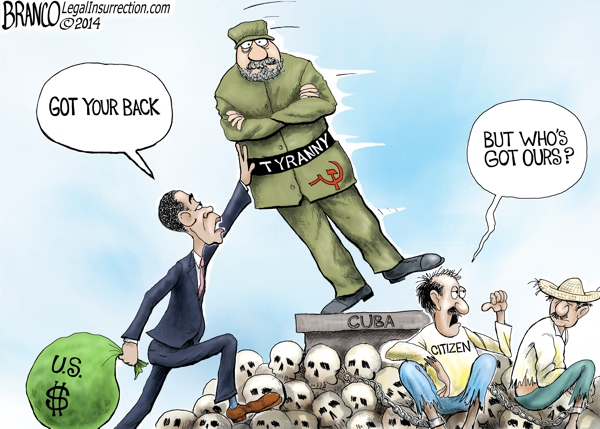
 It has been a year since Obama announced the United States’ universal rapprochement with Cuba, and what exactly has happened since? If you guess that there has been no positive results for the U.S., or Cuban dissidents and migrants, then you would be correct. If you also guess that it benefited the Cuban military, and Russia, you would also be correct.
Immediately, Obama moved to ease restrictions on travel to Cuba by U.S. citizens. In May, the USA removed Cuba from our list of state-sponsored terrorists. In August, the USA opened its embassy in Havana, and last week,the United States announced a bilateral agreement to restore direct flights between the U.S. and Cuba.
Now the really bad, from the Wall Street Journal:
The Havana-based Cuban Commission on Human Rights and National Reconciliation documented 7,686 political arrests in 2015 through Nov. 30. On that day Mr. Maldonado summarized the effects of the Obama détente: “There have been no positive changes. The U.S. has given away too much at the normalization talks, and that has let Cuba continue its repression.” ….
In 2014 Cuba passed a new foreign-investment law to boost capital inflows. Yet the government retained the power to confiscate assets for “public” or “social” ends, and it has gained a reputation for arbitrarily jailing foreign businessmen. Writing in the fall 2015 issue of World Affairs, José Azel, a senior scholar at the University of Miami’s Institute for Cuban and Cuban-American Studies, noted that despite the investment law’s “vaulting language, more than a year later only a handful of investments have been approved.”
Perhaps capitalists are not all that important when Russia is itching to get back into Cuba in a big way. In 2014 Russian President Vladimir Putin forgave $32 billion in Cuban debt to the Soviet Union. Then he converted the remaining $3.5 billion due Moscow into a line of credit for energy and industrial projects on the island.
In return, among other things, the Kremlin gets to use Cuba to establish a station supporting Russia’s global navigation satellite system (Glonass), a rival to the U.S. Global Positioning System (GPS). In a Nov. 17 website post for the Cuban Transition Project at the University of Miami, research associate Hans de Salas-del Valle observed that “the installation of a signals facility in Cuba is part of a broader strategy to integrate Cuba into Russia’s space program.” He added that “Moscow has publicly expressed interest in establishing a satellite launch site in Cuba.” ….
Some 4,000 Cuban migrants trying to get to the U.S. are now trapped in Costa Rica because Nicaraguan President Daniel Ortega, a Castro pal, will not allow them to move north. They’re fleeing tyranny for sure. But they couldn’t have arrived there without, at a minimum, the tacit approval of the Castro regime.
Those refugees are being used as Castro pawns to create a humanitarian crisis and pressure the U.S. for credit and multilateral aid. Havana is betting Mr. Obama will deliver.
 Yeah, it doesn’t seem worth it, does it? Sounds to me like 1960 all over again, only worse.



 Stella's Place