
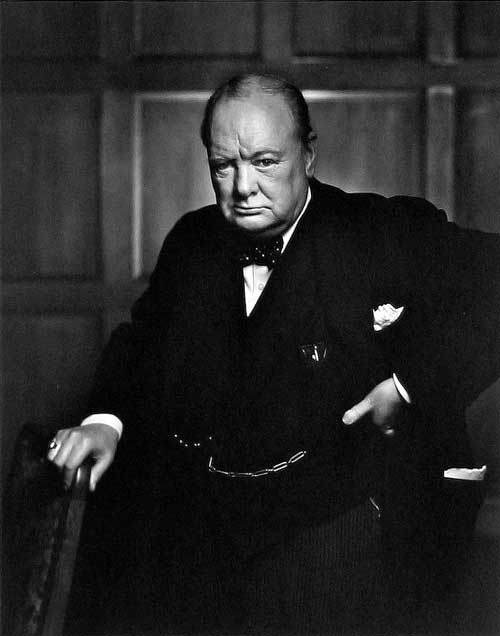
 Today is the anniversary of the birth of Winston Churchill. Born to a peer of the British empire and an American socialite, Churchill rose to the pinnacle of world leadership.
Winston Churchill was the Prime Minister of the UK from 1940 to 1945, and again from 1951 to 1955. He served as an officer in the Army, and was a historian, an author and an artist. In 1953 he was awarded the Nobel Prize for Literature, and was the first person to be made an honorary citizen of the United States in 1963.
Although Churchill accomplished much both in the military and in politics prior to his first term as Prime Minister, it is as the PM during WWII that he is best known.
The day that Britain declared war on Germany, September 3, 1939, Churchill was appointed First Lord of the Admiralty, and a member of Chamberlain’s war cabinet. On May 10, 1940, Chamberlain resigned, as there was no confidence that he would successfully prosecute war against Germany. Winston Churchill was chosen to be his successor. It has been said that Churchill was not popular among his colleagues in either the House of Lords or the House of Commons, but that he was the right man for the job of war Prime Minister because of his courage and energy.
A percentage of the public and government favored a peace agreement with Germany, but Churchill used his rhetorical powers to stiffen the spines of the British people, and prepare them for war. Part of his speech to the House of Commons, June 18, 1940:
… the Battle of Britain is about to begin. Upon this battle depends the survival of Christian civilisation. Upon it depends our own British life, and the long continuity of our institutions and our Empire. The whole fury and might of the enemy must very soon be turned on us. Hitler knows that he will have to break us in this island or lose the war. If we can stand up to him, all Europe may be freed and the life of the world may move forward into broad, sunlit uplands.
But if we fail, then the whole world, including the United States, including all that we have known and cared for, will sink into the abyss of a new dark age made more sinister, and perhaps more protracted, by the lights of perverted science. Let us therefore brace ourselves to our duties, and so bear ourselves, that if the British Empire and its Commonwealth last for a thousand years, men will still say, This was their finest hour.
By refusing the armistice with Germany, and encouraging the British people with his rhetorical skill, Churchill kept resistance alive in Britain. That resistance made possible the Allied counter-attacks of 1942–45, with Britain serving as a platform for the supply of the Soviet Union and the liberation of Western Europe.

Churchill was 65 years old when he took on the job of Prime Minister, and Minister of Defense. You might think that the pressures of the job he had accepted would wear heavily on a man of his age, but it seemed instead to have invigorated him. H.R. Knickerbocker, an American journalist, said in 1941: “The responsibilities which are his now must be greater than those carried by any other human being on earth. One would think such a weight would have a crushing effect upon him. Not at all. The last time I saw him, while the Battle of Britain was still raging, he looked twenty years younger than before the war began … His uplifted spirit is transmitted to the people”.
Churchill’s speeches were a great inspiration to the embattled British. His first as prime minister was the famous, “I have nothing to offer but “blood, toil, tears, and sweat” speech. One historian has called its effect on Parliament as “electrifying”. The House of Commons that had earlier ignored him “was now listening, and cheering”.
Probably one of Churchill’s most famous speeches was given just before the Battle of Britain:
Even though large tracts of Europe and many old and famous States have fallen or may fall into the grip of the Gestapo and all the odious apparatus of Nazi rule, we shall not flag or fail. We shall go on to the end. We shall fight in France, we shall fight on the seas and oceans, we shall fight with growing confidence and growing strength in the air, we shall defend our island, whatever the cost may be.
We shall fight on the beaches, we shall fight on the landing grounds, we shall fight in the fields and in the streets, we shall fight in the hills; we shall never surrender, and if, which I do not for a moment believe, this island or a large part of it were subjugated and starving, then our Empire beyond the seas, armed and guarded by the British Fleet, would carry on the struggle, until, in God’s good time, the New World, with all its power and might, steps forth to the rescue and the liberation of the old.
What made Winston Churchill great?
- He had courage. “Success is not final, failure is not fatal; it is the courage to continue that counts.” (Churchill) “Never, never, give up.” (Churchill)
- He had vision. “When Hitler came to power Churchill did not use judgment but one of his deep insights. This was absolute danger, there was no easy way round. That was what we needed. It was a unique occasion in our history. It had to be grasped by a nationalist leader. Plenty of people on the left could see the danger: but they did not know how the country had to be seized and unified.” (C.P. Snow)
- Churchill was a student of history, and applied his knowledge to current events.”Everyone can recognize history when it happens. Everyone can recognize history after it has happened; but it is only the wise person who knows at the moment what is vital and permanent, what is lasting and memorable.” (Churchill) “History will be kind for me, for I intend to write it.” (Churchill) [attributed]
- He was a master of the written, and spoken, word. It was as a speaker that Churchill achieved his greatest leadership influence. As President Kennedy said, Churchill “mobilized the English language and sent it into battle.” “Not only was the content of his speeches wise and right but they were prepared with that infinite capacity for taking pains which is said to be genius. So was his appearance; his attitudes and gestures, his use of all the artifices to get his way, from wooing and cajolery, through powerful advocacy, to bluff bullying–all were carefully adjusted to the need. To call this acting is quite inadequate. What we are speaking of is transformation, a growth and permanent change of personality.” (Dean Acheson)
Winston Churchill is the embodiment of the ultimate test of leadership: Would world events be the same if he had not lived? The answer, of course, is NO!
Sir Geoffrey Elton:
There are times when I incline to judge all historians by their opinion of Winston Churchill–whether they can see that no matter how much better the details, often damaging, of man and career become known, he still remains, quite simply, a great man.



 Stella's Place
Great piece, thanks Stella. One of my favorite quotes attributed to Churchill is “Never hold discussions with the monkey when the organ grinder is in the room”.
LikeLiked by 1 person